Let's Be Honest: Your Window Display Is Probably Just an Expensive Dust Collector
You’ve spent hours arranging it. You’ve painstakingly positioned that mannequin’s arm at an angle that feels both “casually aspirational” and “geometrically pleasing.” You’ve chosen a color palette that would make Wes Anderson weep with joy. And for what? For people to glance at it for 1.7 seconds before continuing their power-walk to the nearest coffee shop. Your storefront window is the most valuable real estate you own, yet for many retailers, it’s doing little more than holding the building up.
A great window display shouldn’t just be a pretty picture; it should be a magnet. It’s your lead salesperson, your 24/7 brand ambassador, and your silent, tireless customer acquisition machine. If your window isn’t actively pulling people off the sidewalk and through your door, it’s failing. So, let's stop treating it like a museum exhibit and start treating it like the conversion-driving powerhouse it’s meant to be. It's time for an intervention.
The Psychology of the Stare: Making Them Stop and Look
Before you can sell anything, you have to earn a sliver of someone's attention in a world saturated with distractions. Your window is competing with smartphones, barking dogs, and the existential dread of an overflowing email inbox. Here’s how you win that fight.
The Three-Second Rule (and How to Game It)
You have, on average, three to five seconds to snag the attention of a passerby. That’s it. In that time, their brain decides whether your display is “interesting” or just “more visual noise.” To win this micro-battle, you need to be loud without screaming. Think less chaotic flea market and more curated gallery opening.
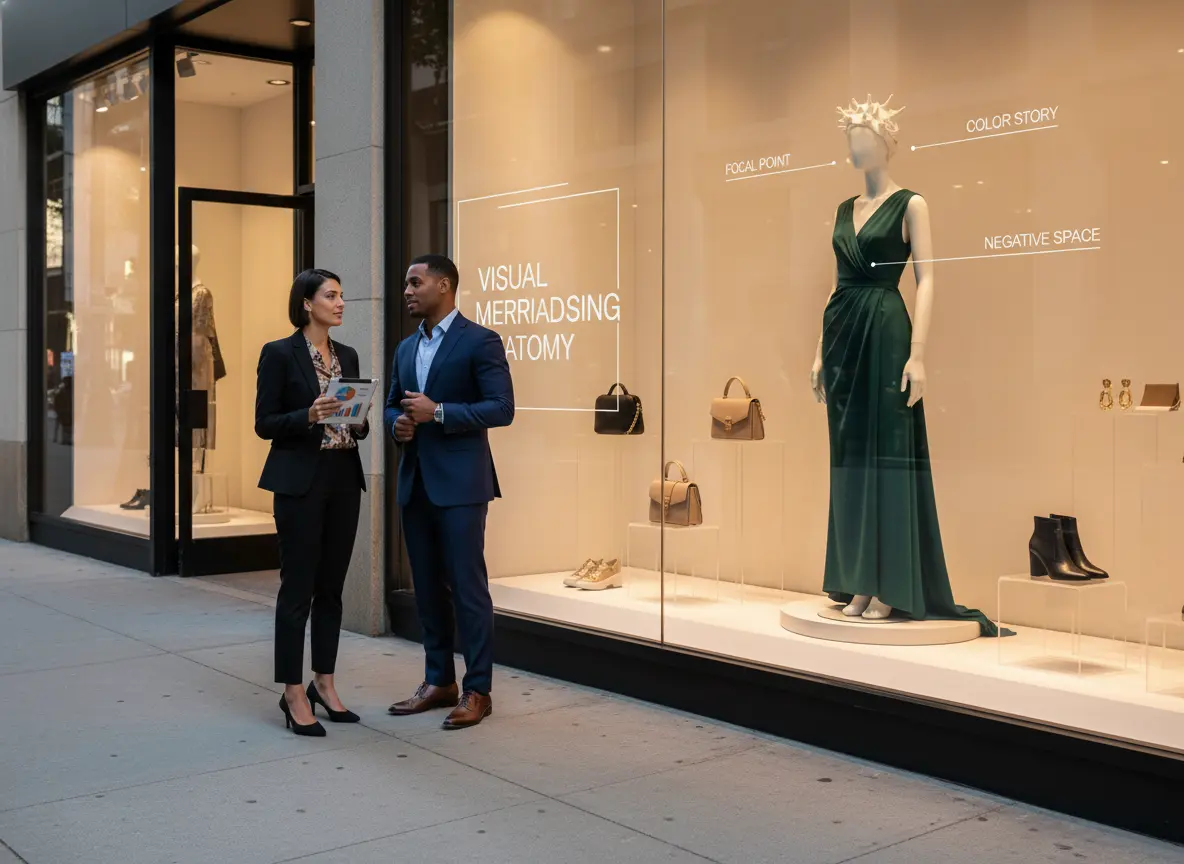
- Create a Focal Point: The human eye craves order. Give it one dominant thing to look at. This could be your hero product, a burst of audacious color, or a single, compelling prop. A window with 15 “amazing” items has no focal point and will be ignored. A window with one stunning dress, dramatically lit, will make people stop.
- Use Motion and Light: Our primitive brains are hardwired to notice movement and changes in light. A subtle rotating platform, a video screen, or even just a well-aimed spotlight can be the difference between being seen and being invisible. Pro tip: ensure your display is just as brilliantly lit at 9 PM as it is at 3 PM. Your window works the night shift, too.
- Tell a Micro-Story: Don’t just show a product; show the product in its ideal moment. Don't show a coffee maker; show a cozy Sunday morning scene with a newspaper, a half-eaten croissant, and the coffee maker as the star. You're not selling an object; you're selling the experience.
It's Not Clutter, It's "Strategic Merchandising"
There's a fine line between a rich, intriguing display and an episode of Hoarders. The temptation to cram every new arrival into the window is strong. Resist it. A cluttered window sends a confusing message and cheapens your brand. It suggests desperation, not curation. The goal is to pique curiosity, not induce anxiety.
Embrace the power of negative space. The empty areas around your products are just as important as the products themselves. They give the eye a place to rest and make your focal points, well, focal. A study from the National Retail Federation found that well-planned displays can increase sales by over 540%. Clutter doesn’t get you there; strategy does.
From Window to Welcome Mat: The Conversion Connection
Okay, you did it. You stopped them in their tracks. They’re peering through the glass, intrigued. Now what? The journey from the sidewalk to the sales floor is the most critical—and often most fumbled—part of the process. Your window makes a promise, and the first ten feet of your store must deliver on it.
Capitalizing on that First Spark
The transition needs to be seamless. If your window promises a serene, minimalist experience, the customer shouldn't be met with a blast of death metal and a messy sales rack the moment they walk in. The theme, colors, and vibe should flow naturally from the outside in. More importantly, you need a way to immediately engage that customer and validate their decision to enter.
What if the story you started in the window was immediately continued by a friendly face the second they stepped inside? What if the promotion you hinted at on the glass was the first thing they heard about? This is where that initial interest converts into a real shopping journey. Without that bridge, curiosity often fizzles out, and they walk right back out the door.
Your Ambassador at the Threshold
Imagine your window features your new line of artisanal Italian leather bags. A shopper, captivated, steps inside. The first "person" they see is Stella, your in-store robotic assistant, who greets them with a warm, "Welcome! Did our new collection of Italian leather bags catch your eye? They're handcrafted in Florence, and we have a special launch promotion on them today only."
In that single interaction, the gap is bridged. The interest generated by the window is captured, validated, and directed. Stella ensures that the momentum isn't lost. She can guide the customer to the exact products, answer initial questions, and reinforce the message of the display, turning a passive window-shopper into an active, engaged customer before your human staff even has to step in.
The Nitty-Gritty of a High-Impact Display
Let's get tactical. A successful display is part art, part science, and part knowing that masking tape is your best friend. Here are the core components that separate the masterpieces from the messes.
The Power of a Pyramid (and Other Shapes)
How you arrange your products matters. The "pyramid principle" is a classic for a reason: it's visually stable and draws the eye upward to the most important item at the apex. Grouping items in threes and fives is also more visually appealing than even numbers. Play with height and depth using risers, shelves, and acrylic blocks. A flat display is a boring display. Create a visual landscape that invites the eye to explore.
Signage: Say More with Less
Your window signage should be a headline, not an essay. It needs to be readable in a few seconds from across the street. Focus on the benefit, the brand, or the offer. Instead of "100% Egyptian Cotton Towel Set," try "Upgrade Your Bathroom to a 5-Star Spa." Use bold, clean fonts. And please, for the love of all that is holy, make sure there are no typos. Nothing screams "amateur hour" like a misspelled word in 3-foot-tall letters.
Refresh, Rotate, and Re-evaluate (Before It Gets Stale)
The biggest mistake retailers make is creating one beautiful window display and leaving it up for six months. Your regulars will stop seeing it. It will become invisible. A dynamic storefront is an interesting storefront. Plan a display calendar and aim to refresh your main window at least every 4-6 weeks, and more often for key holidays or promotions.
Most importantly, measure the impact. Use your door counters or POS data. Did foot traffic increase after the new display went up? Did sales of the featured product spike? Your window display is a marketing tool. Treat it like one and analyze its performance.
A Quick Reminder About Stella
While your window display is your silent salesperson on the street, Stella is your never-miss-a-beat ambassador inside. She’s the perfect handover, ensuring the powerful first impression you create with your display is seamlessly converted into a welcoming and helpful in-store experience for every single shopper.
Stop Decorating and Start Converting
Your window display has a job to do, and it's so much more than just looking pretty. It’s a powerful engine for foot traffic and sales, but only if you build it with purpose and strategy. It needs to grab attention, tell a compelling story, and create an irresistible urge to step inside.
So here's your homework: go stand across the street from your store. Look at your window as if you’ve never seen it before. What story is it telling? Is it clear what you want the customer to do? Is it even interesting? Pick one thing—just one—from this guide and change it this week. Add a spotlight. Simplify the display down to three key items. Write a better sign. Stop letting your most valuable asset just sit there. Put it to work.