Let's Talk About Price Tags (And the Brains That Stare at Them)
You’ve seen it a thousand times. A customer picks up an item, flips over the price tag, and a complex series of micro-expressions flits across their face. It’s a high-stakes, silent negotiation between their desire and their wallet. Are they doing the "I can justify this" mental math? Or are they quietly deciding that, no, they don't really need a handcrafted artisanal dog bowl for $80?
As a store owner, pricing can feel like a shot in the dark. You take your wholesale cost, add a markup you hope isn’t offensive, and cross your fingers. But what if there were a better way? What if you could use a little bit of science—and a dash of human nature—to make your prices not just "fair," but compelling?
Welcome to the wonderfully weird world of psychological pricing. This isn’t about tricking people. It’s about understanding how the human brain perceives value and using that knowledge to frame your offerings in the best possible light. Get ready to turn those hesitant stares into confident "I'll take it!" declarations.
The Classics: Pricing Tactics That Are Oldies But Goodies
Some of these strategies are so common you might not even notice them anymore. But they’re common for a reason: they work. Ignoring them is like leaving a perfectly good tool in the box because it looks too simple.
The Undeniable Power of the Number 9
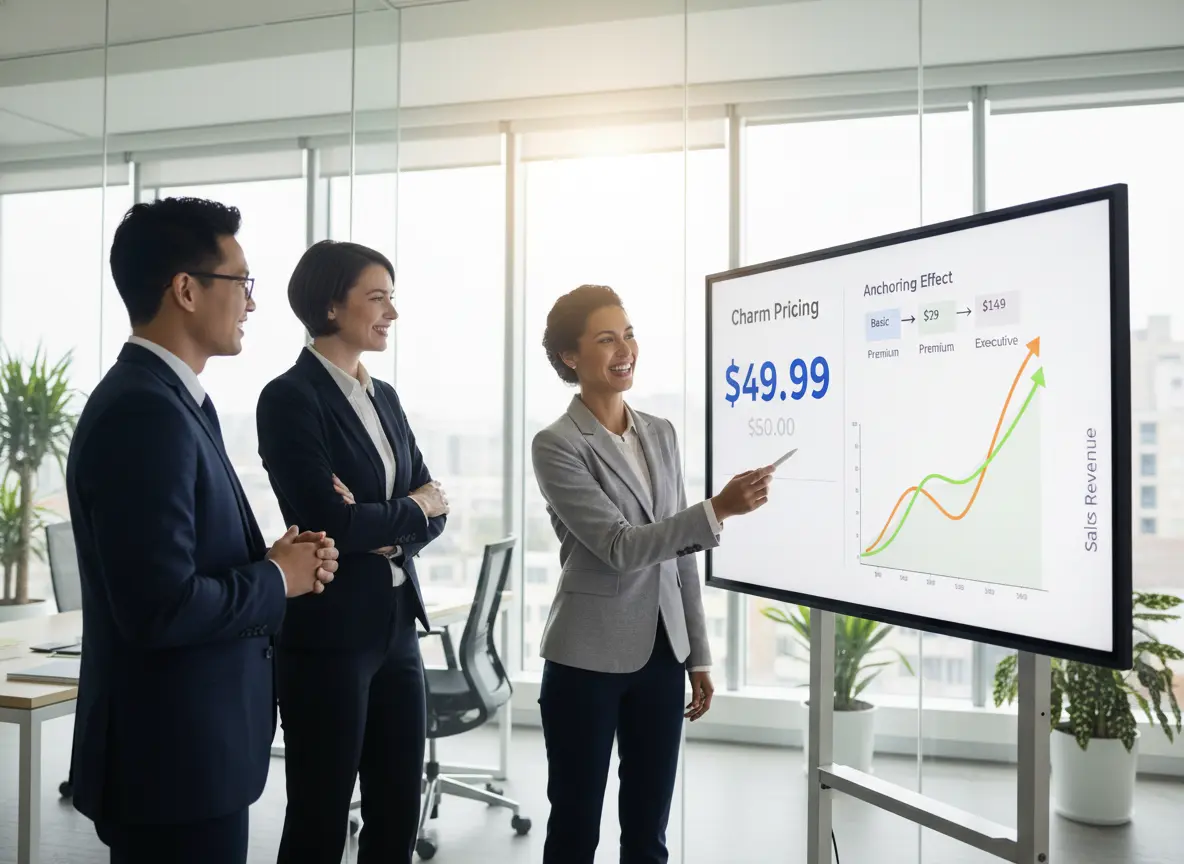
Ah, the beloved $19.99. You’ve seen it everywhere, from big-box retailers to your local hardware store. This is "charm pricing," and it’s a powerhouse. The magic lies in the "left-digit effect." Because we read from left to right, our brain anchors on the first number it sees. A price starting with a "1" feels psychologically, substantially cheaper than one starting with a "2," even if the difference is a single penny.
Don’t believe it? A famous study by MIT and the University of Chicago tested a women's clothing item at three prices: $34, $39, and $44. The item sold best at $39, even outperforming the cheaper $34 price point. The ".99" ending signals "value" to our subconscious. Your move? Audit your prices. Can any of your nice, round $50 or $100 price points be nudged down to $49.99 or $99.99? Test it out—your bottom line might thank you.
Price Anchoring: Setting the Stage for a "Good Deal"
The first price a customer sees is incredibly important. It becomes the "anchor" against which they judge every other price. You can use this to your advantage in a few clever ways.
- High-End Placement: Place a ridiculously premium, $800 designer jacket at the front of a rack. Suddenly, the very nice, very profitable $300 jacket next to it looks like an absolute bargain. The $800 anchor makes the $300 price feel reasonable.
- The "Was/Now" Comparison: This is anchoring 101. By showing the original price ("Was $120") struck through next to the sale price ("Now $90"), you anchor the product's value at $120. This makes the $30 discount feel significant and urgent. Without the anchor, $90 is just… $90.
Take a look at your store's layout and your sales signs. Are you consciously creating anchors to help customers recognize the great value you’re offering?
The Decoy Effect: Making the Choice Obvious
This one is a masterclass in subtle persuasion. The decoy effect involves introducing a third option that is strategically designed to make one of your other options look way more attractive. The most famous example is movie theater popcorn:
- Small Popcorn: $3
- Large Popcorn: $7
That’s a big jump. Many people will just get the small. But now let’s add a decoy:
- Small Popcorn: $3
- Medium Popcorn: $6.50
- Large Popcorn: $7
Almost nobody buys the medium. It's a terrible deal! But it's not meant to be sold. Its sole purpose is to make the Large Popcorn look like an incredible bargain for just 50 cents more. Sales of the large size skyrocket. Think about your product tiers. Can you introduce a slightly-less-appealing option to make your most profitable product the obvious choice?
Communicating Value (Without Yelling "It's a Bargain!")
Once you've set the perfect price, you have to communicate it. How you frame your discounts and deals can be just as important as the numbers themselves. This is where a little help on the sales floor can make a world of difference.
The Art of Announcing a Sale
Ever wonder whether to advertise "20% Off" or "$25 Off"? The "Rule of 100" offers a simple guideline. For any item priced under $100, a percentage discount feels larger. "25% Off" a $40 shirt just sounds more impressive than "$10 Off." For items priced over $100, a specific dollar amount is more impactful. "$100 Off" a $400 couch feels more concrete and substantial than "25% Off."
Communicating this effectively to every single customer is a challenge. That’s where an automated assistant shines. Imagine a shopper walks in, and instead of them having to hunt for signs, Stella greets them with a tailored message: "Hi there! Just so you know, all our winter coats are $75 off today, and all our scarves are 30% off!" By using the Rule of 100, Stella ensures every promotion lands with maximum psychological impact, driving interest in exactly the products you want to move.
Advanced Maneuvers for the Pricing Pro
Ready to move beyond the basics? These strategies require a bit more thought but can have a powerful effect on customer behavior and your average order value.
Bundling vs. Unbundling: The Ultimate "More for Less" Game
Product bundling is the art of packaging several items together for a single, often discounted, price. Think of a "New Parent Survival Kit" that includes diapers, wipes, and lotion, or a "Summer BBQ Bundle" with sauces, rubs, and grilling tools. Bundling is fantastic for a few reasons:
- It increases the perceived value for the customer.
- It raises the average transaction value for you.
- It can help you sell slower-moving items by pairing them with bestsellers.
Unbundling is the opposite. It involves breaking a product or service down into its core components and charging for extras. Airlines are the undisputed champions of this. The low base fare gets you on the plane, but you pay extra for luggage, seat selection, and Wi-Fi. For a retail store, this could mean selling a camera at a competitive price but offering the case, memory card, and extended warranty as separate, high-margin add-ons. It lowers the barrier to entry and gives customers a feeling of control over the final price.
Tiered Pricing and The "Paradox of Choice"
Giving customers choices is good. Giving them too many choices is paralyzing. When faced with a dozen different options, people often choose nothing at all. The solution? Simplify. The magic number is often three. Present your offerings in "Good," "Better," and "Best" tiers.
This model brilliantly leverages human psychology. A small percentage will always choose the cheapest option. Another small group will always want the absolute best. But the vast majority of people will gravitate toward the middle "Better" option. It feels like the safest, most balanced choice. And, conveniently, you can price this middle tier to have your healthiest profit margin.
When in Doubt, Ditch the Dollar Sign
This one feels a little crazy, but research backs it up. In certain contexts, simply removing the currency symbol ($) from a price can increase what people spend. A study from Cornell University found that diners in a restaurant spent significantly more when prices on the menu were listed as simple numbers (e.g., "14") instead of with a dollar sign ("$14").
Why? The symbol "$" constantly reminds people they are spending money, which can trigger a minor feeling of pain or loss. Removing it makes the experience feel less transactional. While this might not be practical for every price tag in your store, consider testing it on signage for premium collections or for service-based offerings to create a more upscale, sophisticated atmosphere.
A Quick Reminder About Your Front Line
While you're busy architecting the perfect pricing strategy in the back office, remember who’s communicating that value to your customers. Having a consistent, reliable presence on the floor is key. That's where Stella, your in-store AI assistant, ensures every promotion is mentioned and every customer is engaged, turning your psychological insights into actual sales.
Conclusion: Price with Purpose
Pricing doesn't have to be a mystical art form. It's a strategic lever you can pull, grounded in decades of research about how people think and make decisions. By being more intentional with your numbers, you’re not trying to pull a fast one on your customers; you’re simply speaking their subconscious language and helping them better understand the value you provide.
Your homework? Don't try to implement all of this at once. Pick one strategy this week and test it.
- Change five of your round-number prices to end in .99.
- Create a new display that anchors a mid-range product with a high-end one.
- Build one simple product bundle to increase average order value.
Track the results. See what works for your store and your customers. A small change to a price tag can lead to a big change in your sales. Now go on, price with confidence.