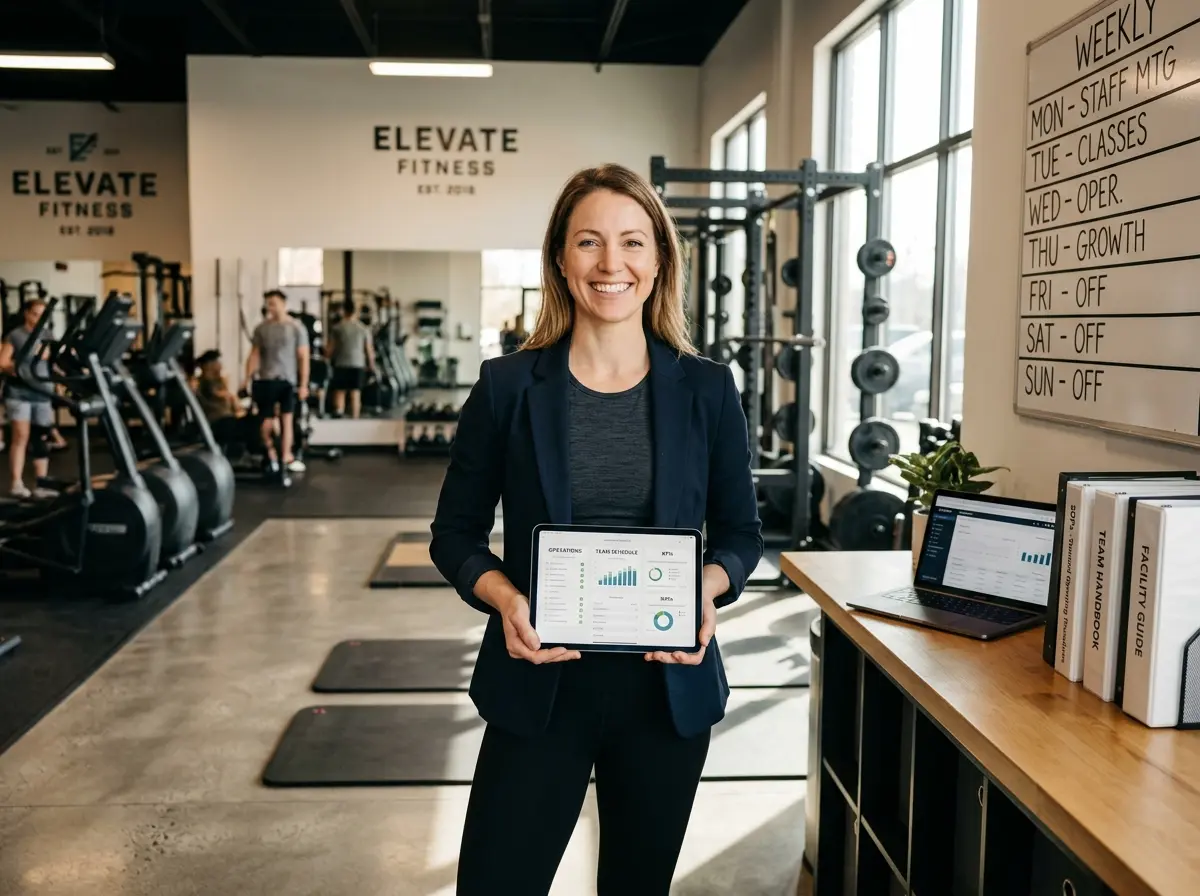
From Burnout to Balance: One Gym Owner's SOP Revolution
Picture this: It's 11 PM on a Friday night, and instead of enjoying a well-deserved weekend, you're buried in paperwork, answering the same questions you answered yesterday, and mentally drafting the employee schedule for the fourth time this week. Sound familiar? For gym owner Marcus Chen, this was every week — a relentless 70-hour grind that had him questioning why he ever left his cushy corporate job in the first place.
Then he discovered the unsexy, unglamorous, wildly effective power of Standard Operating Procedures — and everything changed. Within eight months, Marcus had cut his workweek down to four days, reduced staff confusion by roughly 80%, and actually took a vacation (a real one, not a "I'll just check my email every 20 minutes" vacation). If you're a gym owner running on caffeine and willpower, this one's for you.
Why Gym Owners Are Drowning (And It's Not the Weights)
The "I'll Just Handle It Myself" Trap
The fitness industry has one of the highest owner-burnout rates of any small business sector — and it's not hard to see why. You're managing memberships, scheduling classes, handling equipment maintenance, training staff, running marketing campaigns, and somehow still finding time to actually help members reach their fitness goals. The average independent gym owner works between 55 and 70 hours per week, according to industry surveys. That's not a business — that's a hostage situation.
The core problem isn't that gym owners are bad at business. It's that most gyms run on tribal knowledge — meaning the owner is the walking, talking manual for every single process. What happens when a new front desk hire doesn't know how to handle a membership freeze? They ask Marcus. What happens when a trainer isn't sure about the cancellation policy? They ask Marcus. What happens when the cleaning crew isn't sure which products to use on which equipment? You guessed it — Marcus.
The Myth That SOPs Are Only for Big Corporations
Many small business owners hear "Standard Operating Procedures" and immediately picture a Fortune 500 company with a 300-page policy binder that nobody reads. Fair. But modern SOPs don't have to be corporate nightmares — they can be simple, practical checklists, short videos, or one-page documents that tell your team exactly what to do, when to do it, and how to do it right the first time.
Marcus's first SOP was a single Google Doc. It outlined exactly how to greet a walk-in prospect, what questions to ask, which membership tiers to mention, and how to handle objections. That one document reduced his front desk training time from two weeks to three days. Simple, right? Embarrassingly simple, actually — which is exactly the point.
Building SOPs That Actually Get Used
Start With Your Most Painful Processes First
The best place to start is wherever you're most frequently interrupted. Marcus kept a "interruption log" for one week — every time a staff member asked him a question that had a repeatable answer, he wrote it down. By Friday, he had 23 items on his list. Those 23 items became his first 23 SOPs.
For gyms specifically, the highest-impact SOPs typically cover membership sign-ups and cancellations, class scheduling and substitution protocols, equipment cleaning and safety checks, handling billing issues and payment failures, and new member onboarding sequences. Tackle these first and you'll immediately feel the pressure release.
Automate the Repetition, Document the Judgment
Here's where business owners often go wrong: they try to SOP everything, including decisions that genuinely require human judgment. The goal isn't to turn your staff into robots — it's to eliminate the unnecessary decisions so your team can focus on the ones that actually matter. Document the repeatable stuff. Automate where you can. Trust your people with the rest.
For the truly repetitive, customer-facing tasks — answering the same questions about hours, pricing, class availability, and membership options — technology can carry a surprisingly heavy load. Stella, an AI robot employee and phone receptionist, is one tool that gym owners are starting to use precisely for this reason. At the front of the gym, she greets walk-ins, answers questions about memberships and promotions, and even helps upsell relevant add-ons — without pulling a staff member away from the floor. On the phones, she handles incoming calls 24/7, collects prospect information through conversational intake forms, and routes calls to human staff only when needed. For a gym that gets dozens of calls per week asking about pricing and schedules, that's a meaningful chunk of time handed back to the team.
Quick Reminder About Stella
Stella is an AI robot employee and phone receptionist built for businesses like yours. She stands inside your gym as a friendly kiosk, greeting members and prospects while answering their questions — and she answers your phones around the clock so no lead ever goes to voicemail purgatory. At $99/month with no upfront hardware costs, she's the team member who never calls in sick, never forgets the script, and never asks for a raise.
Marcus's 4-Day Week: The Actual Playbook
Phase One — Document, Delegate, Disappear (Briefly)
Marcus's transformation didn't happen overnight, and it wasn't magic. It was a deliberate three-phase process executed over about eight months. In phase one, he spent four weeks doing nothing but documentation. Every recurring task, every decision he made more than once, every process that lived only in his head — it all went into writing. He used a simple combination of Google Docs for written procedures and Loom videos for anything visual (like how to properly set up the gym floor for a group class).
The delegation piece came next. Rather than handing over his entire operation at once and hoping for the best, Marcus assigned one SOP at a time to specific team members, watched them execute, gathered feedback, and refined the document. Within six weeks, his lead trainer was independently managing the weekly class schedule — a task that had previously eaten three hours of Marcus's Sundays.
Phase Two — Build Accountability Into the System
Documentation without accountability is just a folder nobody opens. Marcus introduced a simple weekly check-in structure where team leads confirmed which SOPs had been followed and flagged any that needed updating. He also built a "living document" culture — staff were actively encouraged to suggest improvements to existing SOPs, which meant the procedures stayed current and the team felt genuine ownership over them.
By month four, Marcus had fully stepped away from front desk coverage. By month six, his operations manager was handling 90% of the day-to-day decisions independently. And by month eight, Marcus booked a four-day workweek as his permanent schedule — Fridays officially off, guilt-free.
Phase Three — Protect the System You Built
The final, often-overlooked phase is protection. It's remarkably easy to let a well-built system erode — one emergency leads to one shortcut, which becomes the new normal, and suddenly you're back to 60 hours a week wondering where it all went wrong. Marcus built two safeguards: a quarterly SOP review (two hours, no exceptions) and a hard rule that any new recurring task gets documented before it gets delegated. The system maintains itself only if you treat maintaining it as non-negotiable.
Taking Back Your Time Starts With One Document
If you're waiting for the perfect moment to get your operations in order, here's some hard news: that moment doesn't exist. The gym won't slow down. The phones won't stop ringing. The questions won't stop coming. But the good news is that you don't need to overhaul everything at once — you just need to start with one process, document it properly, and hand it off.
Here's your action plan:
- Spend one week logging every interruption. Every question, every repeated decision, every task only you know how to do — write it down.
- Pick the top three most painful items and turn them into simple SOPs this week. One page each. Don't overthink it.
- Delegate with support. Assign each SOP to a specific person, walk through it with them once, and let them take the wheel.
- Review and refine monthly until the system runs without you needing to babysit it.
- Automate the repetitive customer-facing tasks wherever technology makes sense — your staff's time is better spent on high-value interactions.
Marcus didn't find more hours in the week. He just stopped spending them on things a good system could handle for him. You can do the same — and you might be surprised how quickly a four-day workweek starts to feel less like a dream and more like a Tuesday.