The Front Desk Is Costing You More Than You Think
Let's paint a familiar picture: a traveler is browsing hotels at 11:47 PM, coffee in hand, ready to book a weekend getaway. They land on your independent hotel's website, have a few questions about pet policies and parking, and — finding no one to answer them — end up booking through Expedia instead. You just paid a 15–25% commission for a guest who was already on your website.
Ouch.
This is the quiet, expensive reality that thousands of independent hotel owners face every day. The big OTAs (Online Travel Agencies) have invested hundreds of millions of dollars in sophisticated booking infrastructure, 24/7 support, and user experience optimization. Independent hotels, often running lean teams and tighter budgets, simply can't match that with traditional staffing models — and they're losing direct bookings because of it.
The good news? AI chatbots have entered the chat. Literally. And they're giving independent properties a surprisingly powerful way to fight back, capture direct bookings, and keep more revenue where it belongs: with you.
Why Independent Hotels Struggle to Win Direct Bookings
The OTA Dependency Trap
There's nothing inherently wrong with listing your property on Booking.com or Expedia. They provide visibility, especially for newer properties or those in competitive markets. The problem is dependency. When OTAs become your primary booking channel, your margins quietly erode, your guest data belongs to someone else, and your ability to build a loyal repeat customer base is significantly hampered.
According to various hospitality industry reports, OTA commissions typically range from 15% to 25% per booking. For an independent hotel averaging $150/night with 20 rooms, that's a staggering amount of revenue leaving the building before you've even changed a single pillowcase. The math is not your friend when you're playing exclusively on their turf.
The Gap Between Interest and Conversion
Here's what most hotel owners don't fully appreciate: a visitor on your direct website is already warmer than one browsing an OTA. They found you specifically. They're interested. The problem is that interest doesn't automatically become a booking — it needs to be nurtured, and quickly.
Studies in hospitality marketing consistently show that response time is a critical factor in conversion. When a potential guest has a question and gets no immediate answer, they don't wait — they bounce. They go somewhere that gives them the path of least resistance to booking. Without a mechanism to engage that visitor in real time, even a beautifully designed hotel website is just a very expensive digital brochure.
Staffing Limitations Are Real (and Getting Worse)
Independent hoteliers know better than anyone that front desk coverage is a constant operational puzzle. Staff call in sick. Turnover in hospitality remains stubbornly high. And expecting your team to simultaneously check in guests, answer phones, manage inquiries, and chat with website visitors in real time is — how do we put this diplomatically — a fantasy. AI chatbots exist precisely in this gap, providing always-on engagement without adding to payroll or scheduling headaches.
How AI Chatbots Are Changing the Direct Booking Game
Real-Time Engagement That Converts
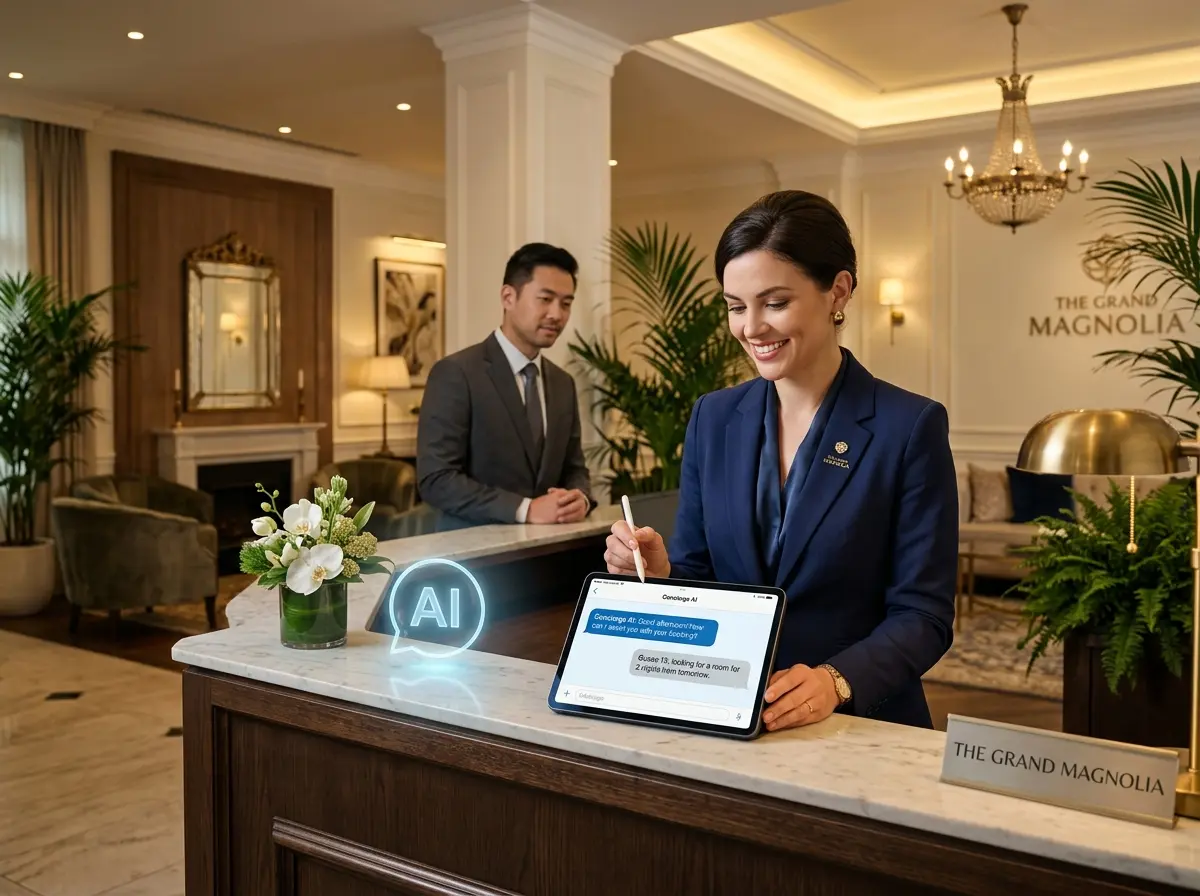
A well-configured AI chatbot on your hotel's website can greet visitors, answer questions about room types, amenities, pet policies, check-in times, local attractions, and — critically — guide them toward booking directly. This isn't just about answering FAQs. A smart chatbot can promote current specials, highlight the benefits of booking direct (like free breakfast or room upgrades), and collect the guest's information for follow-up, all without a single human staff member being pulled away from their other responsibilities.
The impact on conversion rates can be significant. When guests get immediate answers, the friction that drives them to OTAs disappears. That's the whole game.
Where Stella Fits Into the Picture
Stella is an AI robot employee and phone receptionist built for businesses that need professional, always-on customer engagement — and independent hotels are a natural fit. Beyond web chat, Stella answers phone calls 24/7 with full knowledge of your property's services, policies, and promotions, so a potential guest calling at midnight gets a warm, informed response instead of voicemail.
For properties with a physical lobby or check-in area, Stella's in-person kiosk presence means guests and walk-ins are greeted proactively, questions get answered instantly, and upsell opportunities — like room upgrades, spa packages, or restaurant reservations — are never missed. She also captures guest information through conversational intake forms and stores it in a built-in CRM with AI-generated profiles, so your team has context on every inquiry without any manual data entry. At $99/month with no upfront hardware costs, she's a genuinely practical tool for lean hotel operations.
Practical Strategies for Maximizing Direct Bookings With AI
Promote the "Book Direct" Advantage Aggressively
If you're going to compete with OTAs, you need to give guests a compelling reason to skip them. This means clearly communicating what guests get when they book direct — better rates, flexible cancellation policies, complimentary perks, priority room selection, or loyalty points. Your AI chatbot should be configured to lead with these advantages the moment a guest shows booking intent.
Don't bury this information in a footer or a "Why Book Direct?" page that nobody reads. Make it conversational. When a guest asks about availability, the chatbot's response should naturally weave in the direct booking benefit: "We have availability for that weekend! Guests who book directly with us also receive complimentary breakfast — would you like me to walk you through our room options?" That's how you compete.
Use Conversation Data to Improve Your Offering
One underrated advantage of AI chatbots is the data they generate. Every conversation is a window into what potential guests actually care about, what questions they're asking, what objections they have, and where they're dropping off. This isn't just useful for improving your chatbot — it's genuinely valuable business intelligence.
If you notice that guests are repeatedly asking whether you have EV charging, that's a signal. If questions about cancellation policy spike during certain periods, that tells you something about your market's risk sensitivity. Hotels that treat chatbot conversation data as a feedback loop — and actually act on it — will consistently outperform those who set it up and forget it.
Follow Up Like You Mean It
Not every chatbot conversation ends in a booking, and that's fine. What matters is what happens next. When a guest provides their contact information during a chat interaction, that's an opportunity — one that too many independent hotels let evaporate. A timely, personalized follow-up email referencing the specific dates or room types the guest inquired about can recover a significant percentage of those almost-bookings.
Pair your AI chatbot with a simple CRM workflow, and you've built a lightweight but effective direct booking funnel that runs largely on autopilot. It's not glamorous, but it works — and the cost per booking is a fraction of what you'd pay an OTA.
Quick Reminder About Stella
Stella is an AI robot employee and phone receptionist that works 24/7 to engage customers, answer questions, promote your offerings, and capture guest information — both over the phone and in person at a physical kiosk. She handles the interactions your staff doesn't have time for, without the overhead of additional headcount. For independent hotels looking to professionalize their guest engagement without breaking the budget, she's worth a serious look.
Start Small, Win Big: Your Next Steps
If you've made it this far, you probably already suspect that your current approach to direct bookings has some room for improvement. Here's the encouraging part: you don't need to overhaul your entire operation overnight. The path to reducing OTA dependency and growing direct revenue is incremental, and AI chatbots are one of the most accessible entry points available to independent hoteliers right now.
Start by auditing where your current bookings are coming from and what percentage of your revenue is going to OTA commissions. If that number makes you wince — and it probably will — that's your motivation. From there, consider the following action steps:
- Add a chatbot to your website that can answer common guest questions and actively promote direct booking benefits at any hour.
- Configure your AI tools to capture contact information from guests who don't book immediately, so you can follow up with personalized outreach.
- Train your chatbot around your specific advantages — your unique amenities, your direct-booking perks, your cancellation policy — so it's not just answering questions but actively selling your property.
- Review conversation data regularly and use it to refine both your chatbot responses and your broader property offerings.
- Ensure phone coverage is airtight, because plenty of guests — especially older demographics — still pick up the phone, and a missed call is a missed booking.
The OTAs aren't going anywhere, and that's okay. They can remain part of your distribution strategy. But every direct booking you capture is a relationship you own, a commission you keep, and a guest you can invite back on your own terms. With the right AI tools in place, independent hotels have more power to compete than most owners realize. The technology is affordable, the setup is increasingly straightforward, and the ROI — measured in commissions saved — can be almost immediate.
Your front desk is open 24 hours. Is your booking strategy?