Your Phone Stops Working at 5 PM. Your Competitors' Doesn't.
Here's a fun little scenario: It's 9:47 PM on a Tuesday. A homeowner has just discovered what appears to be a suspicious dark spot spreading across their ceiling after an afternoon rainstorm. Panic sets in. They grab their phone and start searching for a roofing company. They find yours — great reviews, professional website, solid reputation. They call. It rings. And rings. And then... voicemail. So they scroll down to the next result and book an appointment with your competitor instead.
Congratulations. You just lost a job in your sleep — literally.
This scenario plays out hundreds of times every year for roofing companies across the country, and most owners don't even realize it's happening. The roofing business is inherently reactive. Storms don't schedule themselves around your office hours, and neither do worried homeowners. If you're not capturing leads the moment they're ready to act, you're handing them to someone who is.
The good news? Automated scheduling and after-hours booking systems have made it entirely possible — and surprisingly affordable — to never miss another inquiry, no matter what time it rolls in. Let's talk about how to make that happen.
Why After-Hours Bookings Are a Gold Mine for Roofing Companies
The Psychology of the Urgent Homeowner
When someone suspects their roof is leaking, they are not patient. They're not going to bookmark your website and call back in the morning like a polite, reasonable person. Research consistently shows that 78% of customers buy from the first company that responds to their inquiry — and in the roofing industry, where urgency is a core driver of business, that number probably skews even higher. A homeowner in distress is emotionally primed to commit. If you give them a way to book an inspection at 10 PM, they will take it. If you don't, they'll find someone who does.
After-hours inquiries aren't just overflow — they're often your most motivated buyers. These are people who have already done their research, already decided they need help, and are ready to move forward. All they need is a door to walk through. Automated scheduling is that door.
When Roofing Customers Actually Pick Up the Phone
It might surprise you to learn that a significant chunk of service inquiries happen outside the traditional 9-to-5 window. Evenings, weekends, and the hours immediately following a storm are peak inquiry times for roofing companies. Homeowners are at work during business hours, too. They're dealing with their own jobs, their kids, their lives. The moment they get a free minute to deal with the roof situation — that's when they reach out. And that free minute is often 8 PM on a Thursday.
If your booking system only works when your office manager is at their desk, you're structurally incapable of capturing a huge segment of your available market. That's not a staffing problem. That's a systems problem — and systems problems have systems solutions.
The Real Cost of a Missed Call
Let's put some rough numbers on this. The average roofing job ranges from $5,000 to $25,000 or more, depending on scope. If your company is missing even two or three qualified after-hours inquiries per month because no one is available to respond, you're potentially leaving tens of thousands of dollars on the table every single year. That's not hypothetical — that's just math. And when you factor in referrals and repeat business from satisfied customers, the lifetime value of a single captured lead becomes even more significant. The cost of an automated scheduling system looks pretty small next to that number.
How Automated Scheduling Actually Works in Practice
The Basic Setup: What You Actually Need
At its core, an automated scheduling system for a roofing company needs to do a few things well. It needs to answer inquiries at any hour, collect the right information (name, address, type of issue, preferred appointment time), confirm the booking, and notify your team so they're ready to follow up or show up. The simpler and more conversational that process is for the customer, the better your conversion rate will be.
The worst versions of these systems are clunky web forms that feel like filing a tax return. The best versions feel like talking to a helpful, knowledgeable person who happens to be available at midnight. The gap between those two experiences is where most of the real business opportunity lives.
Letting Technology Handle the First Touchpoint
This is where tools like Stella — the AI robot employee and phone receptionist — come in. Stella answers phone calls around the clock using the same knowledge she'd use during business hours: your services, your pricing structure, your service area, your availability. When a homeowner calls at 9 PM after a hailstorm, Stella picks up, engages them naturally, collects their information through conversational intake forms, and can schedule or confirm their inspection — all without waking up your office manager.
Her built-in CRM automatically logs the contact, tags them appropriately, and generates an AI summary so your team walks in the next morning with a clean list of new leads, complete with context. No sticky notes. No "I think someone called last night." Just organized, actionable data waiting for you.
Best Practices for Converting After-Hours Bookings Into Paying Jobs
Speed-to-Confirmation Is Everything
Booking an appointment is only half the battle. The other half is making sure the customer doesn't cancel, ghost, or get poached by a competitor before your team shows up. The moment a customer completes a booking, they should receive an immediate confirmation — via text, email, or both. This serves two purposes: it makes the interaction feel official and trustworthy, and it gives them something to reference so they don't second-guess themselves in the morning.
Automated reminder messages sent 24 hours and 2 hours before the appointment have been shown to dramatically reduce no-shows. For a roofing company scheduling inspections, that's not just a nice feature — it's a direct line to your revenue.
Ask the Right Questions During Intake
Your automated system is only as useful as the information it collects. For roofing companies specifically, a good intake flow should capture the homeowner's address (so you can verify service area instantly), the nature of the issue (leak, storm damage, full replacement inquiry, inspection request), when the problem started, and whether there are any urgent concerns like active water intrusion. This lets your team prepare appropriately — or prioritize emergency visits — before they ever make first contact.
Don't ask for everything at once. A conversational, question-by-question intake feels natural and keeps customers engaged. A wall of form fields sends them running.
Integrate Your Scheduling System With Your Existing Workflow
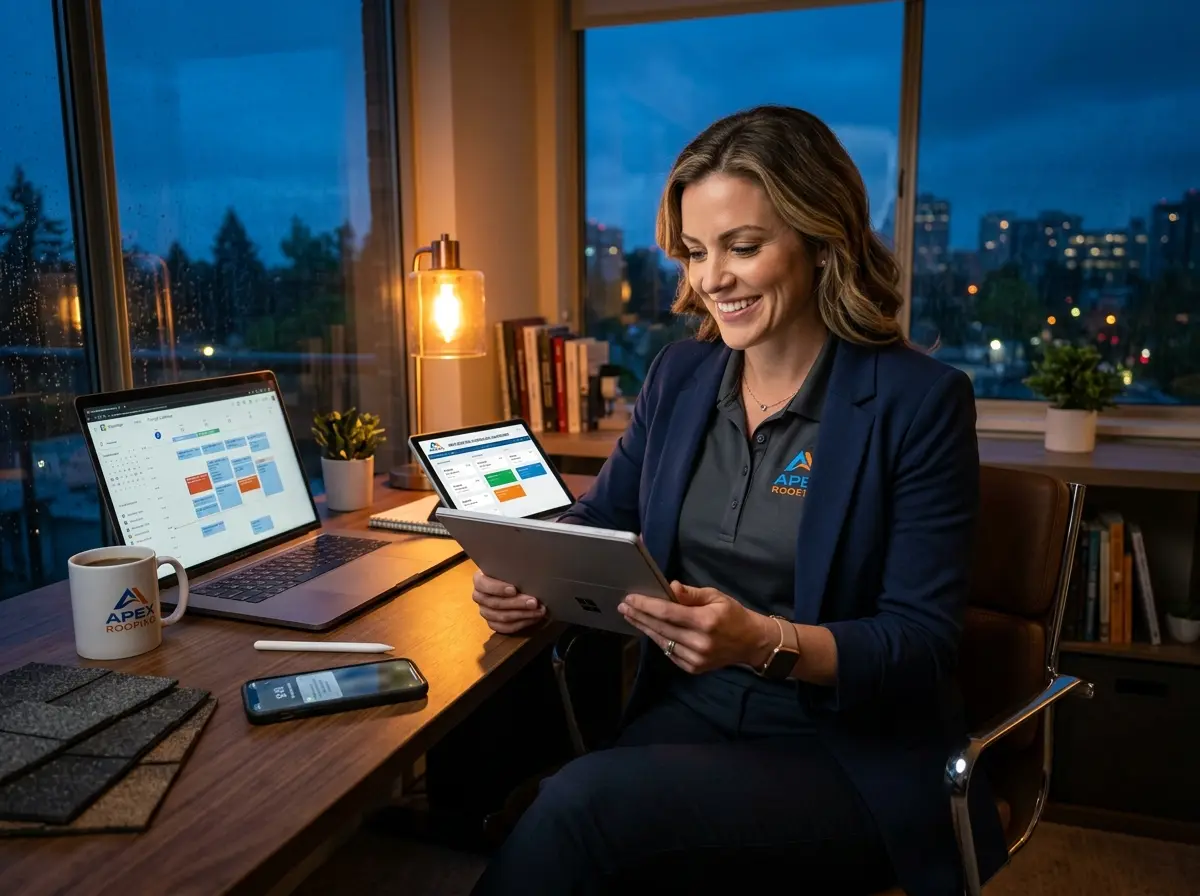
An automated booking system that exists in its own little island is a liability, not an asset. Your after-hours bookings should flow directly into whatever calendar, CRM, or project management tool your team already uses. If your estimators are managing their schedules in Google Calendar, make sure new bookings appear there automatically. If you're tracking leads in a CRM, new contacts should be created without manual data entry.
The goal is to make after-hours bookings feel exactly like regular bookings to your team — just with more of them. Friction in your internal process leads to dropped balls, and dropped balls lead to unhappy customers and lost revenue. Build the workflow once, correctly, and then let it run.
Quick Reminder About Stella
Stella is an AI robot employee and phone receptionist designed to help businesses — including roofing companies — never miss a customer interaction. She answers calls 24/7, collects intake information, manages contacts through a built-in CRM, and keeps your team informed with AI-generated summaries and push notifications. At $99/month with no upfront hardware costs, she's the kind of employee who never calls in sick, never puts a customer on hold indefinitely, and definitely never lets a storm-stressed homeowner roll to voicemail at 10 PM.
Start Capturing the Business You're Already Earning
Here's the reality: the leads are already out there. Homeowners are already searching, already calling, already ready to book. The only question is whether your systems are set up to catch them when they show up — which is frequently at hours no human receptionist is willing to work for any reasonable wage.
To start capturing after-hours bookings effectively, take these steps:
- Audit your current missed-call rate. Check your phone records for the last 30 days and count how many calls came in after hours. That number will motivate everything else on this list.
- Set up an automated phone answering and booking flow that collects key intake information and confirms appointments without human intervention.
- Build your confirmation and reminder sequence so every booking gets an immediate confirmation and at least one reminder before the scheduled appointment.
- Integrate everything into your existing calendar and CRM so your team starts every morning with clean, organized, actionable lead data.
- Review the data monthly. Which nights get the most calls? What types of issues are most commonly reported? Use that information to refine your scheduling windows and staffing decisions.
The roofing companies that win aren't always the ones with the best crews or the lowest prices. They're the ones that make it easiest to become a customer — at any hour, on any day, in any weather. Automated scheduling isn't a luxury for large companies anymore. It's table stakes for any roofing business that's serious about growth. Set it up, let it run, and enjoy waking up to a full calendar.