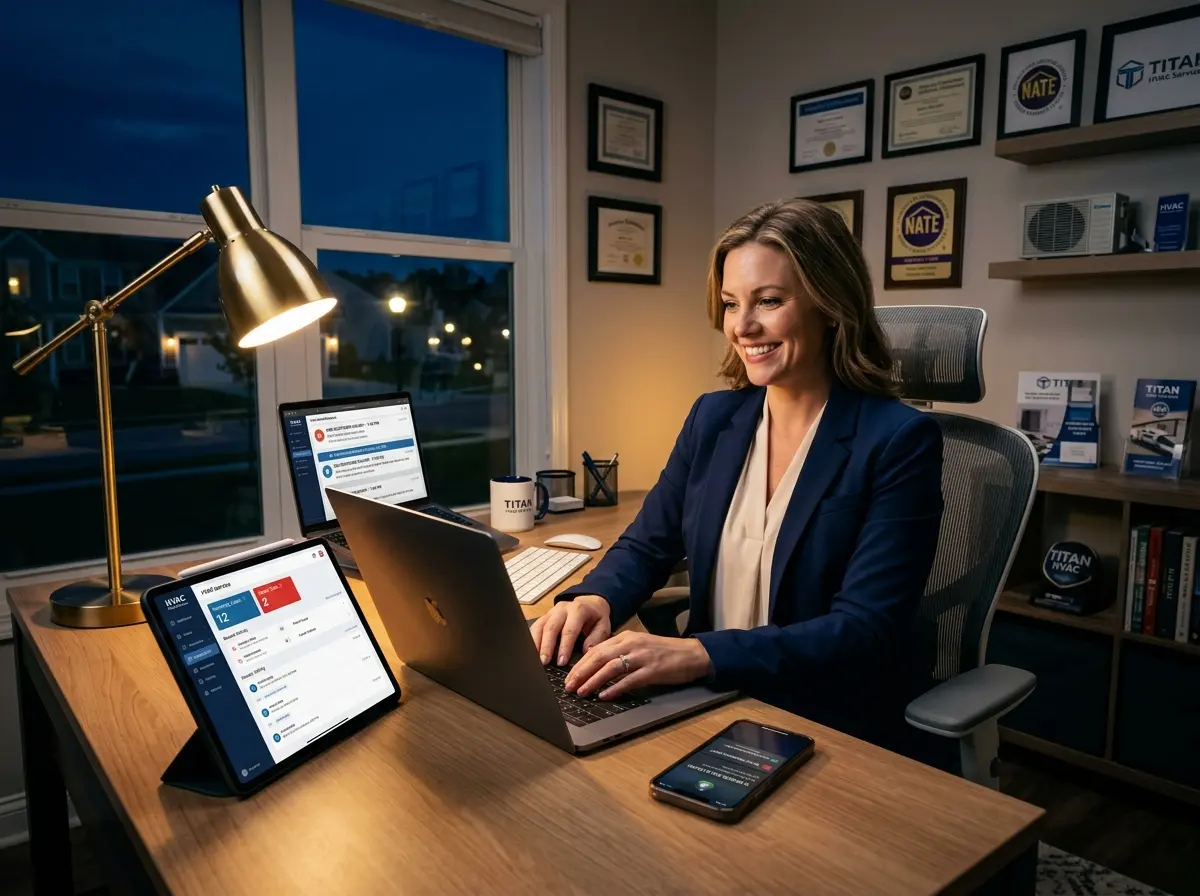
When the Workday Ends, the Leads Don't Have To
Here's a scenario every HVAC business owner knows all too well: it's 9:47 PM on a Tuesday, a homeowner's air conditioner just decided to stage a dramatic protest in the middle of a heat wave, and they're frantically searching for someone — anyone — to help them. They find your business online, they call your number, and they get... voicemail. So they hang up, scroll down, and call your competitor instead. You wake up Wednesday morning completely unaware that a high-value emergency service call just walked out the digital door.
This isn't a hypothetical horror story. It's happening to HVAC companies across the country every single night. Studies suggest that nearly 60% of customers who can't reach a business on the first try will not call back — they'll simply move on. In a service industry where urgency drives purchasing decisions, that's not just a missed call. That's missed revenue, missed relationships, and a missed opportunity to be the hero when a family is sweating through a July night.
The good news? You don't have to hire a night-shift receptionist or forward your cell phone to yourself at midnight. There's a smarter, more affordable strategy — and it starts with rethinking how your business operates after hours.
Why HVAC Companies Lose Leads After Hours (And How to Fix It)
The Urgency Problem Is Real — And It Works Against You
HVAC service is one of those rare industries where customers don't browse casually. Nobody calls an HVAC company to window-shop. When someone picks up the phone, they have a problem — a broken furnace in February, a unit leaking refrigerant, an AC that's making a sound that no machine should ever make. They need help now, and their patience for voicemail boxes is approximately zero.
This urgency dynamic means that after-hours availability isn't a luxury for your business — it's a competitive differentiator. The companies that capture these leads aren't necessarily better at HVAC work. They're just better at being reachable. If your phone system can engage a distressed homeowner at 10 PM, collect their information, and set expectations for a callback, you've already won half the battle before your technicians even wake up.
Voicemail Is Not a Strategy
Let's be honest about voicemail for a moment. It made sense in 1994. Today, it's the digital equivalent of a "gone fishing" sign on your front door. Many customers — especially younger homeowners — won't even leave a voicemail. They'll assume you're disorganized, unavailable, or simply not worth the effort. And they'll be halfway through booking your competitor before your outgoing message even finishes playing.
A proper after-hours strategy replaces passive voicemail with active engagement. That means a system that answers calls, gathers key information (What's the problem? What type of unit? What's the address?), and communicates clearly what the customer can expect next. It turns a dead-end experience into the beginning of a service relationship.
Setting Up a Lead Capture System That Works While You Sleep
Building an effective after-hours lead capture system for your HVAC company doesn't require a massive overhaul. It requires intentionality. Start by auditing exactly what happens when someone calls your business at 8 PM. Test it yourself — call your own number after hours and experience what your customers experience. If the answer is a generic voicemail message, you have room to improve.
From there, consider what information you actually need to prioritize and dispatch a service call effectively. Name, address, type of equipment, nature of the problem, and preferred callback time are usually sufficient to turn an inquiry into a scheduled job. A system that can collect this conversationally — rather than forcing customers to navigate clunky phone trees — will dramatically increase the percentage of callers who complete the process.
Smarter Tools for the After-Hours Challenge
How AI Phone Answering Changes the Game for HVAC Companies
This is where technology earns its keep. Stella, an AI robot employee and phone receptionist, answers your calls 24/7 with full knowledge of your services, pricing, service areas, and current promotions. When that panicked homeowner calls at 10 PM, Stella picks up — not with a robotic phone tree, but with a natural, conversational interaction that collects their information through a built-in intake form and delivers an AI-generated summary straight to your phone as a push notification.
That means you wake up Wednesday morning not to a missed opportunity, but to a detailed lead profile waiting in your CRM — complete with the customer's name, address, the nature of their problem, and everything your dispatcher needs to make the first call of the day count. Stella's built-in CRM also lets you tag, organize, and follow up with after-hours leads systematically, so nothing falls through the cracks. For HVAC companies running lean teams, that kind of organized, automated intake is the difference between a chaotic morning and a fully booked service day.
Building a Complete After-Hours Revenue Strategy
Create Tiered Response Protocols Based on Job Type
Not every after-hours call is a four-alarm emergency, and your response strategy should reflect that. A useful framework is to categorize incoming after-hours inquiries into three tiers: emergency service requests (no heat in winter, no cooling during a heat advisory), urgent but non-emergency requests (unit making noise, inconsistent performance), and standard scheduling requests (maintenance check, seasonal tune-up, quote requests).
Emergency calls should trigger an immediate forwarding protocol to an on-call technician. Urgent calls warrant a next-morning priority callback. Standard scheduling requests can be handled entirely through automated intake and queued for your office team. Configuring your phone system to route calls intelligently based on the nature of the inquiry means your on-call technician isn't being woken up at midnight to schedule a spring maintenance check — and your high-value emergency calls aren't sitting in a voicemail queue until morning.
Use Off-Hours Interactions to Promote and Upsell
After-hours engagement is also a remarkably underutilized marketing opportunity. When a homeowner calls at 9 PM about their air conditioner, they're already in a high-attention, high-motivation state. This is an ideal moment to mention your seasonal maintenance plans, your financing options for equipment replacement, or a current promotion on tune-up packages. A well-configured after-hours system doesn't just collect lead information — it actively communicates the value your business offers, plants seeds for upsells, and reinforces why the customer made the right choice calling you instead of the other guy.
Think about it this way: if your after-hours system mentions a discounted maintenance plan to 50 callers per month and even 10% of them express interest, that's five warm upsell opportunities sitting in your inbox every morning before you've had your first cup of coffee.
Track and Optimize Your After-Hours Performance
An after-hours strategy that you never measure is a strategy you can never improve. Make it a habit to review your after-hours lead data regularly — at least monthly. How many calls came in after hours? What percentage resulted in a booked job? What were the most common issues or questions? Which promotions generated the most interest?
This kind of insight allows you to refine your intake questions, adjust your response protocols for seasonal demand (because summer and winter will look very different for an HVAC company), and identify patterns in customer behavior that can inform your broader marketing strategy. Data isn't just for tech companies — it's for any HVAC business owner who wants to stop guessing and start growing with intention.
Quick Reminder About Stella
Stella is an AI robot employee and phone receptionist available for just $99/month with no upfront hardware costs. She answers your calls around the clock, collects customer information through conversational intake forms, manages leads in a built-in CRM, and delivers instant push notifications to your team — so you never miss a lead, even at midnight. Easy to set up, always ready to work, and infinitely more reliable than a voicemail box.
Stop Letting the Night Shift Work for Your Competitors
The HVAC companies that will dominate their local markets over the next decade won't necessarily be the ones with the best technicians or the flashiest trucks. They'll be the ones that are easiest to reach, fastest to respond, and most professional at every touchpoint — including the ones that happen while the owner is asleep.
Here's what you can do right now to move in that direction:
- Audit your current after-hours experience. Call your own business after hours tonight and see exactly what a customer experiences. Be honest with yourself about what you find.
- Define your lead capture requirements. Identify the minimum information your team needs to prioritize and dispatch a service call effectively.
- Set up tiered call routing. Separate emergency calls from standard scheduling requests so your on-call staff is only activated when truly necessary.
- Implement an AI phone answering solution. Replace passive voicemail with an active, conversational system that engages callers, collects their information, and feeds it directly into your workflow.
- Track your results monthly. Review after-hours call volume, conversion rates, and lead quality so you can continuously improve your approach.
Your competitors are closing for the night. Your leads aren't. The question is whether your business is ready to meet them where they are — or hand them off to someone who is.