Your Google Business Profile Is Either Working for You or Against You
Let's be honest — most law firm Google Business Profiles look like they were set up in 2014, forgotten about, and rediscovered only when someone finally Googled the firm's own name and winced. A blurry logo, three reviews (two from family members), and business hours that haven't been updated since the pandemic. Sound familiar?
Here's the uncomfortable truth: your Google Business Profile (GBP) is often the first impression a potential client gets of your firm. Before they visit your website, before they call you, before they read a single testimonial — they see your profile. And in a field where trust is quite literally the product you're selling, a half-baked profile doesn't just look unprofessional. It costs you clients.
The good news? Optimizing your GBP is one of the highest-ROI, lowest-cost things you can do for your law firm's local visibility. According to Google, businesses with complete profiles are 2.7x more likely to be considered reputable and get 7x more clicks than incomplete ones. So let's walk through exactly what a high-converting law firm GBP looks like — and how to build one that actually does its job.
The Foundation: Getting the Basics Absolutely Right
Before we talk about strategy, let's talk about fundamentals. You'd be surprised how many law firms fumble the basics, then wonder why they're not showing up in the local 3-pack. These aren't glamorous, but they are non-negotiable.
Name, Address, Phone, and Categories — No Shortcuts
Your firm's name on Google should match exactly what's on your website, your letterhead, and your bar association listing. Not "Smith & Associates Legal Group LLC — Personal Injury | DUI | Family Law." Just your actual business name. Google penalizes keyword-stuffed names, and it looks desperate to potential clients anyway.
Your primary business category matters enormously for local search ranking. Choose the most specific, accurate category available — "Personal Injury Attorney," "Family Law Attorney," or "Criminal Justice Attorney" will outperform the generic "Law Firm" for targeted searches. You can add secondary categories too, but let your primary do the heavy lifting.
NAP consistency — Name, Address, Phone — across the web is a foundational SEO signal. If your address appears differently on Yelp, Avvo, and your own website, Google loses confidence in your listing. Audit your citations and clean them up.
Your Business Description Is a Sales Pitch in Disguise
Google gives you 750 characters for your business description, and most law firms use it to write something that sounds like it was generated by a committee and reviewed by no one. "We are a full-service law firm committed to providing excellent legal services to our valued clients." Groundbreaking.
Your description should speak directly to the person searching for help. What practice areas do you specialize in? What geographic areas do you serve? What makes your firm different — contingency fees, multilingual staff, 24/7 availability, decades of trial experience? Lead with what matters to a scared or frustrated person looking for legal help, and naturally incorporate your top keywords without making it read like a ransom note.
Hours, Attributes, and Service Areas
Keep your hours accurate and up to date — including holiday hours. If you offer phone consultations outside of regular office hours, use Google's "More hours" feature to indicate that. Attributes like "Identifies as women-led," "Wheelchair accessible," or "Online appointments available" are small details that can meaningfully influence a searcher's decision. They also feed Google's filtering system, meaning more relevant searchers find you. Don't skip them.
Photos, Reviews, and the Trust Signals That Actually Convert
Photography That Builds Confidence Before the First Call
Law is a high-stakes, high-trust service. People aren't hiring you to fix their sink — they're trusting you with their custody battle, their business, or their freedom. Professional photography on your GBP signals that you take your practice seriously. This means a real headshot of the attorneys (not a courtroom stock photo), an image of your office exterior so clients can find you, and interior shots that show a professional, welcoming environment. Firms with more than 100 photos on their GBP receive 520% more calls than those with fewer photos, according to BrightLocal research. That's not a typo.
Reviews: Your Most Powerful Conversion Tool
Reviews are the closest thing to word-of-mouth at scale, and for law firms, they're especially powerful because most people have never hired an attorney before and genuinely don't know what to expect. A steady stream of recent, detailed reviews — mentioning your practice area, the attorney by name, and a specific outcome — is worth more than any paid ad.
The strategy here is simple but requires consistency: ask every satisfied client for a review, make it easy by sending a direct link, and respond to every single review you receive — positive or negative. Responding to negative reviews professionally and empathetically is actually a positive trust signal to prospective clients. It shows you're paying attention and that you handle conflict with maturity. Imagine that.
Keeping Your Profile Active and Visible
A lot of law firms treat their GBP as a set-it-and-forget-it directory listing. Google, however, rewards active profiles. Posting updates, using Q&A features, and ensuring your phone gets answered when someone calls — these are the behaviors of a business Google wants to recommend.
Where Stella Fits Into Your Local Presence Strategy
Here's a scenario that plays out constantly: a potential client finds your law firm on Google, they're impressed enough to call, and nobody answers. Or worse — they get a voicemail and move on to the next result. All that profile optimization, wasted.
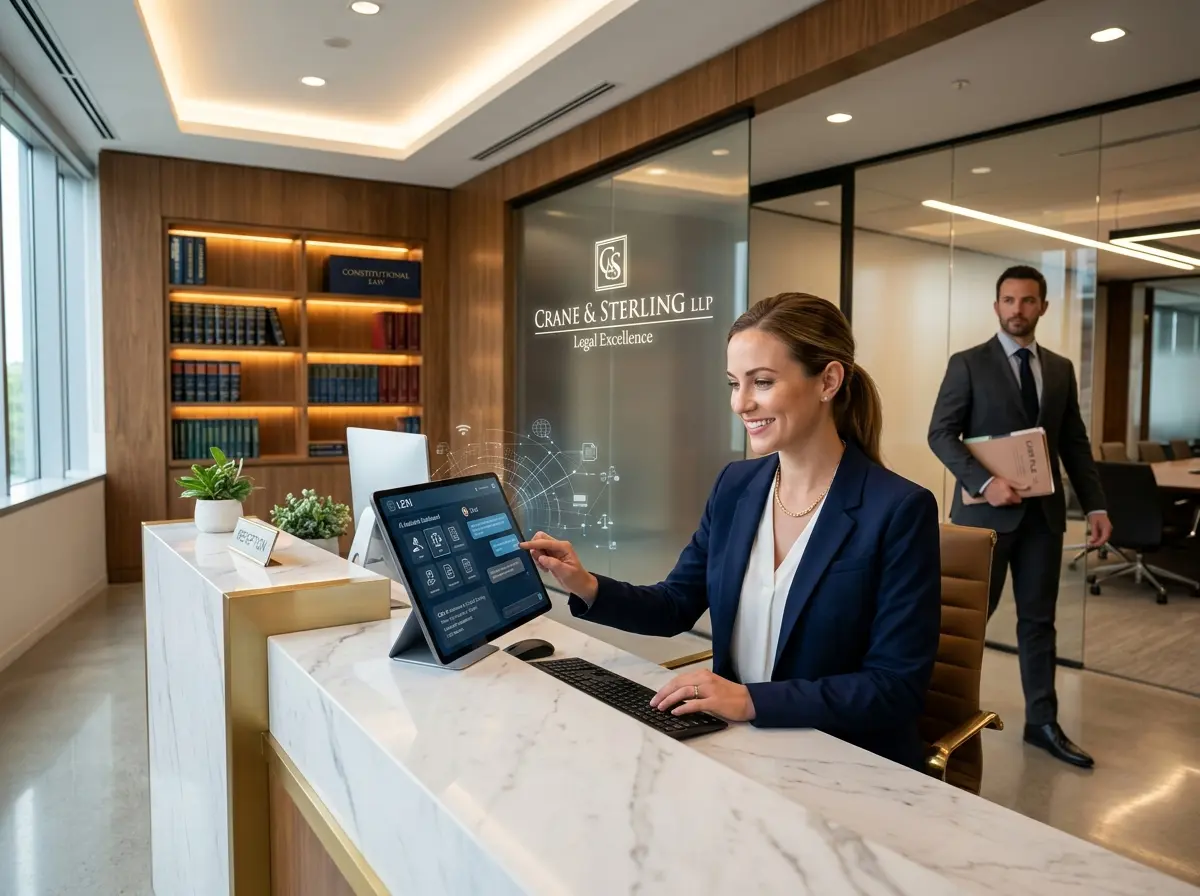
Stella, the AI phone receptionist, solves this directly. She answers every call 24/7, can handle initial intake questions about your practice areas, collect contact information through conversational intake forms, and transfer calls to the appropriate attorney or paralegal based on rules you configure. For law firms with a physical office, Stella can also stand in your lobby as an AI kiosk, greeting walk-in clients and answering their initial questions while staff handle higher-priority work. Her built-in CRM automatically logs client interactions and generates AI-powered profiles — so when a lead follows up days later, your team already has context. When someone's Google search converts into a call, Stella makes sure that call converts into a client.
Advanced Optimization: The Details That Separate Good Profiles from Great Ones
Once your fundamentals are locked in and your reviews are flowing, there's a layer of optimization that most law firms never bother with. This is where real competitive advantage lives.
Google Posts: Show That Someone's Home
Google Posts let you publish short updates directly to your profile — announcements, blog highlights, FAQs, or event invitations. For a law firm, this might look like: "New blog post: What to do immediately after a car accident," or "Now offering free 30-minute consultations for estate planning matters." Posts expire after seven days (or longer for events), so a consistent posting cadence signals to Google that your business is active and engaged. Aim for at least two posts per month. It takes ten minutes and keeps your profile fresh in the algorithm's eyes.
The Q&A Section Is a Hidden Gem
Most law firms ignore the Questions & Answers section of their GBP entirely. This is a mistake. Anyone can post a question on your profile — and anyone can answer it, including you. Proactively seed your Q&A section with the questions your intake team hears most often: "Do you offer free consultations?", "Do you handle cases in [city]?", "What's your fee structure for personal injury cases?" Answering these yourself ensures accuracy, incorporates useful keywords, and reduces friction for prospective clients who might not want to call just to get basic information.
Tracking What's Actually Working
Google Business Profile provides a built-in insights dashboard showing how many people found your profile, what search terms they used, and whether they clicked to call, visit your website, or get directions. Use this data. If you're getting strong impressions but low call-through rates, your profile may need stronger photos or more compelling descriptions. If calls spike after you post a particular update, note what topic resonated. This isn't just vanity data — it tells you what your prospective clients actually care about.
A Quick Word About Stella
Stella is an AI robot employee and phone receptionist built for businesses that can't afford to miss a customer — which is every business. For law firms, she answers calls around the clock, handles intake, and keeps your CRM organized without adding to your payroll. At $99/month with no hardware costs, she's the kind of hire that actually shows up every day.
Turn Your Profile Into a Client Acquisition Machine
Your Google Business Profile isn't a formality — it's the front door of your law firm for a significant portion of your potential clients. The firms that treat it that way, that invest in professional photos, actively cultivate reviews, post consistently, and respond to every question and comment, are the ones showing up at the top of local search results and converting curious browsers into paying clients.
Here's your action plan: this week, audit your GBP against everything covered above. Fix your categories, refresh your description, upload proper photos, and respond to any unanswered reviews or questions. Set a reminder to post an update twice a month. Set up a review request process so you're consistently building social proof. And if calls are going unanswered when your team is busy or the office is closed, fix that problem too — because no profile optimization in the world matters if the phone rings into the void.
The law firms winning local search right now aren't necessarily the biggest or the oldest. They're the ones paying attention. Start paying attention.