Introduction: Because You Deserve More Than $70 Per Hour and a Sore Thumb
Let's be honest — if you're a massage therapist running your own practice, you've probably done the math more times than you'd like to admit. You have a finite number of hands, a finite number of hours, and a very finite back that's quietly filing a complaint every time you take on an extra client. The traditional one-therapist, one-client model is sustainable, sure, but it's also a ceiling. And ceilings, as any ambitious business owner knows, are meant to be broken through.
Enter: couples workshops. Not couples massages — those are table stakes. We're talking about structured, premium-priced workshops where you teach couples how to work on each other, facilitate meaningful connection, and position yourself as an expert educator rather than just a pair of skilled hands. The result? Higher hourly revenue, group settings that multiply your earning power, and clients who leave genuinely excited to come back. It's one of the smartest pivots a massage therapist can make, and yet most practitioners never try it because they're not sure where to start.
This guide walks you through exactly how to design, price, market, and deliver couples workshops that feel premium — and actually are. Let's get into it.
Designing a Workshop Worth Paying For
The difference between a couples workshop that fills up instantly and one that collects digital dust on your booking page often comes down to one thing: perceived and actual value. Anyone can slap together a 90-minute "learn to massage your partner" class. What you want to create is an experience that people talk about at dinner parties.
Structure Your Curriculum Around Transformation, Not Technique
It's tempting to build your workshop entirely around technique — where to put your hands, how much pressure to apply, which strokes work best on the shoulders. And yes, that content matters. But couples don't sign up for these workshops because they want to become massage therapists. They sign up because they want to feel more connected, more relaxed, and more in tune with each other. Your curriculum should reflect that.
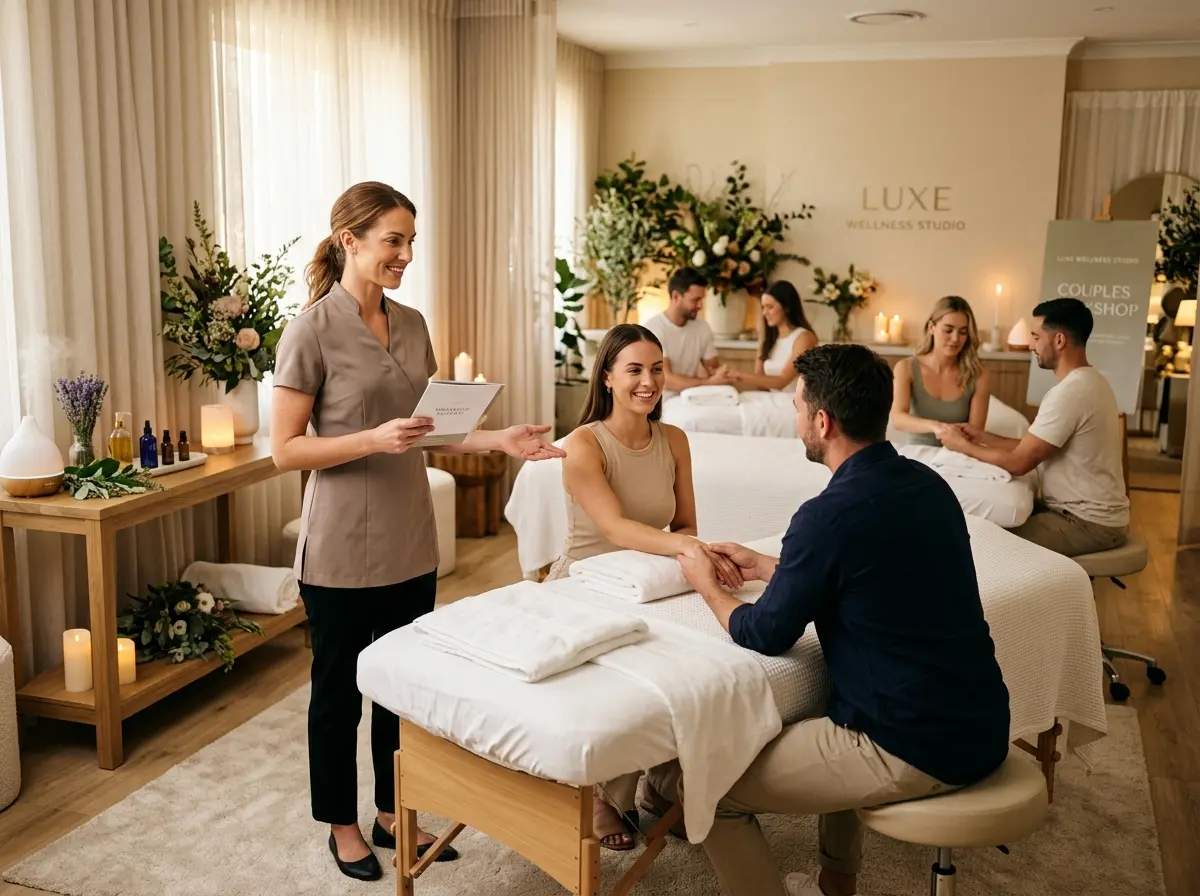
Start with intention. Open the workshop by guiding couples through a brief conversation about what they each need from the other — emotionally and physically. Then move into breathwork and presence exercises before a single hand touches a single shoulder. This primes participants to actually receive and give touch with awareness, rather than just mechanically following instructions. From there, you can teach three to five core techniques — effleurage, petrissage, scalp work, foot reflexology basics — with plenty of practice time. Close with a shared relaxation experience and a takeaway guide they can use at home.
Nail the Pricing Strategy
Here's where therapists consistently leave money on the table. A couples workshop should not be priced like two individual sessions stapled together. You're offering education, experience, ambiance, materials, and your expertise as a facilitator. Price accordingly.
For a two-hour workshop, a price point between $150 and $250 per couple is well within market range in most areas, with urban markets supporting up to $350 for premium experiences. If you run four couples per session — which is very manageable with the right space — you're looking at $600 to $1,400 for two hours of work. Compare that to the $140 to $160 you might earn in the same time doing back-to-back individual sessions, and the math speaks for itself.
Consider tiered offerings as well: a standard workshop, a "date night" deluxe version with champagne and take-home products, and a private couples session for those who want the full personalized experience. Multiple price points give you multiple revenue streams without requiring multiple skill sets.
Streamlining Operations So You Can Actually Enjoy Running This Thing
The workshop business model is fantastic until you realize you're now juggling registrations, follow-up emails, intake forms, and phone calls — all while trying to actually be a massage therapist. This is exactly the kind of operational friction that causes great ideas to quietly die.
Let Technology Do the Administrative Heavy Lifting
This is where smart tools make a real difference. Stella, the AI robot employee and phone receptionist, is built for exactly this kind of multi-tasking business environment. For therapists with a physical location, Stella stands in your space and proactively greets clients, answers questions about your workshop offerings, collects registrations through conversational intake forms, and promotes upcoming events — without you having to interrupt a session to pick up the phone or explain your pricing for the fifteenth time that week.
For phone inquiries — and there will be phone inquiries — Stella answers calls 24/7, walks prospective workshop attendees through the details, and can even collect their information before forwarding the call to you if needed. Her built-in CRM lets you tag contacts by interest (workshop leads, existing clients, retail buyers), add notes, and track who came in from which promotion. That's a proper business infrastructure for $99 a month, which, as a reminder, is less than a single massage session at your new premium pricing.
Marketing Your Workshop to the Right People
You could have the most beautifully designed couples workshop on the planet, and if nobody knows about it, you're just hosting a very intimate party for yourself. Marketing doesn't have to be complicated, but it does have to be intentional.
Tap Into the Occasions People Already Plan Around
Couples workshops sell themselves hardest when they're attached to a moment. Valentine's Day is the obvious one, but don't overlook anniversaries, date night culture, "treat yourselves" gifting around the holidays, and even relationship wellness as an ongoing category. Frame your workshop as a gift experience — because that's exactly what many buyers are looking for — and make it dead simple to purchase as a gift card or voucher. According to industry data from the American Massage Therapy Association, the wellness gifting market continues to grow year over year, with experiential gifts outperforming physical products in customer satisfaction.
Build your marketing calendar around four to six natural booking windows per year and promote each one deliberately: email your existing client list, post behind-the-scenes content on social media showing your workshop space being set up, and ask past participants to share their experience. Word of mouth from a genuinely enjoyable couples experience is some of the most powerful marketing you'll ever get, and it costs nothing except doing a great job the first time.
Partner Strategically with Other Local Businesses
Think about where couples already spend money on experiences: wine bars, boutique hotels, florists, yoga studios, and upscale restaurants. Approach these businesses with a simple co-promotion idea — they promote your workshop to their audience, you promote their business to yours. Better yet, bundle your workshop with a partner's offering (a bottle of wine from the local shop, a dinner reservation nearby) and sell the combined experience at a premium. You both win, and your clients get something they couldn't put together as easily on their own.
You can also pitch your workshop as a corporate wellness offering. HR teams and team leads are always hunting for creative employee appreciation ideas, and a couples workshop for employees and their partners is a genuinely thoughtful option that stands out from the usual gift card approach. A single corporate booking could mean eight to twelve couples in one session — a very good day by any measure.
Quick Reminder About Stella
Stella is an AI robot employee and phone receptionist designed to help business owners like you handle customer interactions without dropping the ball on operations. She greets clients in person, answers phones around the clock, promotes your services and workshops, and manages contact information through a built-in CRM — all for $99 a month with no upfront hardware costs. For a massage therapist building a workshop program, she's the front desk you've always needed but never wanted to hire and train.
Conclusion: Your Next Move Is Simpler Than You Think
Building a couples workshop program isn't a reinvention of your business — it's an intelligent extension of what you already do exceptionally well. You understand the body, you understand how to create relaxation and trust, and you know how to guide people through an experience. Workshops just let you do all of that at a higher price point, with more people in the room, in less total time.
Here's your actionable starting point: pick a date four to six weeks out, design a two-hour curriculum using the structure outlined above, price it confidently between $175 and $250 per couple, and cap it at four to six couples for your first run. Promote it to your existing client list first — these are people who already trust you — and ask them to bring a friend. Collect feedback after the session and refine from there.
As your workshop program grows, lean on tools like Stella to handle the logistics — registrations, intake, follow-up, and phone inquiries — so you can stay focused on the part that actually requires your expertise. The ceiling you've been bumping your head against? Consider it officially raised.