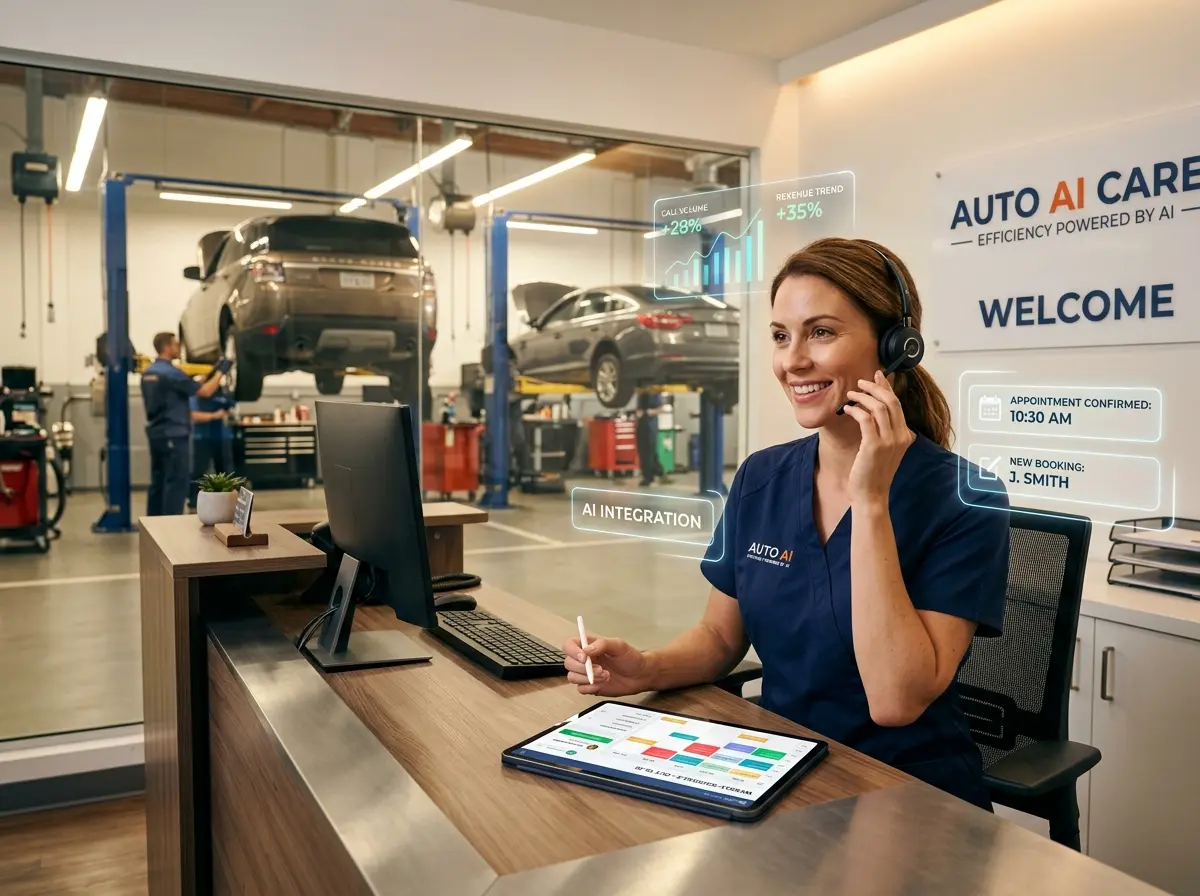
The Phone Is Ringing. Your Tech Is Elbow-Deep in an Engine. Now What?
If you run an auto shop, you already know the drill. The bay is full, your best tech is diagnosing a tricky transmission issue, and the front desk phone rings — again. Nobody picks up. The caller hangs up. And somewhere across town, they're already Googling your competitor.
It's not a staffing problem. It's not a dedication problem. It's a capacity problem — and it's costing you real money every single week. Studies suggest that 62% of calls to small businesses go unanswered, and in a service-driven industry like automotive repair, a missed call is almost always a missed appointment. That's an oil change, a brake job, maybe a full engine overhaul — gone before you even knew it was available.
The good news? Artificial intelligence has quietly gotten very good at doing the things your front desk struggles with most: answering calls instantly, collecting customer information, booking appointments, and even promoting your current specials — all without needing a coffee break or calling in sick on a Monday. Welcome to the era of AI-powered auto shop management. Let's talk about what that actually looks like in practice.
Why Auto Shops Are Uniquely Vulnerable to Missed Opportunities
The Front Desk Bottleneck Is Real
Auto shops operate in a fundamentally split-attention environment. Your revenue is generated in the bays, but your revenue is captured at the front desk. That tension creates a perpetual bottleneck. When the service advisor is walking a customer through a repair estimate, explaining why their car needs new rotors and not just brake pads, the phone doesn't stop ringing just because she's busy. And when the shop is short-staffed — which, let's be honest, is most of the time these days — that bottleneck tightens into a full-on squeeze.
The result is a customer experience that's inconsistent at best. Sometimes callers get a knowledgeable, friendly voice. Sometimes they get a harried tech who doesn't really know today's oil change special. And sometimes they get voicemail — which, in 2024, might as well be a polite way of saying "please call someone else."
After-Hours Calls Are Where the Revenue Leaks Out
Here's a scenario that probably sounds familiar: a driver notices their check engine light at 8:00 PM on a Thursday. They're anxious. They want answers. They call the nearest shop they can find — maybe yours — and they get voicemail. So they call the next one. And that shop, which happens to have an AI receptionist answering 24/7, books them for a Friday morning appointment before you even knew they existed.
After-hours inquiry volume is consistently underestimated by shop owners. Many customers research and decide on a service provider during evenings and weekends, precisely when most shops are closed. If your phone goes unanswered during those windows, you're not just missing a call — you're handing a warm, ready-to-book customer directly to the competition. That's not a maybe. That's math.
Inconsistent Service Writing Costs You Upsells
Even when calls are answered, there's another problem: inconsistency. Not every person who picks up the phone is equally comfortable recommending a cabin air filter replacement alongside a scheduled oil change, or mentioning that your shop is currently running a tire rotation special. Upselling requires confidence, product knowledge, and good timing — and when your service advisor is juggling three customers and a parts vendor on hold, those recommendations tend to fall through the cracks. The result is a lower average repair order than your shop is actually capable of producing.
How AI Tools Are Closing the Gap — And Where Stella Comes In
Instant, Always-On Phone Coverage That Actually Sounds Human
The most immediate and measurable impact AI has had on auto shops is in phone coverage. Modern AI receptionists can answer calls instantly, day or night, using natural conversational language — not the robotic, press-one-for-this-press-two-for-that experience that makes customers want to throw their phones into traffic. They can answer questions about hours, services, and pricing, collect customer vehicle information, schedule appointments, and even transfer calls to a human when the situation genuinely requires it.
Stella does exactly this, and she does it without ever putting a caller on hold to "check on something." She's trained on your shop's specific services, hours, policies, and current promotions — so when someone calls asking whether you service European vehicles or whether you're running a synthetic oil special this month, she knows the answer. Her built-in CRM and conversational intake forms also mean she's quietly collecting customer data with every interaction, building profiles that your team can actually use — vehicle make and model, service history, contact preferences, and more. For a shop trying to run a tighter operation, that's not a small thing.
For shops with a physical location, Stella also operates as a human-sized kiosk right inside the shop — greeting walk-in customers, answering questions, and promoting current deals while your staff focuses on the work that actually requires a human being.
Practical Ways Auto Shops Are Using AI to Book More Appointments
Capturing Leads During Peak Hours Without Adding Headcount
One of the most straightforward wins AI delivers for auto shops is simple: more calls answered, more appointments booked. A shop in a competitive suburban market might receive 40 to 60 inbound calls on a busy Saturday. Without AI assistance, a significant portion of those calls either go to voicemail or get answered by someone who isn't fully equipped to convert the caller. With an AI receptionist handling intake — collecting the customer's name, vehicle details, service need, and preferred appointment time — the conversion rate improves substantially, and your human staff can focus on the customers who are already standing in front of them.
This is particularly effective during the morning rush, when calls spike right as the bays are filling up and the service advisor is trying to write up three vehicles simultaneously. AI doesn't get overwhelmed. It doesn't rush callers. It gives every caller the same attentive, informed experience regardless of how chaotic things are in the shop at that exact moment.
Turning Voicemails Into Actionable Follow-Ups
Even when a caller does leave a voicemail, AI is making that process smarter. Instead of a shop manager wading through a stack of audio messages at the end of the day, AI-generated voicemail summaries surface the key information instantly — who called, what they need, and how urgently they need it — with push notifications delivered to a manager's phone in real time. The result is faster callback times, fewer dropped leads, and a substantially more professional customer experience.
Promoting Specials Without Relying on Your Staff to Remember
Let's be real: your current tire promotion is not being mentioned on every single call. It's probably being mentioned on some calls, by some employees, when they happen to think of it. AI doesn't forget. When configured to promote a current special, an AI receptionist will naturally work it into relevant conversations every single time — not in a pushy, telemarketer way, but in the same way a well-trained service advisor would mention that the shop happens to have a great deal on alignments this week. That consistency, multiplied across dozens of calls per day, produces real incremental revenue.
Quick Reminder About Stella
Stella is an AI robot employee and phone receptionist built for businesses like yours. She answers calls 24/7, greets walk-in customers at her in-store kiosk, promotes your current specials, and manages customer data through a built-in CRM — all for $99 per month with no upfront hardware costs. She's easy to set up, always ready to work, and notably never calls in sick the week before a holiday weekend.
What to Do Next If You're Tired of Losing Calls
If you've read this far, you've probably already done a rough mental calculation of how many calls your shop misses in a typical week and what those appointments might be worth. That number tends to be uncomfortable. The good news is that closing that gap doesn't require a massive technology overhaul or a significant capital investment — it requires the right tool, configured correctly, working consistently on your behalf.
Here's a practical starting point for any auto shop owner ready to take this seriously:
- Audit your missed calls. Pull your phone records for the last 30 days and identify how many inbound calls went unanswered or to voicemail. Multiply a conservative estimate by your average repair order value. That's your baseline opportunity cost.
- Identify your highest-volume call windows. Most shops have predictable peaks — Monday mornings, Saturday middays, right after 5 PM on weekdays. These are the windows where AI coverage delivers the most immediate value.
- Define what a great first interaction looks like. What questions do you want every caller answered? What information do you need collected before the appointment? What specials should be mentioned? If you can define that, you can train an AI to deliver it consistently.
- Start with phone coverage, then expand. AI phone reception is typically the fastest win. Once you see how it performs, you can layer in additional capabilities — kiosk engagement, CRM integration, intake forms — based on what your shop needs most.
The auto service industry is competitive, labor costs are rising, and customer expectations for fast, responsive communication are only going up. Shops that figure out how to deliver a consistent, professional experience at every touchpoint — including the phone — are going to have a meaningful advantage over those that are still relying entirely on whoever happens to be available to pick up. AI isn't a futuristic luxury anymore. For a growing number of auto shops, it's just Tuesday.