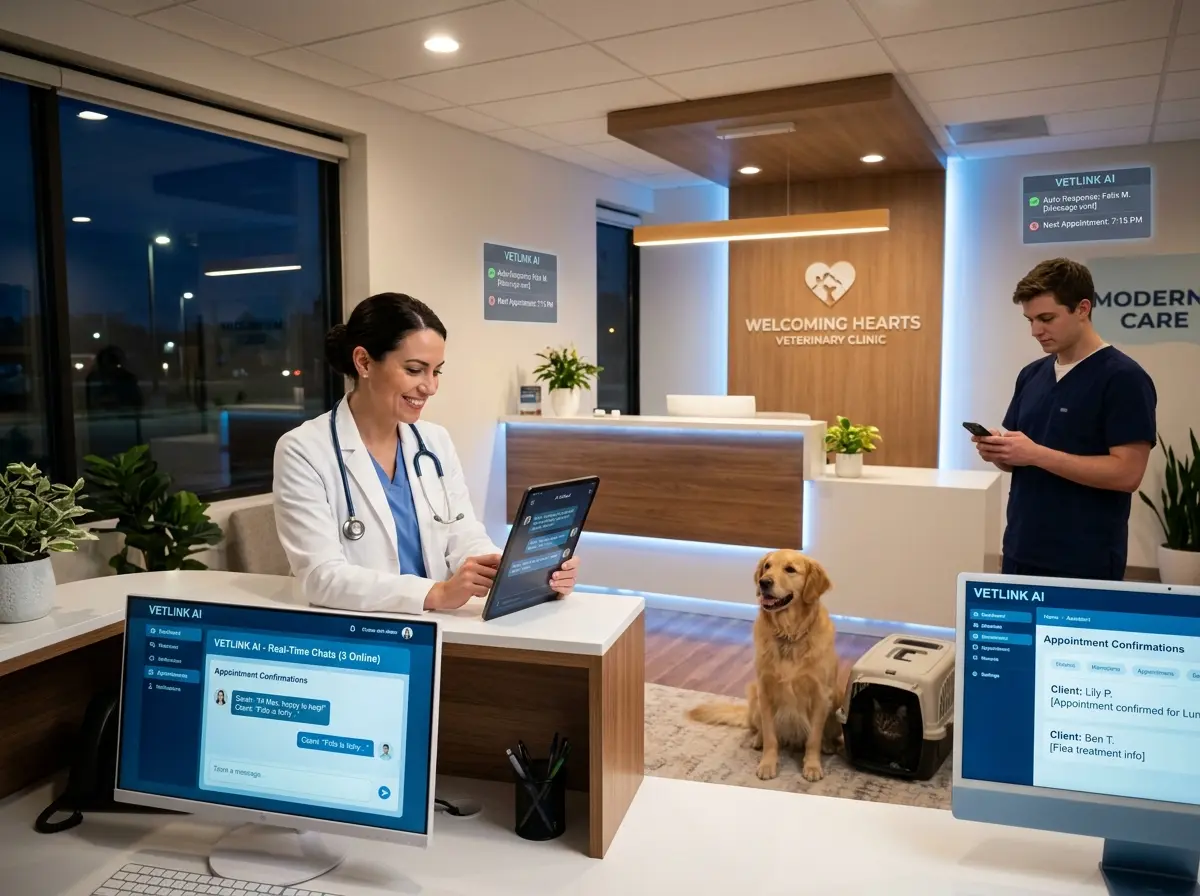
Your Clinic Closes at 6 PM. Your Clients' Anxiety About Their Pets Does Not.
It's 10:47 PM on a Tuesday. Someone's golden retriever just ate something suspicious off the kitchen floor, and their first instinct — before even Googling — is to call you. Your clinic, of course, is closed. The phone rings into a void, or worse, a generic voicemail greeting that sounds like it was recorded in 2009. The client panics, doesn't leave a message, and spends the next three hours doom-scrolling through pet health forums.
Now imagine a different scenario: the phone is answered immediately, warmly, and intelligently. The caller gets clear guidance about whether their situation is an emergency, learns your clinic's hours and next available appointment slots, and hangs up feeling heard — even though it's nearly 11 PM. No staff member was woken up. No one burned out answering the same after-hours question for the fourth time this week.
This isn't a fantasy. It's just AI done right. And for veterinary clinics, after-hours client communication might be the single highest-impact area where artificial intelligence can immediately improve both client satisfaction and staff wellbeing. Let's talk about why — and how.
The After-Hours Problem Is Bigger Than You Think
Most veterinary practice owners acknowledge that after-hours calls are a nuisance. Fewer realize just how much business and goodwill they're quietly hemorrhaging because of how those calls are currently handled — or more accurately, not handled.
The Cost of Silence (And of That Generic Voicemail)
Studies have shown that a significant portion of veterinary clients — some estimates put it as high as 60–70% — will not leave a voicemail when they reach an automated recording. They hang up and move on. Sometimes that means they find another clinic. Sometimes it means they post a frustrated comment on your Google listing. And sometimes it means a pet doesn't get the care it needs in time because the owner didn't know where else to turn.
Your voicemail greeting is not a communication strategy. It's a white flag. And in a competitive veterinary market where clients have more choices than ever, losing even a handful of potential or existing clients per month to after-hours silence adds up to real revenue — not to mention the reputational cost that's much harder to quantify.
Staff Burnout Is a Real and Present Danger
Many clinics try to solve the after-hours problem by simply routing calls to a staff member's personal cell phone. This is a solution in the same way that duct tape is a solution: it technically works, briefly, until it makes everything worse. Veterinary technicians and receptionists are already navigating one of the most emotionally demanding jobs in healthcare. Expecting them to be on-call communicators in their off hours accelerates burnout, increases turnover, and — let's be honest — generates a certain kind of low-level resentment that no team building exercise will fix.
The better answer isn't to push the problem onto your people. It's to build a system that handles the predictable stuff automatically, so your team can focus on what actually requires their expertise and empathy.
Client Expectations Have Permanently Shifted
Post-pandemic consumer behavior changed the game for every service business, and veterinary care is no exception. Clients now expect immediate, helpful responses at whatever hour they happen to need them. They're accustomed to 24/7 access in nearly every other area of their life — banking, food delivery, streaming support — and they're quietly judging businesses that haven't kept pace. An after-hours AI that answers professionally and knowledgeably doesn't feel futuristic to today's clients. It feels normal. What feels outdated is the alternative.
What AI Can (and Should) Handle After Hours
Here's where a lot of business owners get tripped up: they assume AI communication means robotic, frustrating, press-1-for-English experiences. That's old-school IVR technology dressed up in a trendy acronym. Modern AI phone assistants are conversational, context-aware, and genuinely useful. And for veterinary clinics specifically, the use cases are both plentiful and practical.
Where Stella Fits Into Your Clinic
This is where tools like Stella — an AI robot employee and phone receptionist — are genuinely changing the day-to-day reality for service businesses, veterinary clinics included. Stella answers phone calls around the clock using the same business knowledge she'd deploy in person, which means your after-hours callers get accurate answers about your hours, services, emergency protocols, and appointment availability — without a single human being disturbed. For clinics with a physical location, Stella also operates as a friendly in-store kiosk presence, greeting clients as they walk in, answering questions, and promoting services or current offers.
Beyond just answering calls, Stella can collect client information through conversational intake forms during the call itself — gathering details that are automatically organized in her built-in CRM, complete with AI-generated contact profiles, custom fields, and tags. That means a new client who calls at midnight to ask about your wellness plans can be logged, profiled, and ready for a follow-up from your team the next morning. No sticky notes. No "I think someone called last night?" moments. The calls that genuinely require human attention trigger configurable forwarding or a push notification to the right manager — so urgent situations never fall through the cracks, and routine inquiries never wake anyone up unnecessarily.
Implementing After-Hours AI Without Losing the Human Touch
The biggest fear most veterinary practice owners express about AI communication is this: "I don't want my clients to feel like they're talking to a machine." It's a fair concern, and it speaks to something important — your clinic's reputation is built on relationships, trust, and genuine care. The good news is that implementing AI communication thoughtfully doesn't replace that human connection. It protects it.
Set Clear Escalation Rules From Day One
Not every after-hours call is created equal. A client asking about your Saturday hours is very different from a client describing symptoms that sound like a life-threatening emergency. A well-configured AI system knows the difference — and routes accordingly. Build your escalation logic carefully: define the keywords, scenarios, and conditions that should trigger an immediate transfer to an on-call staff member or emergency clinic referral. Everything else — appointment inquiries, policy questions, medication refill requests, new client questions — can be handled gracefully by AI without any human involvement.
This distinction is critical. You're not replacing human judgment in emergencies. You're deploying AI intelligently so that human judgment is reserved for situations that actually need it.
Keep Your AI Informed and Up to Date
An AI receptionist is only as good as the information it has. This sounds obvious, but it's the step most businesses skip. When your holiday hours change, update your AI. When you add a new service — say, veterinary acupuncture or in-home euthanasia consultations — make sure your AI knows about it and can speak to it naturally. When you're running a promotion on dental cleanings in February, your after-hours AI should be mentioning it, just as a great front desk receptionist would.
Treat your AI communication system like a team member that needs to be onboarded and kept in the loop. The clinics that get the most value from AI receptionists are the ones that invest fifteen minutes a month keeping the system current — not the ones that set it up once and forget it exists.
Use After-Hours Data to Improve Your Daytime Operations
Here's an underrated benefit that most clinics don't immediately think about: AI-handled calls generate data. When you can see patterns in after-hours inquiries — the questions that come up repeatedly, the services people ask about most, the times of night your call volume spikes — you gain genuinely actionable intelligence about your clients and your business. Maybe you're fielding so many questions about a particular service that it's worth creating a dedicated FAQ page. Maybe call volume on Sunday evenings suggests you should consider extending Monday morning hours. The data doesn't lie, and it doesn't need to be interpreted through guesswork.
A Quick Reminder About Stella
Stella is an AI robot employee and phone receptionist built for businesses exactly like yours — available as both a physical in-store kiosk and a 24/7 phone answering solution. She's ready to work around the clock, never calls in sick, and runs on a straightforward $99/month subscription with no upfront hardware costs. For veterinary clinics looking to solve the after-hours communication problem without adding headcount or burning out existing staff, she's worth a serious look.
Your Next Steps Start Tonight
The after-hours communication gap in your veterinary clinic isn't an unsolvable problem — it's a systems problem. And systems problems have systems solutions. Here's how to start closing that gap this week:
- Audit your current after-hours experience. Call your own clinic at 9 PM. What happens? Be honest about what a worried pet owner encounters when they reach that moment.
- Map your common after-hours inquiries. Talk to your front desk staff. What are the ten questions they answer on repeat? Those are the exact questions an AI receptionist should be handling.
- Define your escalation thresholds. Decide now — in writing — which call types require a human and which can be handled by AI. Don't leave this to chance or to the AI to figure out on its own.
- Explore your options. AI phone reception is no longer enterprise-only software with enterprise price tags. Tools like Stella make it accessible, fast to set up, and genuinely affordable for independent clinics.
Your clients love their pets with an intensity that doesn't follow business hours. They deserve a communication experience that reflects that. And your staff deserves to clock out without their personal phones becoming a second shift. AI after-hours communication isn't about replacing the warmth and expertise that defines great veterinary care — it's about making sure that warmth is backed up by a system that works as hard as you do.
Even at 10:47 PM on a Tuesday.