Let's Talk About the Money You're Leaving on the Table
Here's a scenario that plays out thousands of times every HVAC season: a homeowner's air conditioner dies on the hottest day of July. They panic, call the first HVAC company they can find, pay emergency service rates, and swear they'll schedule regular maintenance going forward. Then fall arrives, then winter, then spring — and they forget. Again. Until the next meltdown. Literally.
If you're running an HVAC business and you're not actively reminding your customers to schedule seasonal maintenance, you are essentially handing those jobs to your competitors. Not because your customers don't like you — they probably do — but because people are busy, forgetful, and not spending their Tuesday mornings thinking about their HVAC system. That's what you're here for.
A well-executed seasonal maintenance reminder campaign isn't just a nice marketing touch. It's a revenue engine, a customer retention strategy, and a workload management tool all wrapped in one. Let's break down exactly why you should be running one, and how to make it work without losing your mind in the process.
The Business Case for Seasonal Maintenance Campaigns
Predictable Revenue Is the Holy Grail
HVAC businesses live and die by the seasons, which is both a blessing and a curse. Summer and winter bring the calls flooding in. Spring and fall? Crickets. A seasonal maintenance reminder campaign directly attacks this feast-or-famine cycle by encouraging customers to schedule tune-ups during your slower periods — when your technicians have availability and you're not turning away emergency calls because your schedule is already buried.
According to industry data, HVAC businesses that actively market maintenance agreements and seasonal tune-ups report significantly more stable monthly revenue compared to those that rely purely on reactive service calls. When you fill your shoulder-season schedule with pre-booked maintenance visits, you maintain payroll more easily, keep your best technicians from seeking steadier work elsewhere, and reduce the operational chaos that comes with unpredictable demand spikes.
Maintenance Visits Convert Into Bigger Jobs
Here's the part that should really get your attention: a maintenance visit is one of the best sales opportunities you have. When a technician is already in a customer's home checking the system, they're in the perfect position to identify aging components, recommend upgrades, and discuss replacement timelines — all naturally, without a cold pitch. Customers who receive regular maintenance are also far more likely to call you when the system finally does need replacing, because you've already built the relationship and trust.
The math isn't complicated. More maintenance visits mean more chances to catch problems early, more chances to upsell parts and services, and more chances to convert a $150 tune-up into a $6,000 system replacement. Running a reminder campaign is essentially running a pipeline-building campaign in disguise.
Customer Retention Is Cheaper Than Customer Acquisition
You've probably heard this before, but it bears repeating: acquiring a new customer costs five to seven times more than retaining an existing one. Your past customers are already warm. They've hired you, (presumably) liked your work, and trusted you enough to let you into their homes. A seasonal reminder campaign keeps you top of mind so that when maintenance season rolls around, they're calling you — not Googling "HVAC near me" and landing on your competitor's website.
How to Actually Run This Campaign Without It Becoming a Part-Time Job
Start With Your Existing Customer List
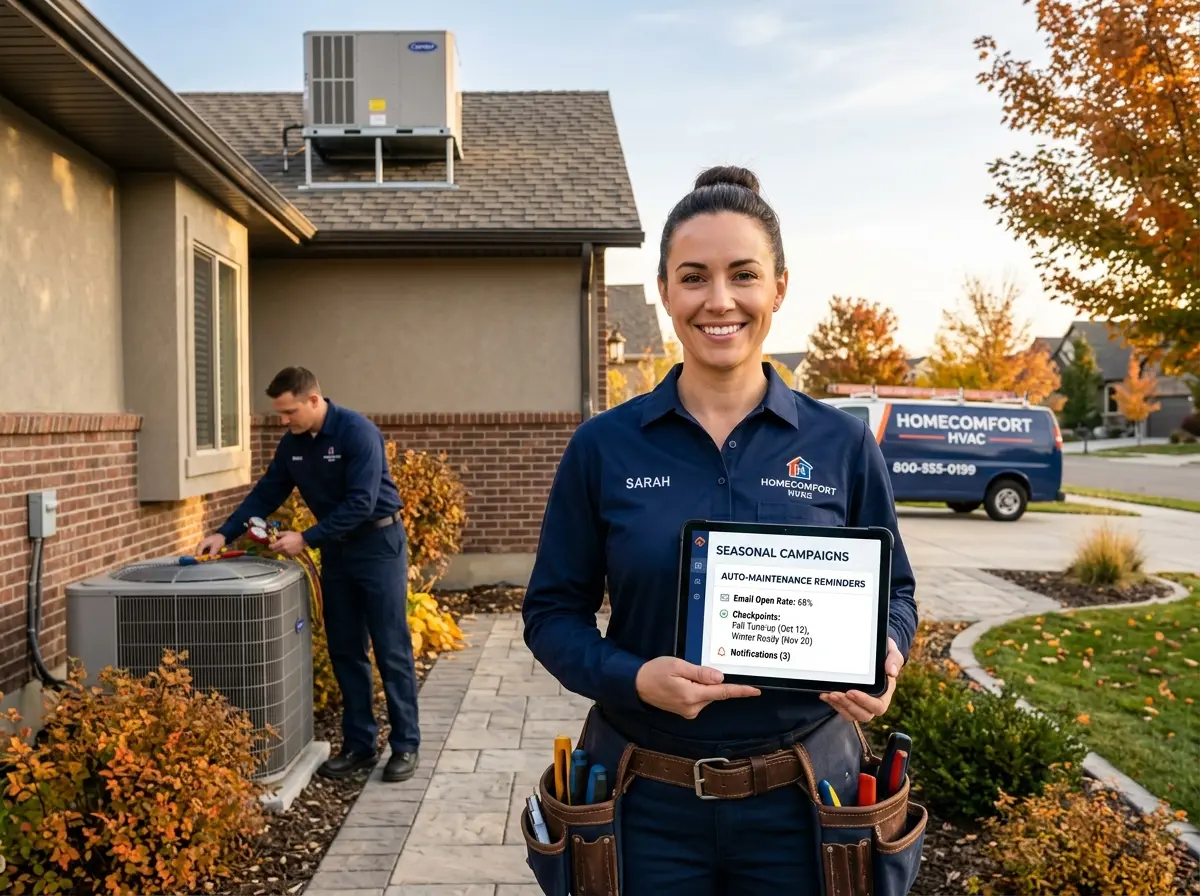
Your CRM is your goldmine. Segment your customers by system type, last service date, equipment age, and location — and then build your outreach around those segments. A customer with a 12-year-old system should be getting a different message than someone who installed a new unit last spring. Personalized reminders convert significantly better than generic blasts, and the segmentation doesn't have to be complicated to be effective.
If your customer data is a mess of spreadsheets and sticky notes, now is a genuinely good time to get that sorted. The campaign only works if you know who you're talking to.
Use Multiple Touchpoints — But Don't Be Annoying About It
A single reminder email sent in March is not a campaign. A real campaign uses a sequence: an early-bird email or text in late winter, a follow-up a few weeks later, a phone call for high-value or at-risk customers, and perhaps a social media push for general awareness. The goal is to show up in enough places that your message lands without making customers feel like they're being stalked by their HVAC company.
Phone outreach, in particular, tends to convert better than email for service businesses — but it's also the most resource-intensive. Your office staff can only make so many calls in a day, which is exactly why automating and augmenting that process matters.
Where Stella Fits Into Your HVAC Workflow
Never Miss an Inbound Call During Your Campaign
Here's the irony that HVAC companies run into every single campaign season: you send out a batch of reminders, the phones start ringing, and then you miss calls because your office is already slammed. Customers leave a voicemail, don't hear back quickly enough, and book with someone else. All that marketing spend, gone.
Stella is an AI robot employee and phone receptionist that answers every call, 24/7, with accurate knowledge of your services, pricing, seasonal specials, and scheduling process. When your reminder campaign drives inbound calls after hours or during your busy period, Stella handles them professionally — collecting customer information, answering questions about your maintenance packages, and routing calls to your team based on the conditions you set. Her built-in CRM and conversational intake forms mean that every caller gets logged, tagged, and summarized so your team can follow up intelligently. No leads fall through the cracks.
Building a Campaign That Actually Gets Results
Make the Offer Compelling and Time-Sensitive
A reminder that just says "hey, time for your tune-up!" is better than nothing, but a reminder that says "schedule your spring AC tune-up before April 30th and get 10% off — our spring slots are filling fast" is significantly better. People respond to urgency and value. The offer doesn't have to be a steep discount; it just has to feel like a reason to act now rather than later. Early-bird pricing, bundled services, priority scheduling, or even a free filter replacement can all serve as effective hooks.
Track What's Working and Adjust
A campaign without measurement is just hope dressed up as a strategy. Track your open rates, call volume, booking conversions, and average job value from campaign-driven appointments separately from your regular inbound traffic. After your first full campaign cycle, you'll have real data on what messages resonated, which segments responded best, and where customers dropped off. Use that to make your next campaign smarter.
Pay particular attention to which offers generate the most calls versus the most bookings — those aren't always the same thing. A flashy discount might get a lot of interest but attract customers who aren't serious buyers, while a well-positioned service bundle might bring in fewer calls and more committed appointments.
Consider a Maintenance Agreement Program as the End Goal
The pinnacle of the seasonal reminder campaign isn't a one-time tune-up booking — it's converting customers into annual maintenance agreement holders. A maintenance agreement locks in recurring revenue, guarantees your technicians regular work, and gives customers peace of mind. Your campaign can serve as the on-ramp: get them in for a tune-up, deliver excellent service, and present the agreement as the logical next step. Done well, this transforms a seasonal marketing effort into a recurring revenue stream that compounds over time.
Quick Reminder About Stella
Stella is an AI robot employee and phone receptionist built for businesses like yours — answering calls around the clock, managing customer intake, promoting your current offers, and making sure no lead goes unanswered. At $99/month with no upfront hardware costs, she's the kind of team member who never calls in sick right in the middle of your spring campaign rush.
Your Next Steps Start Today
Running a seasonal maintenance reminder campaign isn't complicated, but it does require intention. Here's how to get started without overthinking it:
- Clean up your customer list. Segment by last service date, system age, and customer value. Even basic segmentation will meaningfully improve your results.
- Build a simple two to three-touch sequence. An email, a follow-up, and a phone call for your best customers is more than enough to start.
- Create a clear, time-limited offer. Give people a reason to book now rather than "eventually."
- Make sure your phones are covered. Campaigns that drive calls need a reliable way to answer those calls — all of them, not just the ones that come in during business hours.
- Measure and iterate. After your first cycle, you'll know more than you did before. Use it.
The HVAC companies that dominate their local markets aren't necessarily the ones with the best technicians or the lowest prices. They're often the ones that stay in front of their customers consistently, deliver on their promises, and make it easy to do business with them. A seasonal maintenance reminder campaign is one of the most straightforward ways to do exactly that — and the businesses that run them are the ones getting called first when the AC dies on a 98-degree afternoon.
So the real question isn't whether you should be running this campaign. It's why you haven't started yet.