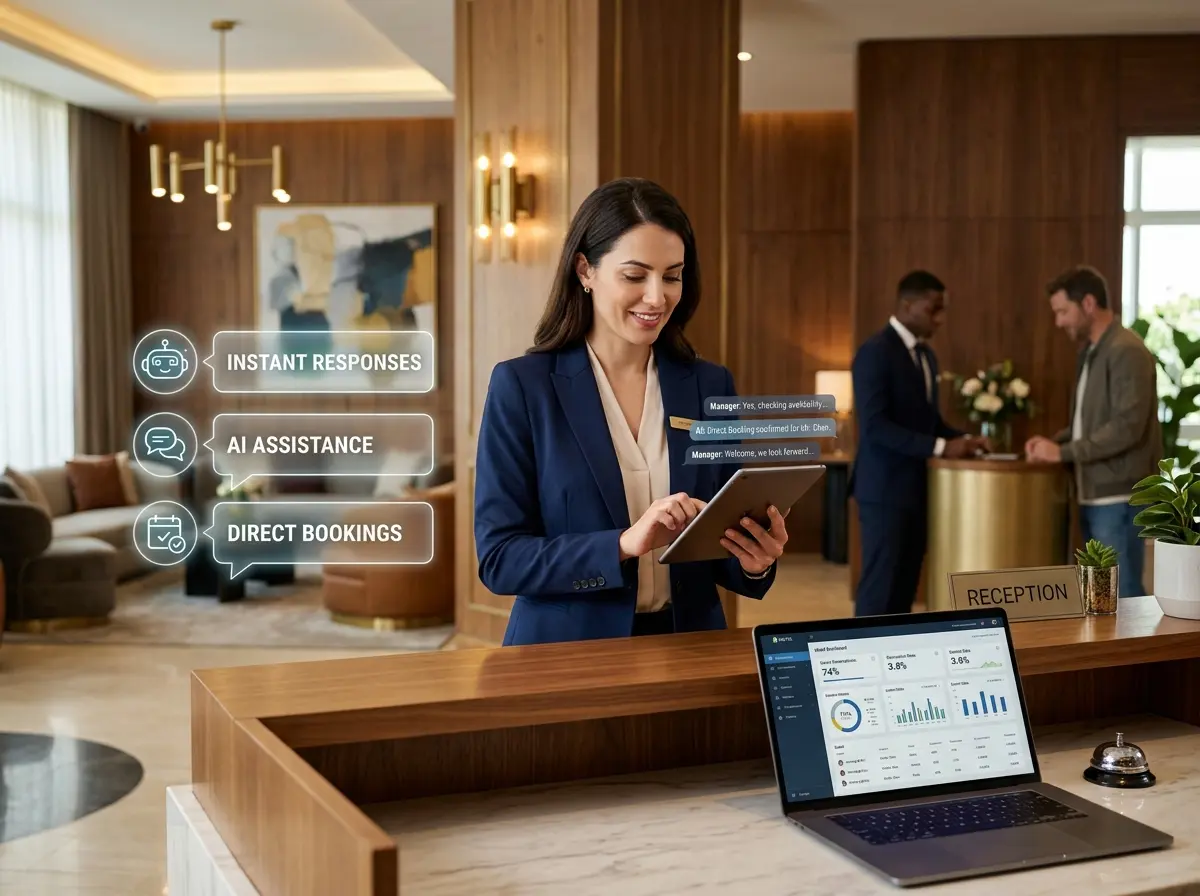
The Front Desk Is Losing You Money — And You Might Not Even Know It
Let's paint a picture. It's 11:47 PM on a Tuesday. A traveler is sitting in their car outside your hotel, phone in hand, debating whether to book your charming independent property or just surrender to the soulless embrace of a major OTA that will happily take 25% of your revenue as a commission. They have a question — something simple, like whether you allow early check-in or if the continental breakfast is actually continental. Your front desk is closed. Your website has a FAQ page nobody reads. And the OTA? It has a chatbot ready to answer in seconds.
Guess where that booking goes.
Independent hotels are fighting an uphill battle against the big booking platforms, and the playing field is anything but level. But here's the good news: AI chatbots have become a surprisingly powerful equalizer. Hotels that deploy them strategically are not only capturing direct bookings they would have lost — they're building guest relationships that keep people coming back, no middleman required. Let's talk about how it's done.
Why Independent Hotels Leak Direct Bookings (And How AI Fixes the Holes)
The 3 AM Problem Is More Expensive Than You Think
According to data from SaleCycle, nearly 40% of travel bookings happen outside of traditional business hours. Your potential guests are night owls, early risers, and international travelers operating in different time zones. When they land on your website at an inconvenient hour with an unanswered question, they don't wait patiently for you to open. They bounce — straight to Booking.com or Expedia, where a commission-hungry platform is delighted to assist them 24 hours a day.
An AI chatbot eliminates this vulnerability entirely. It lives on your website around the clock, ready to answer questions about room types, pet policies, parking, amenities, and availability without so much as a yawn. More importantly, it can guide that hesitant visitor directly into your booking engine before they have a chance to reconsider. The cost of implementation is a fraction of what OTAs charge per booking — and every direct booking you capture is a booking where you keep the full revenue.
Guests Want Answers, Not Scavenger Hunts
Here's an uncomfortable truth: most hotel websites are not as intuitive as their owners believe. Guests shouldn't have to click through five pages to find out whether you have accessible rooms or whether the pool is heated. When they can't find answers quickly, they leave. An AI chatbot acts as an on-demand concierge for your website — one that actually knows your property inside and out and communicates in plain, friendly language.
Well-designed chatbots can handle an impressive volume of pre-arrival questions: cancellation policies, group booking inquiries, local recommendations, package add-ons, and more. They can even be trained to proactively upsell room upgrades or breakfast packages during the conversation, turning a simple inquiry into a higher-value booking. That's not just customer service — that's revenue management.
The OTA Dependency Trap — And the Exit Strategy
Many independent hotels have become so reliant on OTA traffic that reducing that dependency feels impossible. But the math is brutal. If you're paying 20–25% commission on every OTA booking and you have an average daily rate of $150, that's $30–$37.50 gone on every single reservation. Multiply that across hundreds of annual bookings and you're looking at tens of thousands of dollars annually that could stay in your pocket.
The exit strategy isn't to abandon OTAs overnight — they do drive discovery. The strategy is to convert OTA-discovered guests into direct bookers on their next visit. AI chatbots play a key role here by delivering such a seamless, helpful, personalized pre-booking experience that guests begin to prefer your direct channel. Pair that with a simple loyalty incentive — a free upgrade, a late checkout, a bottle of wine — and you've started building a direct booking habit that compounds over time.
AI Tools That Work While You Sleep (Yes, Including One With a Personality)
Where Stella Fits Into the Independent Hotel Equation
While most AI chatbot solutions for hotels focus exclusively on the website experience, Stella takes a broader approach that's worth understanding — especially for boutique and independent properties that wear every hat imaginable. Stella is an AI robot employee and phone receptionist that answers calls 24/7 with the same depth of business knowledge she brings to in-person interactions. For hotels with a lobby or physical reception area, she also operates as a human-sized AI kiosk that greets guests, promotes current offers, and handles common questions so your staff can focus on the things that actually require a human touch.
Where Stella becomes particularly useful for independent hotels is in managing the communication volume that tends to overwhelm small front desk teams — after-hours calls, repetitive questions, and intake of guest information. Her built-in CRM captures guest data during conversations (via phone, web, or kiosk), so you're not just fielding inquiries — you're building a database of guest preferences, contact details, and interaction history that you actually own. At $99/month with no upfront hardware costs, it's an easy conversation to have with your accountant.
Building a Direct Booking Strategy That Sticks
Make Your Website Earn Its Keep
Your website should be your highest-converting booking channel — not an online brochure that sends confused visitors to OTAs. Start by auditing the guest journey from landing page to completed booking. Identify where people drop off, what questions arise at each stage, and where a chatbot could step in to reduce friction. Position your AI chatbot prominently — not buried in a corner — and make sure it's trained to handle the specific questions your guests actually ask, not generic hospitality FAQs from a template.
Consider integrating your chatbot with your booking engine so it can check availability and initiate the reservation process in real time. The fewer clicks between "I'm interested" and "I'm booked," the better your conversion rate will be. Guests who engage with a chatbot during the booking process are significantly more likely to complete their reservation than those who don't — some studies put that lift at 30% or higher.
Use Conversation Data to Personalize the Guest Experience
One of the underappreciated advantages of AI chatbots is the data they generate. Every conversation is a window into what your guests care about — what they're confused by, what they're excited about, and what objections they have before booking. Hotels that capture and act on this data can create genuinely personalized experiences: the couple who mentioned an anniversary gets a note from the manager; the business traveler who asked about quiet floors gets proactively assigned one.
This kind of personalization used to require a full-time guest relations manager. With AI handling the data collection and CRM integration doing the heavy lifting, even a small independent hotel with a lean team can deliver the kind of attention to detail that makes guests feel like regulars — and keeps them coming back without a loyalty points program in sight.
Don't Ignore the Phone — It's Still a Booking Channel
In the age of chatbots and online booking engines, it's easy to forget that a meaningful segment of hotel guests still prefer to call. Older travelers, group organizers, and anyone with a complicated request often pick up the phone — and if they hit voicemail or a harried front desk agent who can't answer their question, that's another booking lost. A well-configured AI phone receptionist handles these calls with patience and accuracy that humans, frankly, can't always sustain during a busy check-in rush.
The key is making sure your AI phone solution knows your property as well as your best front desk agent does — and can escalate intelligently when a situation genuinely requires a human. That balance of automation and personal touch is what separates a seamless guest experience from an infuriating one.
A Quick Reminder About Stella
Stella is an AI robot employee and phone receptionist built for businesses that want reliable, professional customer engagement without the overhead of additional staff. She answers calls around the clock, greets guests in person at her kiosk, collects guest information through conversational intake forms, and manages it all through a built-in CRM — all for $99/month with no upfront costs and no drama about PTO. For independent hotels juggling a thousand priorities, she's the team member who never calls in sick.
It's Time to Stop Donating Revenue to the OTAs
The independent hotel industry has every reason to be optimistic about AI — not because it's trendy, but because it genuinely levels the playing field. Here's how to take action:
- Audit your current booking journey. Where are guests dropping off? What questions are going unanswered? Start there.
- Deploy an AI chatbot on your website that's trained on your specific property details, policies, and offerings — not a generic template.
- Address after-hours calls with an AI phone solution so you never lose a booking to voicemail again.
- Capture guest data intentionally and use it to personalize experiences and build direct relationships that outlast any single stay.
- Build a simple direct booking incentive to give OTA-discovered guests a reason to book with you directly next time.
The OTAs aren't going anywhere, and that's fine — they serve a purpose. But every direct booking you capture is a vote for your independence, your margins, and your ability to build the kind of guest relationships that no algorithm can replicate. AI chatbots are no longer a luxury for properties with tech budgets. They're a practical, affordable tool that independent hotels can — and frankly should — be using right now.
Your guests are out there at 11:47 PM, question in hand. The only question is: will you be there to answer it?