Introduction: The Art of Selling Without Feeling Like a Car Dealership
Let's be honest — when most people think of a dental office trying to sell them something, they immediately picture a used car salesman in scrubs. And yet, cosmetic dentistry is a legitimate, life-changing service that millions of patients would genuinely benefit from, if only someone mentioned it to them without making them feel like they'd wandered into a timeshare presentation.
Here's the uncomfortable truth: most dental teams avoid talking about cosmetic services altogether because they don't want to seem pushy. So instead of a patient leaving with a brighter smile and a treatment plan, they leave with a clean bill of dental health and zero idea that whitening, veneers, or Invisalign were even on the menu. That's not patient-centered care — that's just a missed opportunity dressed up as professionalism.
The good news? There's a middle ground between aggressive upselling and awkward silence. Training your team to have natural, confident, and pressure-free conversations about cosmetic services isn't just possible — it's a skill. And once your team has it, your case acceptance rates will thank you. This guide will walk you through exactly how to get there.
Building the Foundation: Mindset Before Scripts
Reframe "Selling" as "Informing"
The single biggest reason dental teams freeze up when cosmetic services come up is that they've mentally categorized it as "sales" — and nobody went to dental school to become a salesperson. But here's the reframe that changes everything: you're not selling a product, you're expanding a patient's awareness of their own options.
A patient who doesn't know Invisalign exists can't want Invisalign. A patient who's spent years hating their smile in photos but assumes "nothing can be done" genuinely needs someone to tell them otherwise. When your team members internalize this, the energy of the conversation changes completely. It's no longer a pitch — it's a service. And dentists and hygienists are very, very good at providing services.
Establish Shared Language Across Your Team
Nothing derails a cosmetic conversation faster than inconsistent messaging. If your front desk quotes one price range, your hygienist mentions a completely different one, and your dentist uses clinical terminology the patient doesn't understand, the patient walks out confused — and confused patients don't book treatment.
Hold a team meeting (yes, an actual one) to agree on the language you'll use when discussing cosmetic services. Keep it simple, warm, and patient-facing. Instead of "porcelain laminate veneers," try "a thin cover that goes over the tooth and completely transforms how it looks." Instead of "orthognathic repositioning," just say "we can shift your teeth gradually so they line up beautifully." Patients respond to clarity, not credentials.
Practice the Scenarios Out Loud
Role-playing gets a bad reputation because it's awkward. But here's the thing — it's awkward in the break room so it isn't awkward in the chair. Dedicate 15 minutes at your next team huddle to practicing two or three common scenarios: a patient who offhandedly mentions they hate their smile, a patient asking about whitening after a cleaning, or a patient curious about what Invisalign costs. Let team members take turns being the patient and the provider. It will feel silly at first. It will pay off immediately after.
How Technology Can Support the Conversation Before It Even Starts
Let Your Tools Do the Warm-Up Work
One underrated strategy for pressure-free cosmetic conversations is making sure patients are already thinking about cosmetic options before they sit in the chair. When patients have been gently exposed to information about teeth whitening or smile makeovers before their appointment even starts, your team isn't introducing a new idea — they're continuing a conversation the patient already began.
This is where Stella, the AI robot receptionist, can play a surprisingly useful role in a dental practice. In your waiting area, Stella can proactively engage patients in friendly conversation about current promotions, cosmetic service options, or even just ask what brings them in today — normalizing the idea of cosmetic care before anyone in scrubs says a word. On the phone side, she handles incoming calls 24/7, answers questions about your cosmetic offerings, and can even collect patient intake information conversationally — so by the time a patient walks in, your team already knows what they're interested in. That's a warm lead handed directly to your hygienist, without anyone having to awkwardly pivot from "open wide" to "have you considered veneers?"
Structuring the Conversation: What to Say and When to Say It
Timing Is Everything — Don't Lead With the Upsell
The fastest way to make a cosmetic recommendation feel pushy is to lead with it. If a patient barely sits down and is immediately hearing about whitening packages, they're going to feel like a transaction, not a person. Instead, train your team to listen first and recommend second.
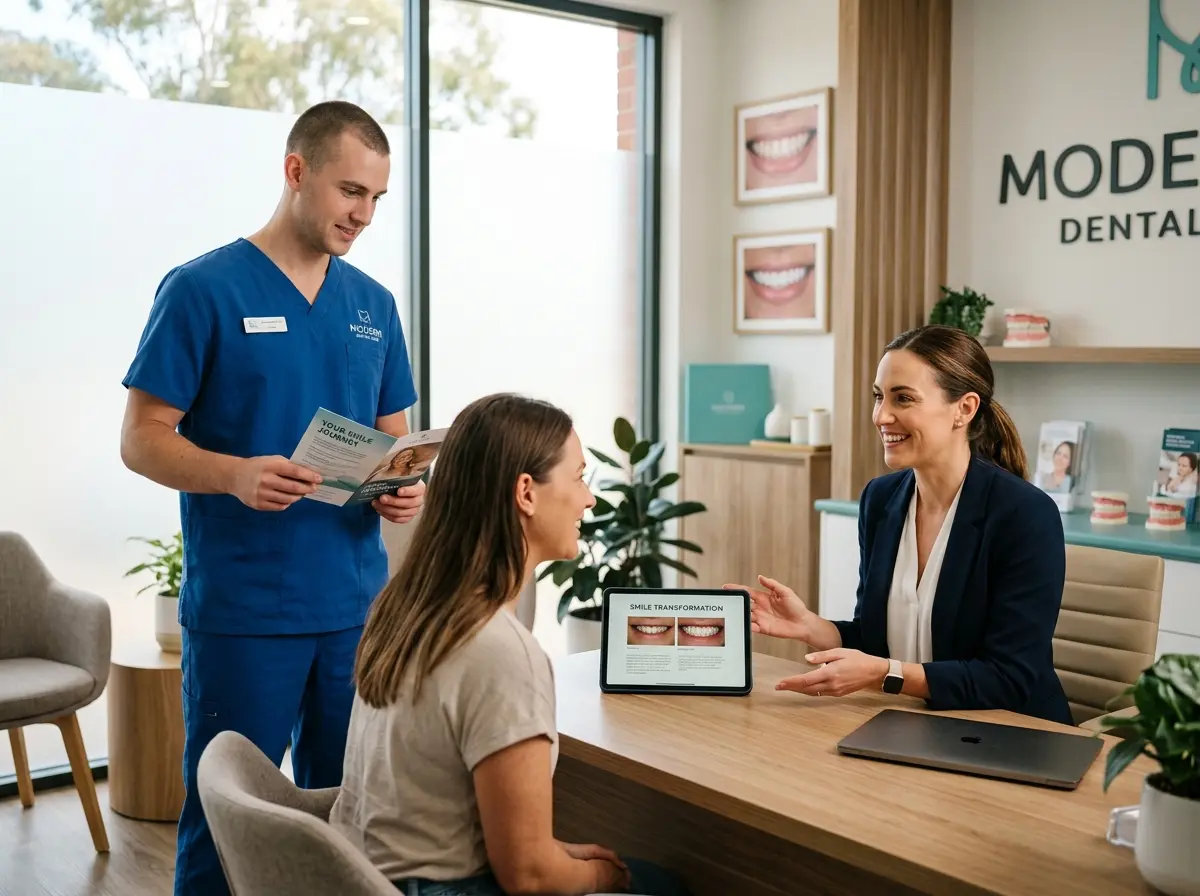
Hygienists are uniquely positioned here because they spend the most time with patients. Encourage them to ask open-ended questions during the appointment: "How do you feel about your smile overall?" or "Is there anything about your teeth that you'd like to change if you could?" These questions invite patients to express concerns they might have been holding onto for years. The cosmetic recommendation that follows isn't a sales pitch — it's a direct response to something the patient just told you they wanted.
The "Mention and Move" Technique
Not every cosmetic mention needs to be a full consultation. In fact, some of the most effective cosmetic conversations are brief, casual, and utterly without pressure. Train your team to use what might be called the "mention and move" approach: introduce the service, gauge interest, and move on without lingering.
For example, a hygienist might say: "I noticed some surface staining — that's totally normal, but if you ever wanted to brighten things up, we do offer professional whitening and it works really well. Just something to keep in mind. Now let's take a look at your back molars." That's it. The door is open. The patient knows the option exists. If they're interested, they'll walk through it. If not, no harm done and no one feels cornered. This approach respects patient autonomy while still doing the job of informing.
Handling Objections With Grace (Not a Rebuttal Script)
At some point, a patient will say "I'll think about it," "I can't afford it right now," or the classic "Maybe next time." Train your team to respond with genuine warmth rather than a sales counter-move. Acknowledge the concern, leave information behind, and make sure the patient knows the door is always open.
Something like: "Of course, no rush at all. I'll leave some information at the front desk for you, and we also have financing options if that's ever helpful to know about." Short, non-pushy, and professional. The goal is for patients to leave feeling respected — because those are the patients who come back, refer friends, and eventually say yes.
Quick Reminder About Stella
Stella is an AI robot employee and phone receptionist built for businesses like yours. She stands in your waiting room engaging patients naturally, answers your phones around the clock, promotes your services, and collects intake information — all for just $99/month with no upfront hardware costs. She doesn't take breaks, doesn't get nervous about mentioning cosmetic services, and never has an off day.
Conclusion: Small Training Investments, Big Practice Returns
Transforming your dental team into confident, pressure-free communicators about cosmetic services doesn't require a massive overhaul — it requires intention, practice, and the right framing. Here's what to walk away with and actually implement this week:
- Host a team mindset conversation about the difference between informing and selling. Get everyone on the same page philosophically before you touch scripts.
- Standardize your language. Write down five to seven cosmetic services and agree as a team on how you'll describe each one in plain, patient-friendly terms.
- Run one role-play scenario at your next morning huddle. Keep it short, make it low-stakes, and do it consistently over several weeks until it feels natural.
- Adopt the "mention and move" technique as a default approach for any non-urgent cosmetic observation during appointments.
- Audit your waiting room and phone experience to ensure patients are being warmed up to cosmetic options before your team even speaks with them.
The practices that do cosmetic dentistry well aren't the ones with the most aggressive sales training — they're the ones where the entire team genuinely believes in the services they offer and feels comfortable sharing that belief naturally. That culture starts with you. Build it intentionally, and your schedule will start filling up with the kind of cases your team actually loves to do. And your patients? They'll be smiling a lot more. Literally.