If You're Still Relying on One-Time Transactions, We Need to Talk
Let's paint a picture. Every Monday morning, a small business owner wakes up and asks themselves the same anxiety-inducing question: "How much money are we making this week?" If the answer depends entirely on how many customers walk through the door or pick up the phone, congratulations — you've built yourself a very stressful guessing game with a side of entrepreneurship.
Now imagine a different Monday. You wake up, check your dashboard, and already know that a significant chunk of this month's revenue is locked in before you've even made coffee. That's the magic of a subscription model — and it's no longer just for software companies and streaming platforms. A growing number of brick-and-mortar businesses, including dog grooming salons, are discovering that predictable, recurring revenue isn't just a luxury. It's a survival strategy.
This post breaks down how one dog grooming business made the leap to subscriptions, what you can learn from their approach, and how to start building predictable revenue into your own operation — no matter what industry you're in.
How a Dog Grooming Business Cracked the Subscription Code
The Problem With the "Come Back When You Need Us" Model
Bark & Bubbles, a mid-sized dog grooming salon in Austin, Texas, had a loyal customer base — or so they thought. Their books were full, their reviews were glowing, and their grooming tables were rarely empty. But when the owner, Priya, sat down to look at the numbers, she noticed something unsettling: nearly 40% of her customers only came in once or twice a year, and almost a third of her "regulars" had quietly drifted away in the past 12 months without a single word.
The issue wasn't service quality. It was friction. Life gets busy, people forget, and without a reason to commit, even the most loyal customer will let three months slide into six. Priya realized she wasn't just in the grooming business — she was in the reminding people to come back business, and she was losing that battle.
Building a Subscription Tier That Actually Made Sense
Rather than slapping a "membership" label on existing services and calling it a day, Priya spent a month mapping out what her best customers actually wanted. She found that her highest-value clients weren't just looking for a clean dog — they wanted convenience, consistency, and a sense of priority. So she built three subscription tiers around exactly that:
- The Clean Pup Plan ($49/month): One bath and brush per month, 10% off all add-ons, priority scheduling.
- The Full Groom Club ($89/month): One full groom per month, free nail trim, 15% off retail products.
- The VIP Pup Package ($149/month): Two full grooms per month, free add-ons, dedicated groomer, and a free monthly "pawdicure."
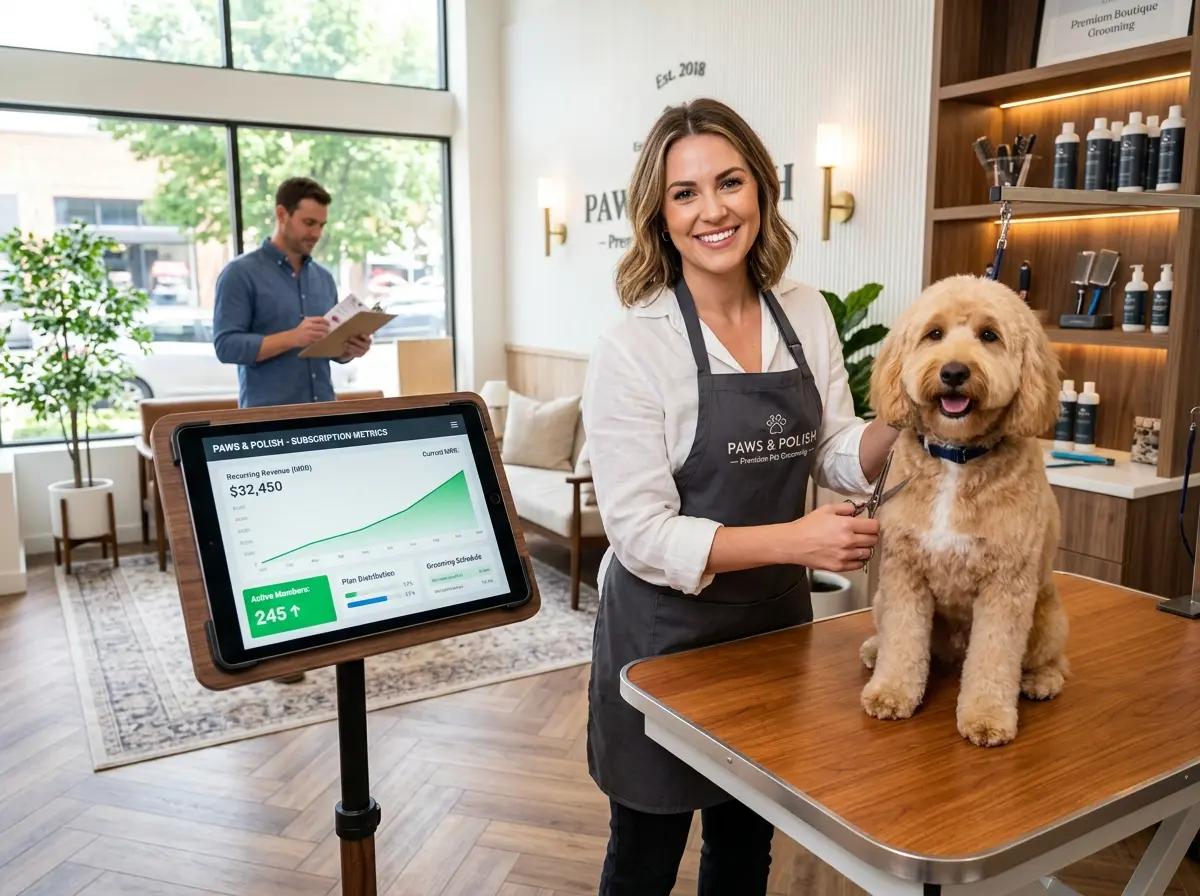
Within six months of launching, over 180 customers had enrolled. That's more than $10,000 in guaranteed monthly revenue before a single walk-in customer had been seen. Priya didn't reinvent her business — she just gave her customers a better reason to stay.
The Psychology Behind Why Subscriptions Work
Here's the slightly uncomfortable truth: subscriptions work partly because of human inertia. Once someone signs up and sets up autopay, they tend to stay signed up — even through the occasional missed appointment or less-than-perfect visit. Studies from McKinsey show that subscription businesses grow revenues roughly 5 times faster than their non-subscription counterparts, and customer lifetime value increases dramatically when churn is managed well.
But beyond inertia, subscriptions also create a genuine psychological shift. Members start to see themselves as part of something — a community, a club, a priority list. That identity connection is incredibly powerful for retention. Priya's VIP clients weren't just customers anymore; they were Bark & Bubbles VIPs, and they told their friends about it.
Tools That Help You Run a Subscription Model Without Losing Your Mind
Managing Member Relationships at Scale
The biggest operational challenge with subscriptions isn't launching them — it's managing them. Who's due for their monthly appointment? Who hasn't booked in six weeks? Which members are using every perk and which are paying but not showing up (a churn risk in disguise)? These questions require systems, and most small businesses don't have great ones.
This is where Stella, the AI robot employee and phone receptionist, can genuinely lighten the load. For grooming salons and other service businesses with a physical location, Stella greets customers at the door, proactively promotes your membership tiers, and answers questions about what each plan includes — without pulling a staff member away from an actual dog. On the phone side, she handles incoming calls 24/7, collects customer information through conversational intake forms, and logs everything into her built-in CRM with AI-generated contact profiles, custom fields, and tags. That means you can tag all your subscribers, track their visit history, and get a real-time picture of your membership health — without building a spreadsheet at midnight.
Designing a Subscription Offer Your Customers Will Actually Buy
Start With Your Most Popular Services, Not Your Entire Menu
One of the most common mistakes business owners make when building a subscription model is trying to package everything. Resist that urge. Your subscription should be built around the services your customers already love and use repeatedly — not the ones you wish they'd buy more of. Look at your transaction history and ask: what do my best customers purchase consistently? That's your subscription core. Everything else becomes an upsell opportunity, which is a much healthier place for it to live.
For Bark & Bubbles, the full groom was the obvious anchor. For a gym, it might be group classes. For a spa, it could be a monthly facial. For a law firm, it might be a monthly retainer covering a set number of consultations. The specific service matters less than the principle: recurring value for a recurring price.
Price for Perceived Value, Not Just Cost Coverage
Subscription pricing is as much art as science. Price too low, and you've just created a discount program that eats your margin. Price too high, and no one signs up. The sweet spot is usually 10–20% below what the same services would cost à la carte, with enough added perks (priority scheduling, exclusive discounts, small freebies) to make the math feel obvious to the customer.
Priya tested her pricing by running a soft launch with her 50 most loyal clients before opening enrollment to everyone. She collected feedback, adjusted one tier, and launched publicly with confidence. That kind of low-stakes validation is available to almost any business owner and is far better than guessing on a spreadsheet.
Make Cancellation Easy — Yes, Really
This one feels counterintuitive, but making it easy to cancel actually reduces cancellations. When customers feel trapped, they get resentful and churn loudly (hello, bad reviews). When they feel in control, they stay longer and churn quietly when they do leave. Be transparent about your cancellation policy, make the process simple, and focus your energy on delivering enough value that cancellation never feels worth the effort. That's the sustainable version of retention — not the kind that relies on confusing billing pages and unanswered emails.
Quick Reminder About Stella
Stella is a friendly AI robot employee and phone receptionist designed for businesses of all sizes, from solo service providers to multi-location retailers. She stands inside your store as a human-sized kiosk, engages walk-in customers, promotes your offers, and answers calls around the clock — all for $99/month with no upfront hardware costs. If you're building a subscription model and need a reliable, always-on presence to promote it and manage incoming inquiries, she's worth a look.
Your Predictable Revenue Era Starts Now
The subscription model isn't a magic trick — it's a structural decision that changes the entire rhythm of your business. Instead of hunting for new customers every week, you build a base of committed ones who fund your operations before you've opened the doors. Instead of riding revenue rollercoasters, you forecast with confidence and invest in growth from a position of stability.
Here's how to get started without overthinking it:
- Audit your top services. Look at what your best customers buy most often and build your subscription core around that.
- Design two or three tiers. Give customers options, but not so many that they freeze. A good, better, best structure works beautifully.
- Test with your loyalists first. Soft-launch to your existing top customers, gather feedback, and refine before going public.
- Set up the right systems. You'll need a way to manage member data, track engagement, and handle incoming questions at scale — so plan for that infrastructure from day one.
- Promote it consistently. A subscription that no one knows about is just a good idea collecting dust. Make sure every customer touchpoint — in-store, online, and over the phone — mentions your membership options.
Priya's dog grooming salon went from monthly revenue anxiety to a business she could actually plan around. The dogs got cleaner. The clients got happier. The Mondays got a lot less stressful. There's no reason your business can't do the same — regardless of whether your customers have four legs or two.