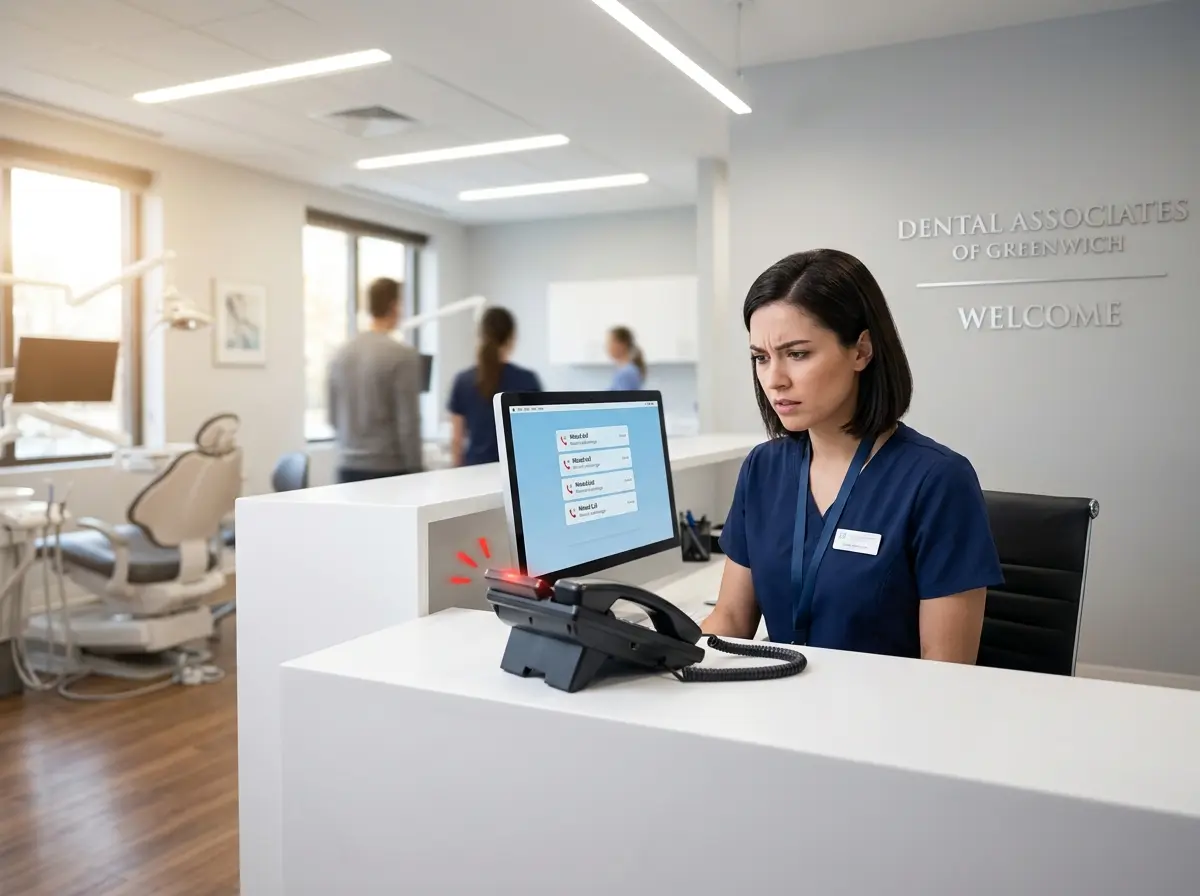
Your Phone Is Ringing. Nobody's Picking Up. Patients Are Leaving.
Here's a scenario that plays out in dental offices across the country every single day: A potential new patient has a toothache. They Google "dentist near me," find your practice, like what they see, and pick up the phone to schedule an appointment. The phone rings. And rings. And rings. Then — the sweet serenade of a voicemail greeting recorded in 2019 kicks in.
They hang up and call the next dentist on the list.
You just lost a patient before they ever sat in your chair. And the worst part? You probably don't even know it happened. According to research from dental industry consultants, up to 35% of new patient calls go unanswered during peak hours, lunch breaks, and after business hours. In a world where patients expect the same instant responsiveness from their dentist as they get from Amazon, that's a business problem masquerading as a staffing inconvenience.
The good news is this is entirely fixable. Let's talk about why your phone situation is costing you new patients — and what a modern dental practice can do about it.
The Real Cost of a Missed Call in Dentistry
New Patients Have Zero Loyalty to Your Hold Music
Unlike your established patients who love Dr. Reynolds and wouldn't dream of switching practices, a new patient calling for the first time has absolutely no emotional attachment to your office. They're shopping. They're comparing. And the moment they hit your voicemail, their thumb is already scrolling to the next Google result. Studies show that nearly 80% of callers who reach a voicemail do not leave a message — they simply move on. So the idea that "they'll just call back" is a comforting myth your front desk staff is telling you, and themselves.
Consider the lifetime value of a dental patient. Between routine cleanings, X-rays, fillings, crowns, whitening treatments, and the occasional emergency visit, a single loyal patient can be worth $1,000 to $5,000 or more over their lifetime with your practice. Multiply that by the number of unanswered calls you get in a week, and suddenly that lunch-break voicemail situation stops feeling like a minor inconvenience.
After-Hours Calls Are Where the Money Sleeps
People don't get toothaches on a schedule. They don't decide to finally fix that chipped tooth during your open office hours. A huge portion of people researching dental care do it in the evenings, on weekends, or during their own lunch breaks — which happen to overlap suspiciously well with yours. If your practice isn't available to capture those inquiries the moment interest strikes, that interest evaporates fast.
The dental practices that are winning new patient acquisition right now aren't necessarily the ones with the fanciest websites or the most Instagram-worthy waiting rooms. They're the ones that answer the phone. It's shockingly unsexy advice, but the data backs it up consistently.
Your Front Desk Staff Is Already Overwhelmed
Let's be honest about something: asking your front desk coordinator to simultaneously check patients in, verify insurance, handle billing questions, manage the schedule, and answer every incoming call with warmth and professionalism is a tall order. They're doing their best, but the multitasking tax is real. When the waiting room is full and two lines are ringing, something gives — and more often than not, it's the incoming new patient call that gets sacrificed for the patient standing right in front of them. That's not a staffing failure. That's a systems failure.
How Modern Dental Practices Are Plugging the Leak
AI Receptionists: The 24/7 Front Desk That Never Calls Out Sick
The smartest thing a dental practice can do right now is stop treating phone coverage as a staffing problem and start treating it as a technology problem — because technology actually has a solution. Stella is an AI robot employee and phone receptionist that answers every call, any time of day, with the same knowledge and professionalism as your best human staff member. She can answer questions about your services, explain your new patient intake process, discuss office hours and insurance policies, collect patient information through conversational intake forms, and even take detailed messages with AI-generated summaries pushed directly to your team. For practices with a physical location, she also functions as an in-office kiosk — greeting patients when they walk in and reducing the load on your front desk during peak hours. Her built-in CRM captures patient contact details and interaction notes automatically, so no new patient inquiry ever falls into a black hole again.
The point isn't to replace your human staff. It's to make sure every single call gets answered — even at 11 PM on a Sunday when someone's crown just fell out and they're stress-eating ice cream.
Fixing Your New Patient Phone Experience From the Ground Up
Audit Where Your Calls Are Actually Going
Before you can fix the problem, you need to understand its scope. Pull your call data — most phone systems and VoIP platforms track missed calls, average answer times, and call volume by time of day. If you don't have that data, that's already telling you something important. Look specifically at calls that came in during lunch (noon to 1:30 PM), after 5 PM, and on weekends. That's where the gap typically lives. Once you see the numbers, the urgency tends to become very real, very quickly.
Rethink Your Hold and Transfer Protocols
Even the calls that do get answered can be handled better. If a new patient is calling to schedule their first appointment and they get put on hold for four minutes, transferred twice, and then asked to call back for insurance verification — congratulations, you've successfully out-inconvenienced the dentist visit itself. New patients are already a little anxious. Make the scheduling process as frictionless as possible.
Some practical improvements worth considering:
- Designate one team member during peak hours whose primary job is answering incoming calls — not double-tasking at the front desk.
- Set a practice-wide standard that new patient calls are never placed on hold for more than 60 seconds without a check-in.
- Use callback scheduling tools so patients can request a specific time to be called rather than waiting on hold.
- Make sure your voicemail — when it does catch a call — includes a direct callback number, your hours, and a warm message that doesn't sound like it was recorded during the Clinton administration.
Train Your Team on New Patient Conversion, Not Just Scheduling
There's a meaningful difference between answering a phone and converting a new patient inquiry. Your front desk team is the first impression of your practice, and how they handle that first call either builds trust or quietly erodes it. Training doesn't need to be elaborate — even a short monthly role-play session where staff practice handling common new patient scenarios (insurance questions, anxiety about procedures, pricing concerns) can make a measurable difference in how many callers actually book.
Patients who feel heard and welcomed during their first phone interaction are significantly more likely to show up for their appointment, less likely to cancel, and more likely to refer friends and family. The phone call isn't just logistics. It's relationship-building before the relationship has even officially started.
Quick Reminder About Stella
Stella is an AI robot employee and phone receptionist built for businesses like yours. She answers calls 24/7, handles patient questions, collects intake information, and keeps your team notified — all for $99/month with no upfront hardware costs. Whether you need her on the phones, in your office as a patient-facing kiosk, or both, she's always ready to work and never puts anyone on hold indefinitely.
Stop Letting the Answering Machine Steal Your Schedule
The dental practices that will thrive over the next decade aren't necessarily the ones with the most sophisticated equipment or the most aggressive marketing budgets. They're the ones that make it easy to become a patient. And right now, for a significant portion of practices, the first and most fixable barrier is the phone.
Here's what you can do this week to start turning things around:
- Pull your missed call report and identify your highest-volume missed call windows.
- Listen to your outgoing voicemail message — seriously, actually listen to it — and update it if it's outdated, cold, or unclear.
- Talk to your front desk team about what's getting in the way of answering calls during busy periods.
- Explore AI phone solutions to cover after-hours, overflow, and lunch-hour gaps without adding headcount.
- Set a goal: every new patient inquiry answered within the same business day, without exception.
New patients are out there looking for a dentist right now. They're calling. The only question is whether someone — or something — is picking up. Make sure the answer is yes.