Introduction: The Waiting Room Isn't the Problem — The Phone Is
Walk into any urgent care clinic on a busy Monday morning and you'll witness a familiar scene: a waiting room full of people who don't feel well, a front desk staff that looks like they haven't slept since Thursday, and a phone ringing so relentlessly you'd think it was personally offended by being ignored. Welcome to the urgent care experience.
Here's the thing — most urgent care operators spend enormous energy optimizing the in-person experience: better signage, faster check-in kiosks, slicker EHR systems. And yet, the patient journey almost always begins before anyone walks through the door. It begins on the phone. And if that phone experience is chaotic, rushed, or staffed by someone who's also simultaneously checking in walk-ins and answering insurance questions, you're already starting on the wrong foot.
A well-designed patient pre-registration phone flow changes that. It transforms your incoming calls from a fire drill into a streamlined intake process that saves time, reduces front desk stress, improves patient satisfaction, and — not insignificantly — makes your clinic look like it has its act together. Let's talk about how to build one that actually works.
The Case for Pre-Registration: Why It Matters More Than You Think
The Hidden Cost of Unstructured Intake
Every time a patient calls your clinic without a structured intake process in place, your front desk staff is essentially performing an improvised juggling act. They're collecting the patient's name, reason for visit, insurance information, and date of birth — all while manually entering data, answering follow-up questions, and trying to give the caller the impression that they are the only person who matters right now. It's a lot to ask of anyone, let alone someone managing a lobby full of impatient patients.
The operational cost of this inefficiency is real. Studies have shown that unstructured patient intake can add 5–10 minutes of administrative work per patient — and in an urgent care setting seeing 60 to 100 patients per day, that adds up fast. You're not just losing time; you're losing accuracy. Rushed data entry leads to typos, missing insurance details, and incorrect contact information that creates downstream billing headaches nobody wants to deal with.
What a Pre-Registration Flow Actually Looks Like
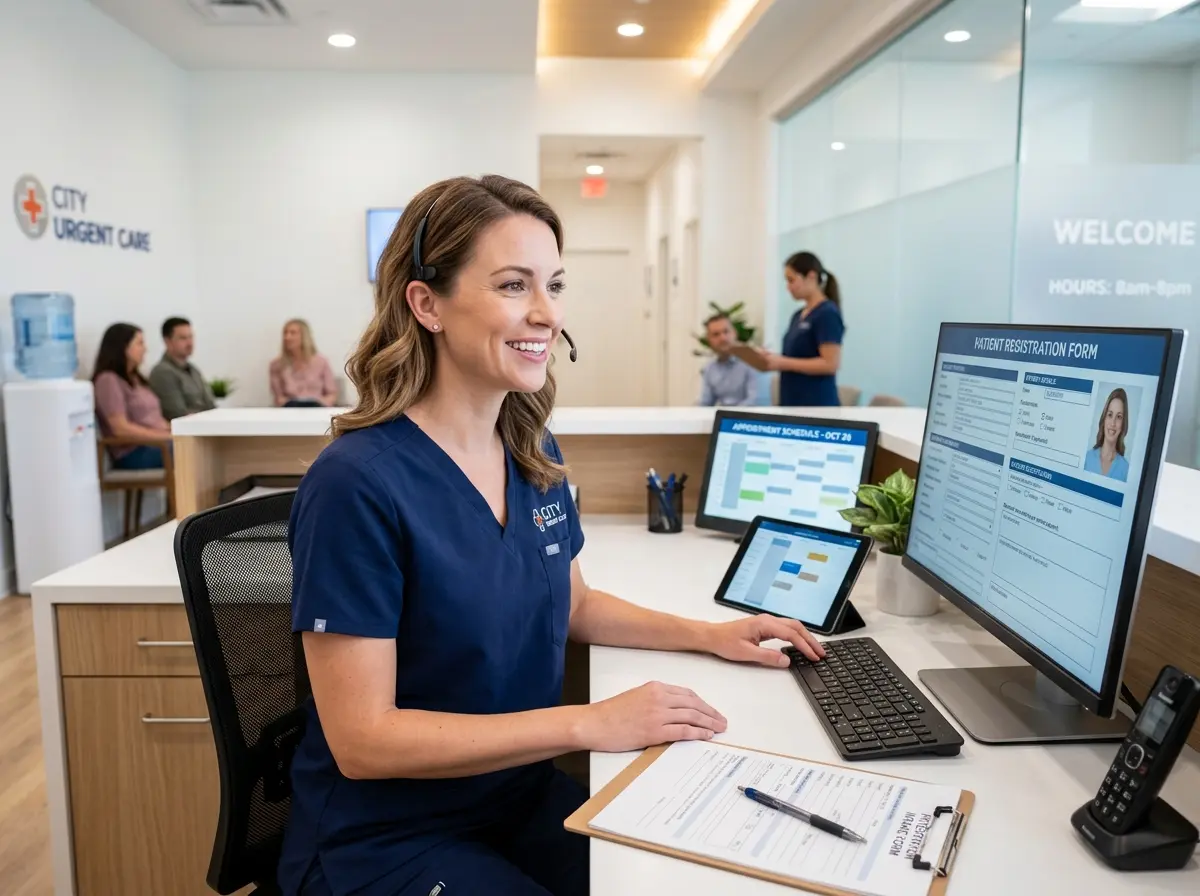
A pre-registration phone flow is simply a scripted, structured sequence of questions and responses that guides the caller through the intake process before they ever arrive at your clinic. Done well, it collects the essential information you need — patient demographics, reason for visit, insurance carrier and ID, primary care physician if applicable, consent acknowledgments, and estimated arrival time — and deposits it cleanly into your system so your front desk can greet them by name and get right to work.
The key word here is structured. This isn't about being robotic or cold. It's about ensuring that every caller, regardless of which staff member picks up the phone, receives the same consistent, professional experience. Your intake process shouldn't change depending on whether it's 9 AM on a Tuesday or 6 PM on a Friday. Patients don't care what day it is — they just want to know you're ready for them.
The Patient Experience Payoff
Here's something urgent care operators sometimes overlook: patients who pre-register report significantly higher satisfaction scores. Why? Because it signals competence. When someone arrives at your clinic and the front desk already has their information, it communicates that your operation is organized, professional, and respectful of their time. For a patient who's feeling miserable and anxious, that experience is worth its weight in five-star Google reviews.
How Technology — Including AI — Can Handle the Heavy Lifting
Automating Intake Without Losing the Human Touch
You might be thinking, "Great, but who's actually going to run this pre-registration flow consistently?" Fair point. Staffing is arguably the biggest operational challenge facing urgent care clinics today. Turnover is high, training takes time, and asking your front desk to simultaneously manage walk-ins and execute a structured phone intake process is a recipe for burnout and errors.
This is exactly where AI-powered phone tools earn their keep. Stella, an AI robot employee and phone receptionist, can handle inbound calls 24/7, walking patients through a fully customizable pre-registration flow using natural, conversational language. She asks the right questions in the right order, collects the patient's information through built-in conversational intake forms, and logs everything directly into her integrated CRM — complete with AI-generated contact profiles, custom fields, and tags. No manual data entry, no missed fields, no "sorry, can you repeat that?" while simultaneously checking in a walk-in. When a call requires human attention — say, a patient with a complex insurance question or a medical concern that needs clinical judgment — Stella can forward the call to your staff based on configurable conditions. For urgent care clinics with a physical location, she also greets patients at the door as an in-store kiosk, ensuring the experience is seamless from first contact to final checkout.
Building a Pre-Registration Flow That Actually Works
The Essential Elements of a Strong Intake Script
A good pre-registration script is thorough without being exhausting. You want to collect everything you need — and nothing you don't. At minimum, your flow should capture the following:
- Patient name and date of birth — for identification and record matching
- Reason for visit — helps staff prepare and can triage urgency
- Insurance information — carrier name, member ID, and group number
- Contact number and preferred callback method
- Estimated arrival time — allows staff to manage flow and reduce lobby congestion
- Any known allergies or current medications (optional but valuable)
The tone matters, too. Patients calling urgent care are often stressed, in pain, or worried. Your intake script should be warm and efficient — not overly formal, not overly casual. A simple, "We want to make sure everything is ready for you when you arrive" goes a long way toward putting someone at ease.
Handling Edge Cases Without Derailing the Flow
Not every call is a straightforward pre-registration. Some patients won't have their insurance card handy. Others will have questions about wait times, accepted insurances, or services you offer. Some will call in a panic because a child has a high fever and they just want to know if they should come in right now. Your flow needs to be designed with these scenarios in mind.
The solution is branching logic — a fancy way of saying your script has pre-built responses for common detours. If a patient doesn't have their insurance information, your flow should gracefully collect what they do have and let them know they can bring the card when they arrive. If someone asks about wait times, the flow should provide a realistic estimate or direct them to your online wait tracker if you have one. The goal is to keep the conversation moving productively, not to trap patients in a loop that makes them want to hang up and try the urgent care down the street.
Connecting Pre-Registration to Your Broader Operations
Pre-registration data is only valuable if it actually gets used. That means your intake flow needs to connect — either directly or through a clean handoff — to your EHR, your front desk workflow, and your staff communication system. If a patient pre-registers at 7 AM for a 10 AM visit but that information is sitting in a voicemail nobody has listened to, you've achieved exactly nothing.
Think through the full data journey: Where does the information go after it's collected? Who reviews it, and when? How does it get flagged for staff who need to act on it before the patient arrives? Build those processes before you launch your flow, or you'll have a shiny intake system feeding into a black hole. Push notifications, CRM tags, and AI-generated intake summaries can all help ensure that pre-registered patients receive a noticeably better experience than walk-ins — which is the whole point.
Quick Reminder About Stella
Stella is an AI robot employee and phone receptionist built for businesses that want a professional, always-available front-of-house presence without the overhead of additional staff. She answers calls 24/7, conducts conversational intake, manages a built-in CRM, and — for clinics with a physical location — greets patients in person as a human-sized AI kiosk. At just $99/month with no upfront hardware costs, she's one of the most practical tools an urgent care operator can add to their front desk arsenal.
Conclusion: Stop Letting the Phone Be Your Weakest Link
Your urgent care clinic is only as efficient as its most chaotic touchpoint — and right now, for most clinics, that touchpoint is the phone. A well-designed patient pre-registration flow doesn't just reduce front desk stress (though it absolutely does that). It speeds up check-in, improves data accuracy, elevates the patient experience, and gives your staff the breathing room to actually focus on care rather than frantic data collection.
Here's how to get started:
- Audit your current phone intake process. Time it. Count the fields you're collecting. Identify where staff improvise and where information gets lost.
- Draft a structured intake script with branching logic for the most common call scenarios at your clinic.
- Choose a tool to run the flow consistently — whether that's a trained staff member following a script, an AI phone receptionist, or a combination of both.
- Map the data journey from intake to front desk to clinical staff so collected information is actually used.
- Measure the results. Track average call handling time, front desk data entry errors, patient satisfaction scores, and lobby wait times before and after implementation.
Your patients are already dealing with the inconvenience of not feeling well. The least you can do is make sure the experience from "first phone call" to "seen by a provider" is as smooth as humanly — or artificially intelligently — possible.