You Have About 30 Seconds — Make Them Count
Here's a scenario that plays out in retail stores across the country every single day: A customer walks in, glances around, gets zero acknowledgment from anyone, pokes at a display for ninety seconds, and walks back out. No purchase. No conversation. No reason to return. Just another piece of foot traffic that evaporated into the void while your staff was busy restocking shelves or chatting in the back.
Retail conversion — the art of turning browsers into buyers — is one of the most underestimated challenges in physical retail. The average retail conversion rate hovers somewhere between 20% and 40%, which sounds reasonable until you realize it means that most people who walk into your store leave without buying anything. That's not a foot traffic problem. That's a conversion problem, and it's almost entirely fixable.
The good news? You don't need a massive overhaul, a six-figure consultant, or a personality transplant. You need a smarter first five minutes — and a clear strategy for what happens when a customer crosses your threshold. Let's break it down.
The Psychology of the In-Store Decision
Before you can convert a browser into a buyer, it helps to understand what's happening in their head the moment they walk through your door. Spoiler: it's not "I am ready to spend money." It's closer to "convince me this was worth stopping for."
First Impressions Are Doing the Heavy Lifting
Research from the retail consulting world consistently shows that customers form an opinion about a store within the first 8 to 10 seconds of entry. That opinion determines whether they relax and browse or stay guarded and ready to bolt. A warm, immediate acknowledgment — even something as simple as eye contact and a smile — signals that this is a place where people are welcome. The absence of that signal sends the opposite message, regardless of how beautiful your merchandising is.
The challenge, of course, is consistency. Your best employee greets every customer like they're a long-lost friend. Your second-best does it most of the time. And then there's the rest of the shift, when everyone's slammed, and customers are walking in to the sound of absolute silence. Consistency is where the conversion gap lives.
The "Just Browsing" Barrier and How to Lower It
We've all said it. "Just browsing, thanks." It's practically a reflex — a polite way of saying "don't follow me around the store." The problem is that many retail staff interpret this as a full stop: back off and let them be. But the data tells a different story. Customers who receive a second, well-timed interaction — not immediate and hovering, but natural and helpful — are significantly more likely to purchase than those left entirely alone.
The sweet spot is re-engagement around the 60-to-90-second mark, ideally triggered by what the customer is looking at, not just a generic "find everything okay?" The goal is to move from transactional ("Can I help you?") to consultative ("That's one of our most popular items — are you shopping for yourself or as a gift?"). One opens a door. The other starts a conversation.
Environment Sells When Your Staff Can't
Signage, layout, and sensory experience all contribute to conversion in ways that don't require a single word from your team. Clear promotional messaging at eye level, logical product groupings that encourage discovery, and an environment that feels curated rather than chaotic all reduce friction in the buying decision. If a customer has to work hard to figure out your pricing, your promotions, or where anything is — they'll often just leave rather than ask.
Putting Technology to Work at the Point of Entry
Here's where things get interesting for retail owners who are tired of relying entirely on human consistency to drive conversions. There's a meaningful role that smart technology can play — not to replace your team, but to make sure every single customer who enters your store gets an immediate, engaging, informed welcome.
Let an AI Employee Handle the First Hello
Stella is a human-sized AI robot kiosk designed to stand inside your store and greet every customer who walks in — proactively, consistently, and without ever having a bad day. She can talk naturally with customers about your products, current promotions, and specials, functioning as an always-on brand ambassador who doesn't disappear into the back room. For retail environments where that first 30-second window is make-or-break, having a guaranteed, knowledgeable point of contact at the entry can meaningfully shift your conversion numbers.
Beyond the in-store experience, Stella also answers your phone calls around the clock — which matters more than people think. A customer who calls to ask about a product or your hours and gets no answer doesn't usually call back. They Google a competitor. Stella handles those calls with the same business knowledge she uses in person, and can forward to human staff when needed or take detailed AI-summarized voicemails so nothing falls through the cracks.
The 5-Minute Conversion Framework (Actually Actionable)
Enough theory — here's what the first five minutes of a customer's in-store experience should look like if you want to move the conversion needle without hiring a coach or redesigning your entire operation.
Minute One: Acknowledge Without Ambushing
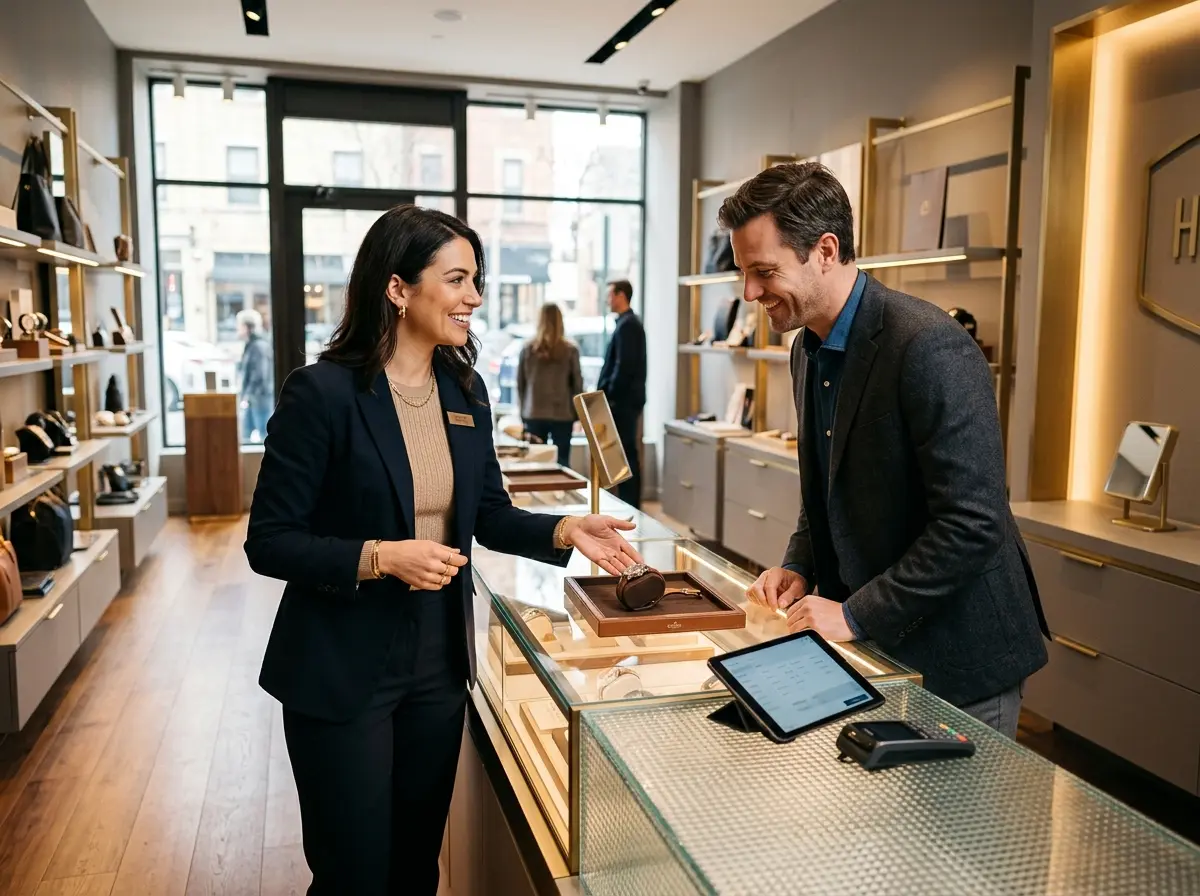
The moment a customer enters, someone — or something — should acknowledge them. Not with a sales pitch, not with "Are you looking for anything specific today?" but with a genuine, low-pressure welcome. This can be a staff member, or it can be a well-positioned technology touchpoint. The goal is simple: the customer should feel seen. That micro-moment of recognition lowers their guard and buys you the next four minutes.
Minutes Two Through Three: Create a Reason to Explore
This is where your environment and your team work together. During this window, a customer is orienting themselves — mentally mapping your store and deciding whether it's worth their time. A brief, natural mention of something timely helps here enormously. Phrases like "We just got new arrivals in the back" or "Our buy-two promotion is running through the weekend" give the customer a reason to stay and look further rather than completing a quick visual scan and heading for the exit. Promotions only convert if customers know about them. Don't assume the signage alone is doing the job.
Minutes Four and Five: The Consultative Re-Engagement
If a customer has made it three minutes in without purchasing, they're interested — they just haven't found their moment yet. This is the window for a second, smarter touchpoint. Train your staff to observe before they approach: What is the customer holding? What section are they in? What's their body language? A comment that connects directly to what they're looking at — "That one comes in two other colors, and the matte finish is really popular" — feels helpful rather than pushy. It also subtly signals product knowledge, which builds trust faster than any promotional sign ever will.
At the end of those five minutes, a customer should know about at least one promotion, have had at least two positive human interactions, and feel like the store understood what they were looking for. That's the conversion formula. Simple in concept, genuinely difficult in execution — which is exactly why most stores don't hit it consistently.
Quick Reminder About Stella
Stella is an AI robot employee and phone receptionist built for businesses of all kinds — retail, restaurants, service providers, and more. She stands inside your store engaging customers and promoting your offerings, while simultaneously being available to answer phone calls 24/7 with the same expertise. At $99/month with no upfront hardware costs, she's one of the more practical ways to add a reliable, knowledgeable presence without adding to your payroll headaches.
Turn Your Foot Traffic Into Revenue — Starting This Week
The gap between the customers who walk into your store and the customers who actually buy something is not a mystery. It's a process problem, and process problems are solvable. Start by auditing your own first-five-minute experience — walk in as a customer would and notice what happens. Are you greeted? Are promotions communicated? Does anyone circle back naturally, or does the first "just browsing" response end all contact?
From there, build the habits and systems that make a great customer experience repeatable, not dependent on who's working that afternoon. Train your team on the consultative re-engagement approach. Make your promotions impossible to miss. Consider where technology can fill the consistency gaps that even your best staff can't always cover. And take your phone calls seriously — every unanswered call is a potential customer who decided your competitor was easier to reach.
Retail isn't dying. Mediocre retail experiences are dying. The businesses winning in physical retail right now are the ones that treat every walk-in as an opportunity worth capturing — because it is. You already paid for that foot traffic through your rent, your marketing, and your location. Converting it is just good business sense.