Introduction: The Couch Commitment Problem
Selling furniture is, in many ways, an act of psychological warfare — a friendly one, of course, but warfare nonetheless. Your customer walks into your showroom, sits on a gorgeous sectional, falls completely in love with it, and then says the four words every furniture sales associate dreads: "I need to think about it." Translation: they're going home, they're going to measure their living room with a tape measure they can't find, they're going to argue with their spouse about whether it's "too big," and then they're going to buy something cheaper from a big-box store because they couldn't visualize how yours would actually look in their space.
It doesn't have to be this way. Augmented reality (AR) has quietly matured from a gimmicky tech novelty into a genuinely powerful sales tool for furniture retailers — one that directly addresses the single biggest obstacle to closing: the inability to picture the product at home. According to a study by Deloitte, 71% of shoppers say they would shop more often if AR were available, and IKEA reported a significant reduction in returns after launching its AR-enabled Place app. The furniture industry, with its large price points and highly personal purchase decisions, is arguably the industry most poised to benefit from this technology.
This guide is here to help you understand how AR works in a furniture retail context, how to implement it without needing a computer science degree or a venture capital budget, and how to use it as a genuine competitive edge — not just a cool demo you show off at trade shows.
Understanding AR in the Furniture Sales Context
What AR Actually Does (and Doesn't Do)
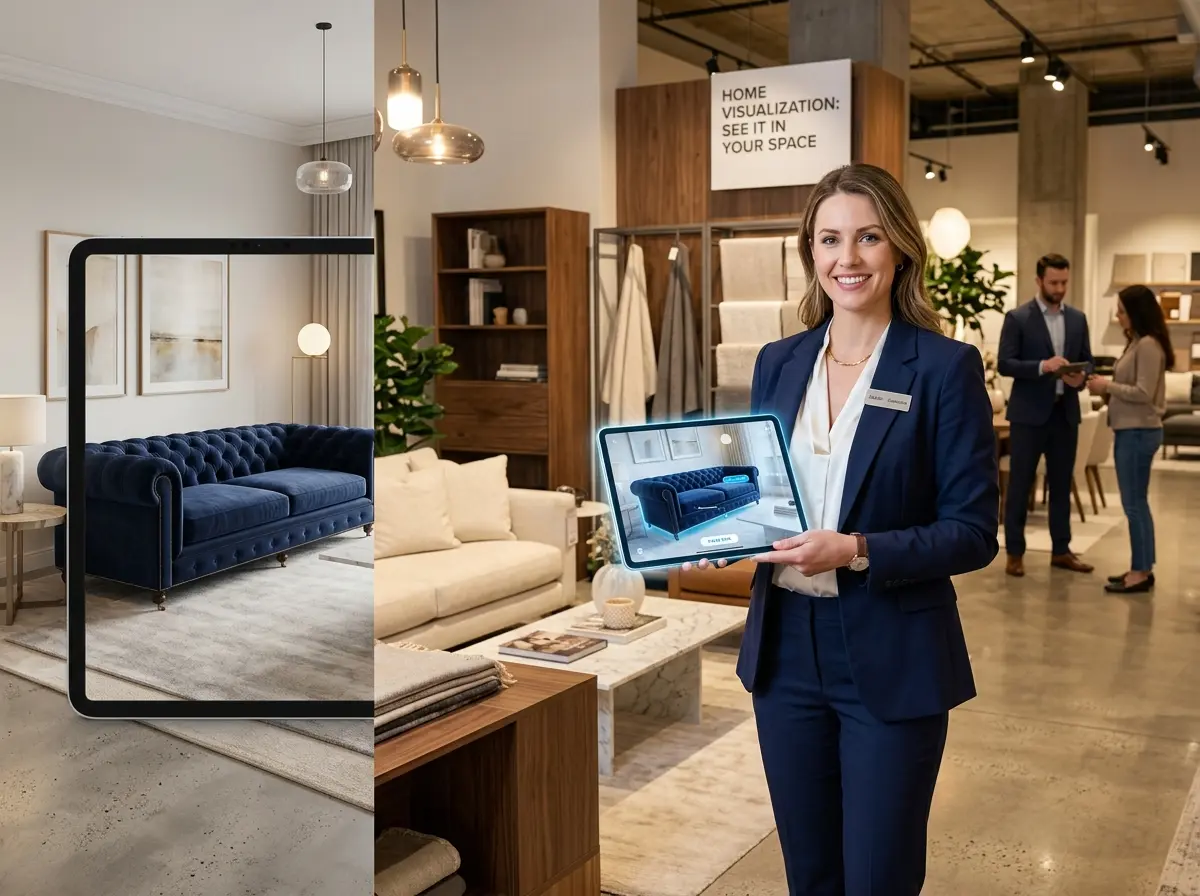
Let's clear something up right away: augmented reality is not virtual reality, and it doesn't require your customers to strap on a headset that makes them look like they're auditioning for a sci-fi film. In the furniture context, AR typically works through a smartphone or tablet camera. The customer points their device at their living room, bedroom, or home office, and the app overlays a 3D model of the product — scaled to actual dimensions — into the live camera view. They can walk around it, spin it, swap out colors or fabrics, and take a screenshot to show their partner or designer.
What AR doesn't do is close the sale for you. It's a visualization tool, not a salesperson. It removes friction, builds confidence, and dramatically shortens the decision-making cycle — but the human connection, the product knowledge, and the relationship still matter enormously. Think of AR as handing your customer a really good map. They still have to want to make the journey.
The Platforms and Tools Worth Knowing About
You don't need to build a custom AR app from scratch (though that's an option). Several established platforms cater specifically to furniture and home décor retailers:
- IKEA Studio / IKEA Place — A benchmark example of retail AR done well, great for inspiration even if you're not IKEA.
- Shopify AR — If your store runs on Shopify, you can upload 3D models and enable AR product viewing with relatively little technical lift.
- Vertebrae / Vntana — Enterprise-grade 3D and AR platforms that integrate with e-commerce and in-store displays.
- Marxent — Specializes in furniture and home furnishings AR, with robust room planning features.
- RoomSketcher / Planner 5D — More accessible tools for smaller retailers that let customers design entire rooms, not just place individual pieces.
The right platform depends on your inventory size, your e-commerce setup, and your budget. Many of these services offer free trials or tiered pricing that makes them accessible for independent furniture retailers — not just the national chains with eight-figure marketing budgets.
Getting Your Products into 3D
Here's where most smaller retailers hit a wall: AR requires 3D models of your products, and creating them takes effort. Your options range from hiring a 3D modeling freelancer (often $50–$200 per piece, depending on complexity) to using photogrammetry apps that generate models from a series of smartphone photos. Some manufacturers are now providing 3D assets directly to their retail partners, so it's absolutely worth asking your vendors whether they already have these files available. Many do, and they're just not advertising it loudly.
Start with your top 20 bestsellers and highest-margin pieces. You don't need your entire catalog in 3D on day one — you need enough to make the experience feel meaningful and to test what actually moves the needle on conversions.
Integrating AR into Your In-Store and Digital Experience
Making AR a Seamless Part of the Sales Floor
AR works best when it doesn't feel like an interruption — when it's a natural extension of the conversation between your staff and your customer. Train your team to introduce the AR feature early in the discovery process, right after a customer expresses interest in a piece. Phrases like "Would you like to see how that looks in your room before you decide?" tend to land well because they remove pressure while adding value.
Consider setting up a dedicated AR station or demo area in your showroom with tablets pre-loaded and ready to go. Customers who can experiment independently — without needing a staff member to hold their hand — are often more willing to engage. Make the experience self-service where possible, and staff-assisted where the product complexity warrants it.
This is also where Stella, the AI robot employee and phone receptionist, can lend a hand — or, technically, a screen. Stella's in-store kiosk presence means she can greet customers as they walk in, proactively introduce AR features, and guide them toward trying the visualization tool — all without pulling a salesperson away from an active conversation. On the phone side, she handles incoming calls 24/7, meaning a customer who calls after hours to ask "do you have an AR app I can use at home?" gets a real, knowledgeable answer instead of a voicemail. It's a small thing that adds up to a noticeably more professional experience.
Turning Visualization into Conversion
Bridging the Gap Between "I Love It" and "I'll Take It"
The moment a customer has successfully visualized your sofa in their living room via AR is a golden moment — and most furniture retailers let it slip through their fingers. The customer says "Oh wow, that actually looks amazing," and then... nothing. The energy dissipates. Don't let that happen. Train your team to treat the AR visualization as a soft close, not a product demo. Follow up immediately with specifics: lead times, financing options, current promotions, and what happens next. The emotional high of seeing the product in their space is fleeting; capitalize on it while it's there.
If the customer isn't ready to buy in-store, make sure they leave with something concrete — a saved AR screenshot, a shared link to the product page with the AR view enabled, or a follow-up email that includes both. You want the visualization to follow them home and keep working for you after they've left the building.
Using AR Data to Understand Your Customers Better
Many AR platforms provide analytics: which products get visualized most, how long customers spend in the AR experience, what configurations they select. This is genuinely useful data. If customers consistently try out a particular sofa in AR but rarely convert, that's a pricing or messaging problem worth investigating. If a product that rarely gets floor traffic is frequently visualized via AR, that's a signal to give it better physical placement or more promotional attention.
Layer this behavioral data alongside your sales data and customer feedback, and you start building a much clearer picture of where hesitation lives in your sales funnel — and where AR is genuinely removing it versus where other barriers remain.
AR as a Post-Purchase Confidence Builder
One underused application of AR in furniture retail is the post-purchase experience. Buyers who feel confident they made the right choice are less likely to cancel orders, request returns, or leave lukewarm reviews. Sending a post-purchase email with a link to the AR view — framed as "want to start planning the rest of the room around your new piece?" — reinforces their decision, reduces buyer's remorse, and opens the door to additional sales. It's cross-selling with good manners.
Quick Reminder About Stella
Stella is an AI robot employee and phone receptionist built for businesses like yours. She stands in your store as a friendly, knowledgeable kiosk presence — greeting customers, answering questions, promoting deals, and keeping things moving without demanding a paycheck or a lunch break. She also answers your phones around the clock, handles voicemails with AI-generated summaries, and keeps your customer information organized through a built-in CRM. At $99/month with no upfront hardware costs, she's one of the more straightforward investments a retail business can make.
Conclusion: Stop Losing Sales to Imagination Gaps
The furniture industry has always suffered from one core problem: customers are asked to make expensive, emotionally loaded decisions based on their ability to mentally transport a showroom piece into their home. Augmented reality doesn't solve every challenge in furniture sales, but it does solve that one — and that's not a small thing. Reduced hesitation, fewer returns, stronger conversion rates, and a more memorable in-store experience are all legitimate, documented outcomes from retailers who have committed to AR as part of their sales process.
Here's what to do next: pick your top-selling or highest-margin pieces, reach out to your vendors about existing 3D assets, and evaluate one or two AR platforms with a free trial. Don't aim for perfection out of the gate — aim for a version that works well enough to test. Train your floor staff to introduce AR naturally and to use the visualization moment as a transition to the close. Build AR links into your follow-up emails and post-purchase communications. And if you want to make sure your store is consistently presenting all of this — along with your current promotions and product knowledge — to every customer who walks through the door or calls your number, take a serious look at what an AI assistant like Stella can do for you.
The gap between your showroom and your customer's living room has never been smaller. It's time to close it.