Introduction: The Callback Black Hole Is Costing You Customers
Picture this: a homeowner's pipe bursts on a Saturday evening. They call three HVAC and plumbing companies. Two of them send the call to voicemail. One of them promises — promises — a callback within the hour. Three hours later, the homeowner has already hired the one company that actually picked up, and the other two businesses have no idea they just lost a paying customer. They're still thinking they'll call back "in a bit."
This is the callback black hole, and it is absolutely devouring revenue in the home services industry. According to research from Lead Response Management, the odds of qualifying a lead drop by over 80% if you wait longer than five minutes to respond. Five minutes. Yet most home service businesses — plumbers, HVAC techs, roofers, electricians, landscapers — are operating with skeleton crews, working in the field all day, and relying on "we'll get back to you" as a customer retention strategy. Spoiler: it's not working.
The good news is that building a callback promise system that customers actually trust isn't some corporate pipe dream reserved for big franchises. It's a series of intentional choices about how you communicate, what you commit to, and how you follow through — every single time. Let's break it down.
Why Your Current Callback System Is Probably Broken
The Trust Gap Between Promise and Reality
Most home service businesses don't have a callback system — they have a callback intention. There's a big difference. An intention is "we try to call people back the same day." A system is a defined workflow with accountability, tracking, and consistent execution regardless of how chaotic the job site gets. When customers experience the gap between your promise and your reality, they don't assume you're busy. They assume you don't care. And in a service industry built almost entirely on trust, that's a catastrophic impression to leave.
The frustrating part is that most business owners genuinely do care. The breakdowns happen in the handoff — the moment between a customer leaving a message and someone on your team actually following up. That handoff is where leads go to die.
What Customers in Home Services Actually Expect
Home service customers are increasingly conditioned by the speed of e-commerce and on-demand apps. They expect acknowledgment fast — not necessarily a full solution, but contact. Research from HubSpot found that 90% of customers rate an "immediate" response as important or very important when they have a service question, with "immediate" typically meaning within 10 minutes.
Here's the kicker: your competitors probably aren't meeting that bar either. Which means the first business to build a reliable, trustworthy callback promise system in their local market has a genuine competitive advantage — not just a marginal one, but a significant one.
The Real Cost of a Missed Callback
Let's do some quick math. If your average job is worth $400 and you're missing just five callback opportunities per week due to poor follow-up, that's $2,000 in lost weekly revenue. Over a year, you're looking at over $100,000 walking out the door — not because your work is bad, but because your phone game is. That number has a way of clarifying priorities pretty quickly.
Building the System: How Stella and Smart Processes Work Together
Start With the Acknowledgment Layer
The first element of any trustworthy callback promise system is immediate acknowledgment — letting the customer know their request was received the moment it comes in. This is where most small home service businesses struggle hardest, because they simply can't staff a phone line 24/7. That's exactly where Stella, the AI robot employee and phone receptionist, fills a critical gap. Stella answers every call with the same professional, informed presence regardless of whether it's 2 PM on a Tuesday or 11 PM on a holiday weekend. She collects customer information through conversational intake forms right on the call — name, address, nature of the problem, urgency level — and pushes an AI-generated summary notification to your managers immediately. The customer hangs up feeling heard. Your team wakes up to a fully organized lead. That's your acknowledgment layer, solved.
For businesses with a physical location — think showrooms for window companies or flooring retailers — Stella's in-store kiosk presence means walk-in customers are greeted and engaged proactively too, with all that information flowing into her built-in CRM automatically.
Define Your Promise — Then Actually Keep It
Once acknowledgment is handled, you need to define a callback promise you can actually keep. Not the one that sounds impressive, but the one your team can execute consistently on your worst day. For most home service businesses, a realistic and trustworthy promise looks something like this: urgent issues within 1 hour, standard inquiries within 2–4 business hours, after-hours requests by 8 AM the next morning. Post this promise on your website, say it in your voicemail greeting, and have Stella communicate it during every call. A promise stated clearly and kept consistently is worth more than a vague "we'll get back to you soon."
The Three Pillars of a Trustworthy Callback Promise
Pillar One: Speed and Consistency
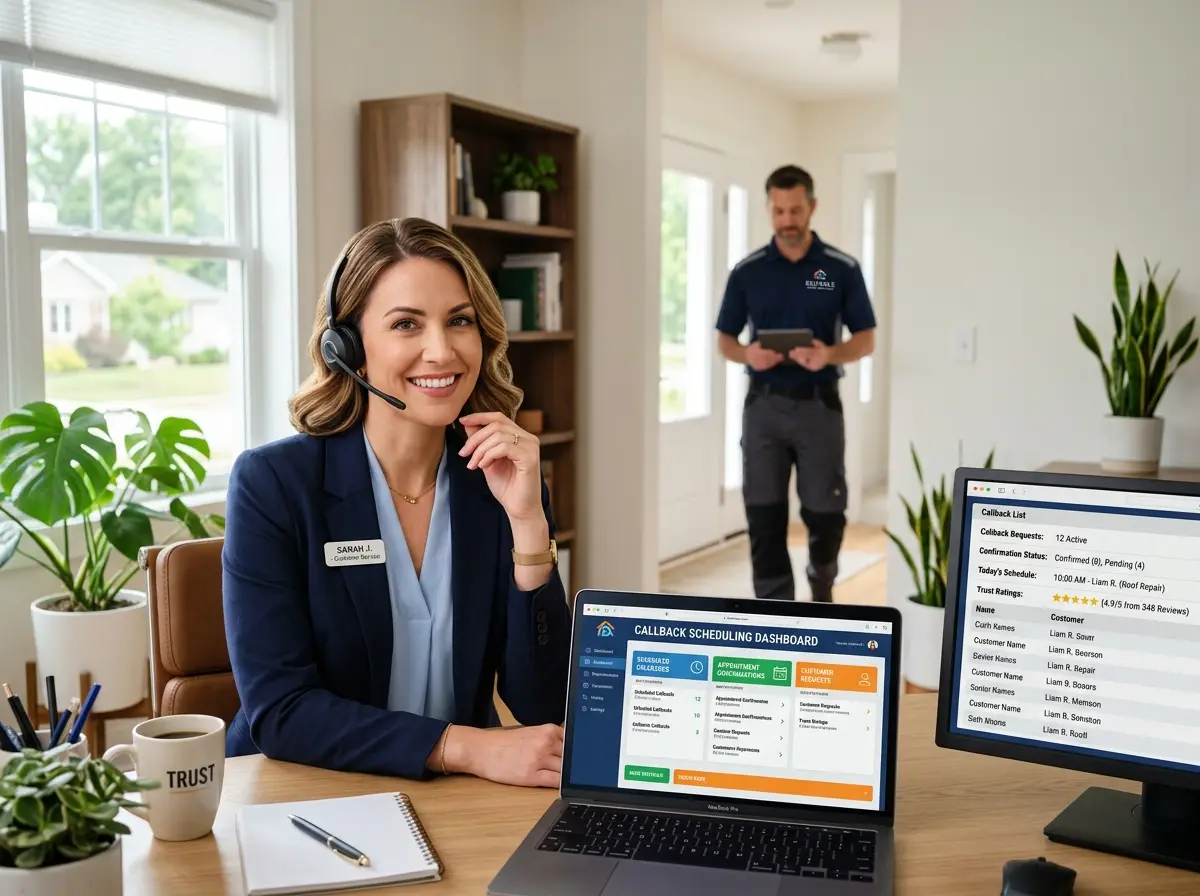
Speed matters, but consistency matters more. A customer who receives a callback in 45 minutes once and four hours the next time has no idea what to expect from you — and unpredictability feels unreliable. Build your callback workflows around your slowest likely response time, not your fastest. Set internal response timers, assign callback ownership to specific team members, and use your CRM to track whether follow-ups actually happened. If a lead falls through the cracks, you want to catch it in your system — not when you read a one-star review three weeks later.
Pillar Two: Transparent Communication Throughout
One of the most underrated moves in home services is the proactive status update. If you said you'd call back in two hours and something came up, send a quick text: "Hey, this is Mike from [Company]. We're finishing up a job and will call you by 4 PM — we haven't forgotten you." That one message does more for customer trust than a dozen five-star reviews. Customers aren't necessarily upset when things take longer than expected. They're upset when they feel ignored. Transparent communication eliminates that feeling entirely.
Pillar Three: Closing the Loop After Every Contact
A callback promise system doesn't end when you make the call — it ends when the customer's need is fully resolved and documented. After every callback, log the outcome in your CRM: Did they book? Did they need more time? Did they go with a competitor? These notes aren't just good record-keeping; they're a goldmine for improving your sales process over time. Patterns in lost leads can reveal pricing objections, availability gaps, or communication breakdowns that you'd otherwise never see. The businesses that close this loop consistently are the ones that improve fastest.
Quick Reminder About Stella
Stella is an AI robot employee and phone receptionist that answers calls 24/7, greets in-store customers, collects lead information through conversational intake forms, and manages contacts through a built-in CRM — all for $99/month with no upfront hardware costs. She's always on, always professional, and never accidentally puts a customer on hold for eight minutes while looking for a pen.
Conclusion: Stop Losing Jobs to Your Voicemail
Building a callback promise system that customers actually trust comes down to three things: acknowledge fast, commit honestly, and follow through every time. None of this requires a massive team or a corporate budget. It requires intentional process design and the right tools to fill the gaps — especially after hours, when the jobs that get booked first are often the ones that matter most.
Here are your actionable next steps to get started this week:
- Audit your current callback rate. For the next two weeks, track every inbound call or inquiry and how long it takes your team to respond. The data will be humbling and motivating in equal measure.
- Write your callback promise. Define specific timeframes for urgent versus standard inquiries, and post them publicly on your website and in your phone greeting.
- Close the handoff gap. Whether that's through an AI phone receptionist like Stella, a dedicated office staff member, or a structured on-call rotation, make sure every inbound lead is captured and routed immediately — not "when someone gets a chance."
- Start logging outcomes. Every callback should have a result logged in your CRM. Booked, lost, pending, or follow-up needed. Build this habit now and it will pay dividends for years.
Your customers aren't asking for miracles. They're asking to feel like they matter to your business. A trustworthy callback system is how you show them — consistently, professionally, and without needing a clone of yourself — that they absolutely do.