Your Medical Practice Deserves More Than a Folding Table and a Candy Bowl
Every year, community health fairs pop up across neighborhoods, schools, churches, and corporate campuses — and every year, dozens of medical practices show up, set out some brochures, and wonder why they're not seeing a surge of new patients afterward. If this sounds familiar, you're not alone. The health fair circuit can feel like a lot of effort for very little return, especially if your booth strategy begins and ends with a bowl of sugar-free candy and a stack of business cards no one will ever call.
Here's the good news: community health fairs are actually a goldmine for patient acquisition — if you approach them with intention. Studies show that consumers are up to 60% more likely to choose a healthcare provider they've met in person, and health fairs are one of the few environments where potential patients are already primed to think about their health. That's a gift. The problem isn't the venue. It's the strategy.
This post is going to walk you through how to build a health fair presence that actually generates new patients — from pre-event planning to post-event follow-up — without requiring you to become a carnival barker or spend your entire marketing budget on a single Saturday morning.
Building a Booth Experience That Actually Attracts People
Stand Out Before They Even Reach You
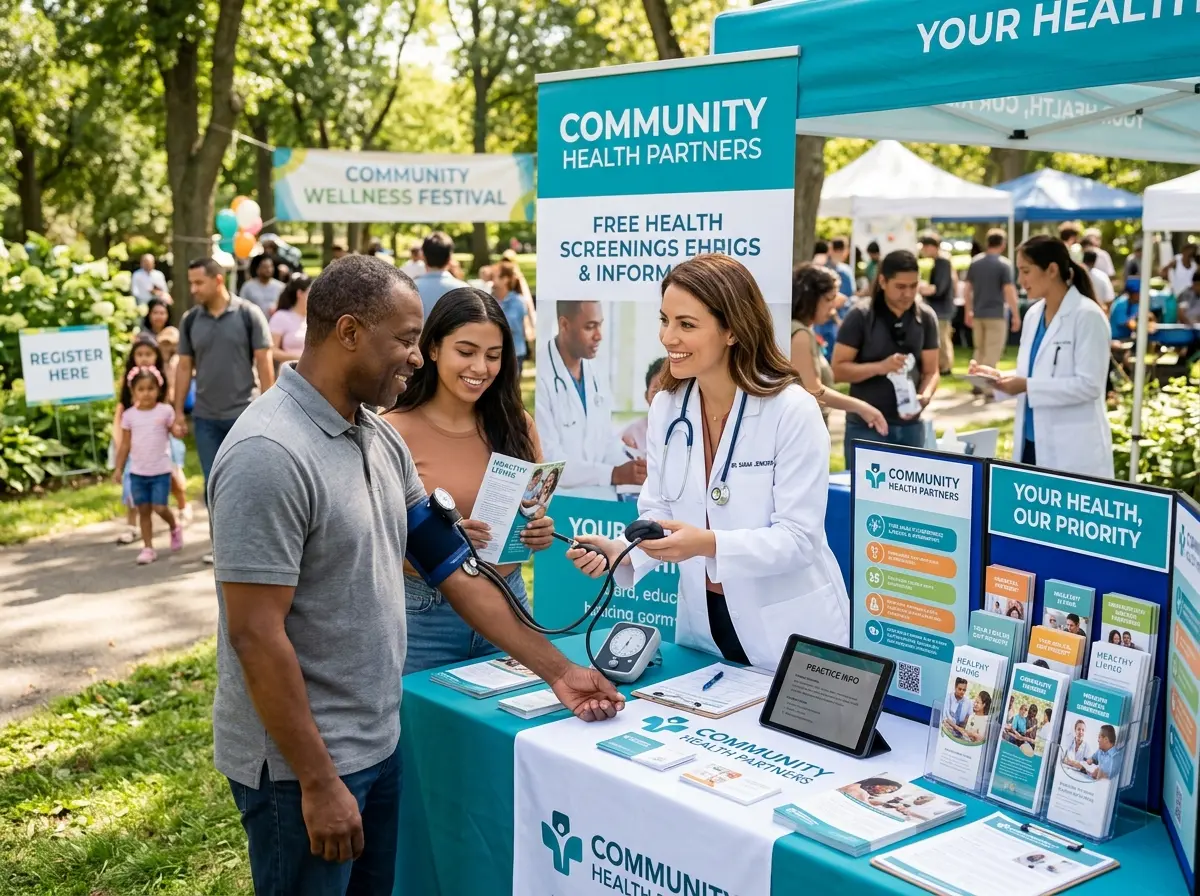
Let's be honest: most health fair booths look exactly the same. A table, a banner, maybe a lucky spinning wheel if someone got creative. If you want people to stop — and you do want people to stop — your booth needs a visual reason to exist. Invest in a professional, branded pop-up display that clearly communicates who you are and what problem you solve. Not just your practice name, but a value statement. Something like "Your neighborhood's primary care team — accepting new patients now" is far more compelling than your logo floating above a tablecloth.
Consider adding an interactive element. Free blood pressure checks, glucose screenings, or BMI assessments give people a tangible reason to walk over and engage. These low-barrier health touchpoints do double duty: they demonstrate your clinical competency, and they open a natural conversation about the attendee's health needs — which is exactly the conversation that leads to a booked appointment.
Train Your Team to Have Real Conversations
Your staff at the booth are not there to hand out pamphlets. They are there to connect with people. Train everyone who represents your practice at the fair to ask open-ended questions: "What kind of doctor do you currently see for that?" or "Have you had your annual physical this year?" These aren't pushy sales tactics — they're the kinds of genuine, caring questions a good healthcare provider naturally asks. The goal is to make attendees feel seen, not sold to.
Designate at least one clinical staff member — a nurse, PA, or physician — to be present at the booth for credibility. When someone is on the fence about switching providers, speaking with an actual clinician rather than a marketing coordinator can be the difference between a follow-up appointment and a forgotten interaction. People trust people in scrubs. Use that wisely.
Capture Information Without Making It Awkward
This is where many practices fumble. You had great conversations, distributed 200 brochures, and performed 80 blood pressure checks — and you left with a clipboard that has 12 illegible names on it. That's not a lead list; that's a regret.
Set up a simple, frictionless way to collect contact information. A tablet-based intake form works beautifully — it looks professional, it's fast, and the data goes somewhere useful. Offer a genuine incentive: a free new patient consultation, a wellness guide download, or entry into a raffle. Frame it as "Stay connected with us for health tips and updates" rather than "Give us your information." The former feels like value. The latter feels like a trap.
How Technology Can Work the Booth (and the Phones) With You
Don't Let Leads Slip Through the Cracks While You're Away
Here's a scenario that happens more than any practice owner wants to admit: you're out at a health fair on Saturday, your staff is busy managing the booth, and your office phone goes unanswered — or worse, it rolls to a generic voicemail greeting that sounds like it was recorded in 2009. A potential new patient calls, gets nothing useful, and moves on to the next Google result. That's a real cost, and it's entirely preventable.
Stella, an AI robot employee and phone receptionist, ensures your practice never goes dark — even when your team is off-site working a health fair. She answers incoming calls 24/7, answers questions about your services, hours, and insurance policies, and can collect patient intake information conversationally over the phone. Her built-in CRM automatically organizes the contacts she gathers with AI-generated profiles, custom tags, and notes — so when you're back in the office Monday morning, your lead list is already waiting for you, clean and actionable. She also stands inside your physical location as a friendly kiosk presence, so your front desk experience remains professional even when key staff are pulled elsewhere.
Following Up in a Way That Actually Converts
Speed Matters More Than You Think
The fortune is in the follow-up, and in healthcare, timing is everything. Research from various CRM and sales studies consistently shows that leads contacted within the first hour of expressing interest are significantly more likely to convert than those contacted even 24 hours later. Health fair attendees who dropped their contact information are warm leads — they were curious enough about their health to engage with you in person. But that warmth fades fast.
Build a follow-up sequence that starts within 24 hours of the event. A personalized email or text that references the specific interaction — "It was great meeting you at the Riverside Community Health Fair on Saturday" — is far more effective than a generic newsletter blast. If you gathered information about their specific health concerns during the event, even better. A brief message that says "You mentioned you haven't had a physical in a while — we'd love to help with that" shows you were actually listening, which is a rare and appreciated quality.
Convert Interest Into Scheduled Appointments
Your follow-up goal isn't to inform — it's to book. Every communication should have a clear, low-friction call to action that leads directly to scheduling. "Click here to book your free new patient consultation" is better than "We hope to hear from you soon." Use an online booking tool if you have one, or make sure your phone line is staffed and ready to handle incoming calls from people responding to your outreach.
Consider creating a health fair-specific landing page or offer that tracks conversions back to the event. This does two things: it gives the prospective patient a tailored experience, and it gives you data on what's working. If you attended three health fairs this quarter and one of them generated 85% of your new patient bookings, you now know where to invest your time next year. That's not luck — that's strategy with receipts.
Nurture the Ones Who Aren't Ready Yet
Not every health fair contact will book an appointment right away, and that's okay. Some people are early in their decision-making process. Some are comparing options. Some just wanted the free blood pressure check and were mildly curious. For these contacts, a long-term nurture approach is the right play. Add them to a monthly wellness email that provides genuine value — seasonal health tips, reminders about annual screenings, updates on services you offer. When they're finally ready to choose a provider, you want to be the name they already feel like they know.
The practices that win at community health fairs aren't necessarily the ones with the biggest booths. They're the ones that show up consistently, follow up relentlessly, and build familiarity over time. Trust in healthcare is earned slowly and lost quickly. Your health fair presence is just the first touchpoint in what should be a deliberate relationship-building effort.
A Quick Reminder About Stella
Stella is an AI robot employee and phone receptionist built for businesses exactly like yours. She greets patients at your front desk as a physical kiosk presence, answers your phones 24/7 with the same business knowledge she uses in person, collects intake information through conversational forms, and keeps your CRM organized automatically — all for $99 a month with no upfront hardware costs. While you're out building community relationships at health fairs, she makes sure your practice keeps running like you never left.
Your Next Health Fair Should Be Your Best One Yet
Community health fairs are one of the most underutilized patient acquisition channels in healthcare marketing. The barrier to entry is relatively low, the audience is pre-qualified, and the trust-building potential is enormous. But like any marketing initiative, results are proportional to preparation and follow-through.
Here's your action plan:
- Audit your current booth setup — Does it communicate your value clearly? Does it give people a reason to stop? If not, invest in an upgrade before your next event.
- Train your team on conversational engagement — Replace pamphlet-pushing with genuine questions and clinical presence.
- Set up a proper lead capture system — Use a tablet form with a real incentive, and make sure the data flows into a CRM you'll actually use.
- Build a 48-hour follow-up protocol — Personalized outreach, a clear booking call to action, and a longer-term nurture sequence for those who aren't ready yet.
- Ensure your phones are covered — Whether that's with additional staff coverage or an AI receptionist, don't let new patient calls go unanswered while you're off-site.
Health fairs aren't going away, and neither is your competition. The practices that treat every booth appearance as a serious business development opportunity — rather than a reluctant community obligation — are the ones that fill their patient panels while everyone else wonders why their candy bowl strategy isn't producing results. Go be the booth people actually remember.