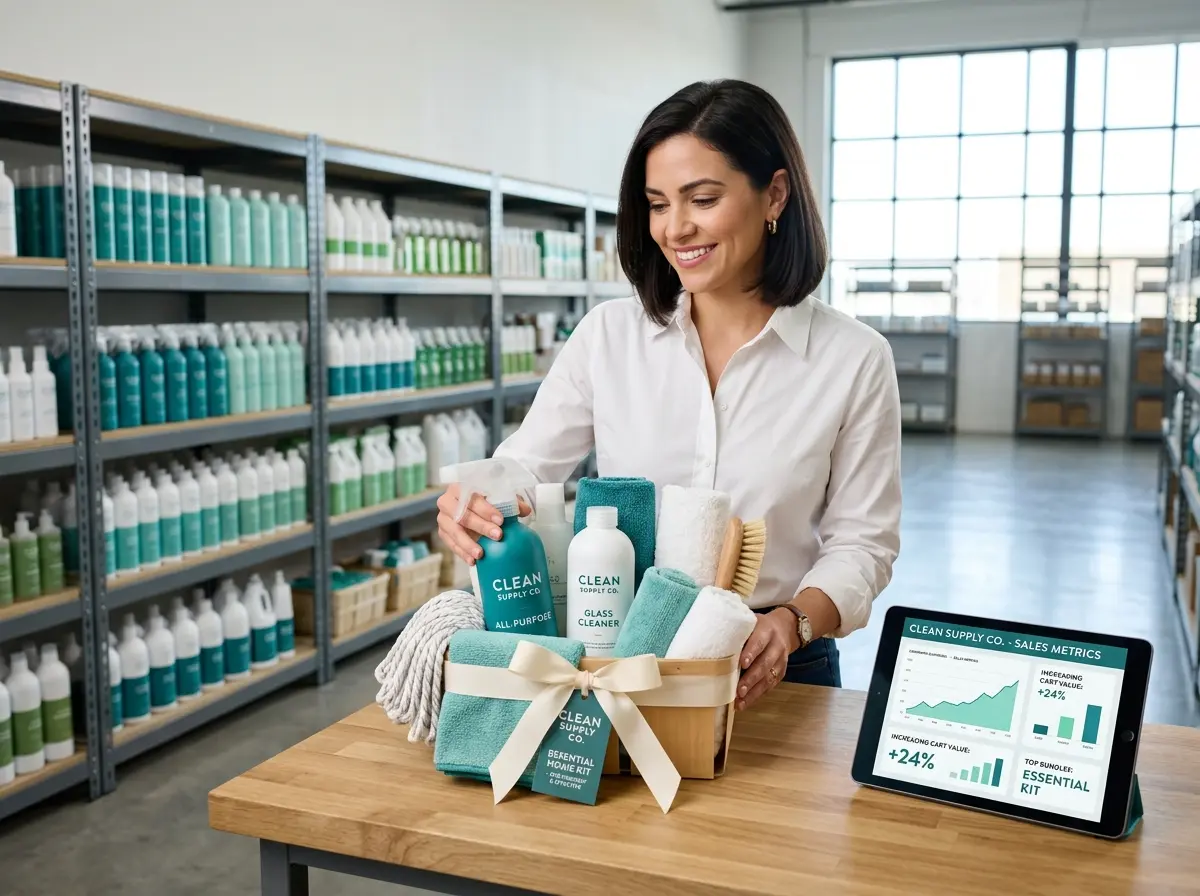
Stop Leaving Money on the Table (Literally, It's Just Sitting There)
Let's be honest — nobody walks into a cleaning supply store thinking, "I'll just grab one thing and be on my way." And yet, somehow, that's exactly what happens far too often. A customer grabs a mop, ignores the bucket display three feet away, and checks out. You watch $15 in potential revenue stroll out the door. Painful, right?
The good news is that the cleaning supply industry is practically built for product bundling. Think about it — every product you sell has a natural companion. Cleaning solution needs a spray bottle. A scrub brush needs a handle. Floor cleaner needs a mop. The relationships are obvious, the logic is airtight, and the opportunity to increase your average cart value is enormous — if you know how to package it.
Bundling isn't just a retail trick. It's a customer service strategy. Done well, it saves your customers time, simplifies their purchasing decisions, and makes them feel like they got a deal — even when your margins are perfectly intact. According to McKinsey, product bundling can increase revenue by 10–30% when implemented thoughtfully. That's not pocket change. That's a real, measurable difference in your bottom line.
So let's talk about how to do it right — from building logical bundle sets to pricing them strategically and making sure your customers actually know the bundles exist.
Building Bundles That Actually Make Sense
The biggest mistake cleaning supply businesses make with bundling is throwing random products together and slapping a discount on them. A "mystery savings box" might work for some industries, but your customers came in for a reason — they have a cleaning problem to solve. Your bundles should solve it completely.
Start With the Job-to-Be-Done Framework
Think less about your product categories and more about what your customer is actually trying to accomplish. Are they setting up a commercial kitchen? Doing a post-construction deep clean? Managing a janitorial closet for an office building? Each of these "jobs" has a predictable set of tools and supplies associated with it. Build your bundles around the job, not the shelf section.
For example, a "New Restaurant Starter Kit" might include degreasers, sanitizing solution, floor cleaner, microfiber cloths, gloves, and a mop bucket system. That bundle is incredibly easy to market because the customer can immediately see themselves using it. Compare that to a generic "cleaning bundle" that includes three different disinfectants and a scrub brush — one of these tells a story, and one of them just takes up shelf space.
Identify Your Natural Product Pairs and Clusters
Even if you don't want to build full kits, identifying your natural product pairs is a quick win. Look at your sales data — which products are frequently purchased together? Which products are almost always used together but not purchased together? That second group is your goldmine. Those are the items your customers are buying elsewhere, forgetting to grab, or not realizing you carry.
Common high-performing pairs in cleaning supply retail include concentrate cleaners paired with dilution equipment, floor machines paired with the appropriate pads or chemicals, and disposable gloves paired with chemical-resistant alternatives for heavier jobs. Once you identify your pairs, merchandise them together physically and digitally — and make bundling them a no-brainer with a modest price incentive.
Create Tiered Bundle Options
Not every customer has the same budget or the same scope of work. A solo housekeeper has very different needs than a facilities manager for a hospital. Offering tiered bundles — think Starter, Professional, and Commercial — lets you serve multiple customer segments without alienating anyone. It also anchors pricing perception. When customers see three options, they tend to choose the middle one, which is exactly where you want them.
How Stella Can Help You Sell Bundles Around the Clock
Here's where things get interesting. You can design the most brilliant bundle strategy in the world, but if no one tells your customers about it, it might as well not exist. That's where Stella comes in — an AI robot employee and phone receptionist that proactively engages customers both in-store and over the phone.
In-Store Engagement and Phone Upselling
In your physical location, Stella stands as a human-sized AI kiosk that greets customers, asks what they're working on, and can immediately start recommending relevant bundles based on the conversation. Instead of a customer wandering past your bundle displays without a second glance, Stella initiates the conversation — naturally and consistently, every single time. On the phone side, she answers calls 24/7 and can highlight current bundle promotions, walk callers through their options, and collect customer information through built-in intake forms and a CRM — so no lead or upsell opportunity slips through the cracks while your staff is busy.
Pricing and Presenting Your Bundles for Maximum Impact
A well-built bundle that's priced or presented poorly will still underperform. Pricing strategy and visual presentation are where many small businesses lose the plot — either discounting too aggressively and hurting margins, or not communicating enough value to justify the bundle price at all.
Price for Perceived Value, Not Just Discount Depth
The psychology of bundle pricing is well-documented. Customers don't necessarily need a massive discount to feel like a bundle is worth it — they need to feel like they're getting convenience and completeness. A bundle priced at 10–15% below the combined individual prices is typically enough to drive the decision, while still maintaining healthy margins for you.
One effective tactic is to anchor the bundle price against the individual totals prominently. Show the "if purchased separately" price crossed out next to the bundle price. It's a classic move because it works. You're not just selling products — you're selling the feeling of a smart purchase.
Merchandise Bundles Like They're the Star of the Show
Physical placement matters enormously. Bundles that are merchandised on end caps, near the register, or in dedicated "solutions" sections dramatically outperform bundles that are just tagged on a regular shelf. Use signage that speaks to the outcome — "Everything you need for spotless commercial floors" — rather than just listing the products inside. Online, give your bundles their own product pages with detailed descriptions, photos of the products in use, and customer reviews. Don't just create a bundle SKU and bury it in a category page. Give it a stage.
Offer Subscription Bundles for Recurring Revenue
If you sell to commercial clients — and many cleaning supply businesses do — subscription bundles are one of the most powerful tools available to you. A monthly auto-ship bundle of consumables like trash liners, paper products, and cleaning chemicals locks in recurring revenue, reduces churn, and simplifies purchasing for your clients. Even a modest subscription program can dramatically stabilize your monthly cash flow. Start simple — offer your top five consumable products as a monthly bundle and see how many customers opt in. The number will likely surprise you.
Quick Reminder About Stella
Stella is an AI robot employee and phone receptionist built for businesses exactly like yours — she greets customers in-store, answers calls around the clock, promotes your bundles and deals, and never takes a sick day. At just $99/month with no upfront hardware costs, she's one of the most cost-effective team members you'll ever onboard. Whether you have one location or you're running an online-only operation, Stella shows up ready to work every single day.
Put Your Bundle Strategy Into Action
Bundling is not a complicated strategy, but it does require intention. The businesses that see real results from it aren't necessarily the ones with the flashiest promotions — they're the ones that took the time to understand their customers' needs, built bundles around real use cases, priced them intelligently, and then made sure customers actually knew those bundles existed.
Here's a simple action plan to get started this week:
- Pull your last 90 days of sales data and identify your top 10 most frequently purchased product pairs.
- Build three bundle concepts based on your most common customer "jobs" — one for residential, one for small commercial, one for larger facilities if applicable.
- Price each bundle at 10–15% below the combined individual prices and create clear, outcome-focused signage for each.
- Merchandise your bundles prominently — end caps, register areas, and dedicated online pages with full descriptions.
- Explore a subscription option for your top consumable products and pitch it to your five best commercial clients first.
- Make sure your team — human and AI — knows the bundles inside and out so they can recommend them confidently in every customer interaction.
Increasing your average cart value doesn't require overhauling your business. It requires making it easier for customers to buy more of what they already need. Your bundles do that — so build them thoughtfully, price them strategically, and get them in front of every customer who walks through your door or picks up the phone. The revenue is already there. You just have to package it.