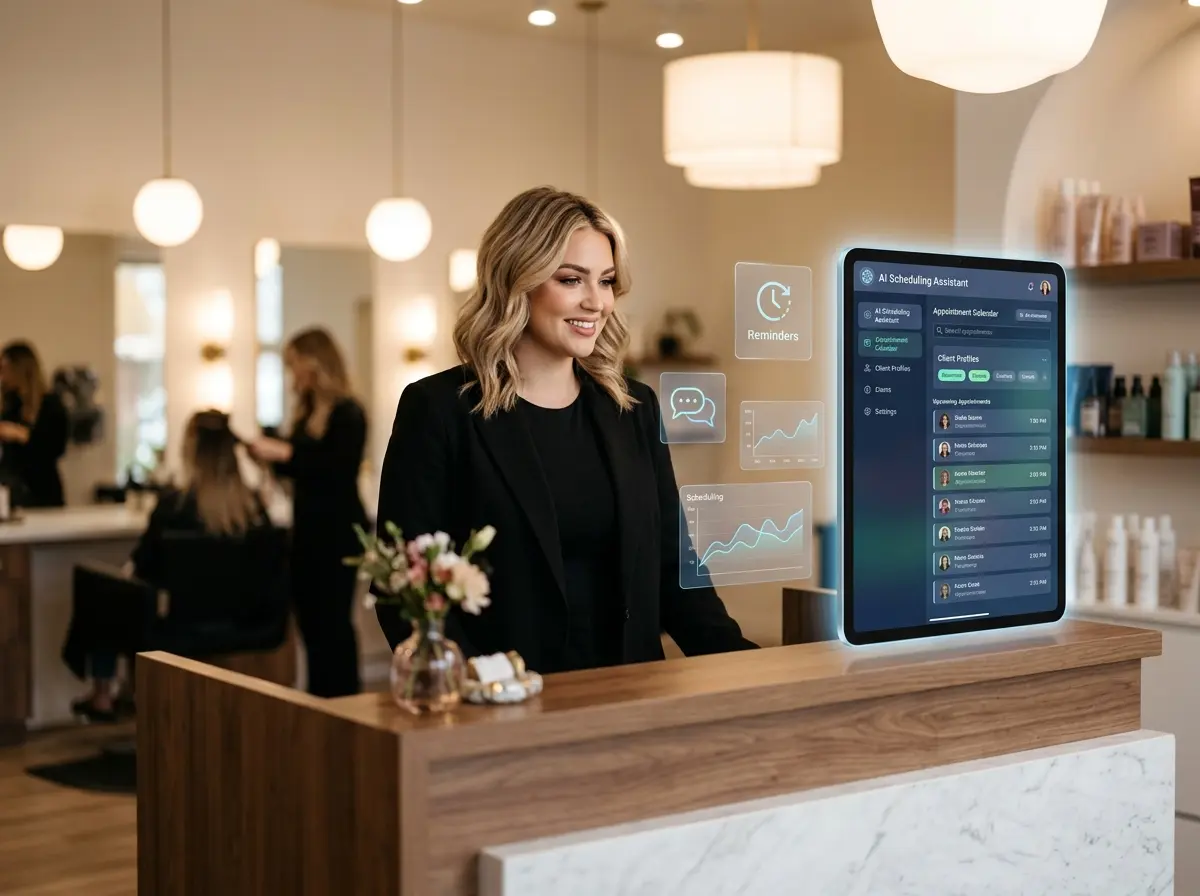
Your Front Desk Has a Calling — And It's Not Answering the Phone
Let's paint a picture. It's a busy Saturday at your salon. Every chair is full, your stylists are in the zone, and the phone is ringing. And ringing. And ringing. Meanwhile, someone just walked through the front door and is standing at the desk, looking around with that politely impatient expression that says, "I exist and I would like to be acknowledged." Your receptionist is doing their best — bless them — but they are one human with two ears, two hands, and a finite amount of patience.
This is the daily reality for most salon owners, and it's not a staffing failure. It's a structural one. The front desk has always been asked to do too much: greet walk-ins, answer phones, check clients in, upsell retail products, explain promotions, take bookings, and somehow stay cheerful through all of it. Something always slips. Usually, it's revenue.
The good news? The front desk is evolving — and AI is leading the charge. Not to replace your team, but to pick up everything they physically cannot do all at once. Here's what that actually looks like in practice.
The Real Cost of Front Desk Gaps
Missed Calls Are Missed Money
Here's a stat that should make any salon owner put down their coffee: missed calls are one of the top reasons salons lose clients to competitors. Studies in the service industry consistently show that a significant portion of callers — some estimates suggest over 60% — will not leave a voicemail and will simply call the next business on their list. In a neighborhood with three other salons, that's a costly game of phone tag you didn't know you were playing.
The problem isn't that your staff doesn't care. It's that they can't be everywhere. A stylist mid-blowout cannot answer the phone. A receptionist helping a client at checkout cannot simultaneously walk someone through your color service menu over the phone. These aren't performance problems — they're physics problems.
The Hidden Revenue Leak at the Front Desk
Beyond missed calls, there's a quieter revenue leak that happens every day: inconsistent upselling. When a client checks out, someone should be mentioning the deep conditioning treatment that pairs beautifully with their color service, or the retail product their stylist literally just used on their hair. But your receptionist may be tired, distracted, or simply unsure what to recommend — and so the moment passes.
Multiply that across dozens of checkouts per week, and you're leaving a meaningful amount of retail revenue on the table. Not because your team is bad at their jobs, but because consistent, knowledgeable upselling requires attention and information that isn't always available at the exact right moment.
Turnover Makes It Worse
Salon receptionist turnover is notoriously high. Every time someone new starts, there's a training period where they don't fully know your services, your pricing, your promotions, or the subtle art of handling an unhappy client at the desk. That knowledge gap costs you — in customer experience, in staff morale, and sometimes in clients who simply don't return after a confusing or unwelcoming interaction.
Where AI Fits Into the Salon Front Desk
An Always-On Presence That Actually Knows Your Business
This is where things get genuinely exciting. AI-powered front desk tools — particularly those designed for physical retail environments — can fill the gaps that human staffing simply cannot. Stella, for example, is a human-sized AI robot kiosk and phone receptionist built for businesses exactly like yours. She stands inside your salon, greets customers who walk in or walk by, and engages them proactively with information about your services, current promotions, and retail offerings. No coffee breaks, no bad days, no forgetting to mention the seasonal color special.
On the phone side, Stella answers calls 24/7 — including after hours, on weekends, and during those chaotic mid-day rushes when your entire team is elbow-deep in someone's highlights. She can handle common questions about services, hours, and pricing entirely on her own, and forward calls to a human team member when the situation genuinely calls for it. Voicemails come with AI-generated summaries and push notifications to managers, so nothing falls through the cracks. At $99/month with no upfront hardware costs, it's the kind of front desk upgrade that actually pays for itself.
What AI Can Do That Your Staff Genuinely Cannot
Be in Two Places at Once — Consistently
The single biggest advantage AI brings to a salon front desk is simultaneity. While your receptionist is helping a client at the counter, an AI kiosk can be engaging the person who just walked in, answering their questions, and telling them about your loyalty program. While your team is fully booked on a Saturday afternoon, an AI phone receptionist is answering every single call with the same warm, informed tone it used on Monday morning. Consistency at scale is something humans aren't built for — not because of any flaw, but because we get tired. AI doesn't.
Personalized Promotion Without the Awkward Pitch
Nobody likes feeling sold to. But everyone appreciates a relevant recommendation delivered naturally. AI excels at weaving promotional information into conversation in a way that feels helpful rather than pushy. When a client asks about balayage services, an AI assistant can seamlessly mention the current color package promotion or the complementary gloss treatment that's popular with balayage clients — without it feeling like a scripted upsell. That kind of natural, contextual recommendation is something that takes human staff months to master, and they still won't do it 100% of the time.
Data That Actually Helps You Run Your Business
Here's something your current front desk almost certainly isn't doing: systematically collecting insights about every customer interaction. Which services are clients asking about most? Which promotions generate the most questions? What time of day do most calls come in, and what are people calling about? This information is genuinely valuable for making staffing, marketing, and inventory decisions — and most salons have no structured way to capture it.
AI front desk tools change that. Every interaction becomes a data point. Over time, you build a clearer picture of what your clients want, what's working, and where you're leaving opportunity on the table. That's the kind of intelligence that used to require a consultant. Now it comes built into your front desk.
Quick Reminder About Stella
Stella is an AI robot employee and phone receptionist designed to work inside your salon and on your phone lines simultaneously. She greets clients, promotes your services, answers questions, handles calls around the clock, and never has a rough morning. At $99/month with no upfront hardware costs and an easy setup process, she's built to be a practical addition to any salon — not a science fiction fantasy.
Making the Shift: Practical Next Steps for Salon Owners
Start by Auditing Your Front Desk Gaps
Before investing in any technology, spend one week paying close attention to where your front desk breaks down. How many calls go unanswered? How often does your receptionist get pulled away from a client to answer the phone? Are your retail products being mentioned consistently at checkout? You may find the gaps are larger than you realized — and that's actually useful information, because it tells you exactly what to fix.
Think of AI as Infrastructure, Not a Gimmick
The salons that will thrive over the next decade are the ones treating AI as a foundational part of how they operate — not a novelty they tried once. Just as you invested in your booking software or your POS system, an AI front desk presence deserves to be evaluated seriously, implemented thoughtfully, and measured over time. The goal isn't to be cutting-edge for its own sake. The goal is more consistent client experiences, fewer missed opportunities, and a staff that can focus on what they're actually trained for.
Let Your Human Team Do What Only Humans Can
The best outcome of bringing AI into your front desk isn't replacing your receptionist — it's freeing them to do the things that genuinely require a human touch. Handling a difficult client situation with empathy. Building real rapport with regulars. Supporting the team during a stressful rush. Those moments matter enormously, and they suffer when your receptionist is also trying to be a phone operator, a product expert, and a promotional kiosk all at the same time. Give them the breathing room to be excellent at the human parts of the job. Let the AI handle the rest.
The front desk of the future isn't a robot instead of a person. It's a smart combination of both — and the salons that figure that out first are going to have a very noticeable competitive edge. The phone's already ringing. The question is who's going to answer it.