You've Got Skills — Now Let's Turn Them Into Sales
You've spent years mastering your craft, building a community, and creating a space where people come to grow stronger — physically, mentally, and spiritually. Your students love you. Your dojo is thriving. And yet, somehow, your private lesson slots are half-empty and your gear display is basically just a really expensive dust collector. Sound familiar?
Here's the uncomfortable truth: most martial arts studios leave significant revenue on the table every single month simply because they don't have a structured approach to upselling. It's not a talent problem. It's not even a product problem. It's a systems problem. Your students want to improve faster. They want the right gear. They just need someone — or something — to connect those dots for them at the right moment.
According to industry research, acquiring a new customer costs five to seven times more than retaining and upselling an existing one. Your current students are already bought in. They trust you. That's the hardest part of sales, and you've already done it. Now it's time to build the systems that turn that trust into revenue — without feeling like a used car salesman in a gi.
Building a Culture That Makes Upselling Natural
The word "upselling" makes a lot of martial arts instructors uncomfortable. You got into this business to teach, not to sell. Fair enough. But here's the reframe you need: recommending a private lesson to a struggling student isn't sales — it's coaching. Suggesting the right protective gear to a sparring student isn't a pitch — it's a safety conversation. When upselling is rooted in genuine value, it doesn't feel transactional. It feels like leadership.
Know Your Students' Goals Before You Suggest Anything
The most effective upsell is one that meets a student exactly where they are. A white belt who's nervous about their first tournament has completely different needs than a brown belt who's been training for six years and wants to sharpen a specific technique. Before you can recommend anything, you need to know what each student is working toward.
Make goal-setting part of your onboarding process. During intake, ask new students what brought them in, what they hope to achieve, and what their timeline looks like. Revisit those goals at regular intervals — monthly check-ins, belt promotions, or even just a quick conversation after class. When you know a student wants to compete within six months, suddenly recommending a private lesson on competition strategy isn't upselling. It's a logical next step in their journey.
Train Your Staff to Spot the Moments That Matter
Your instructors see things in class that create natural upsell opportunities every single day — a student who keeps making the same technical error, a teenager who's outgrown their gear, a parent who mentions their child has been struggling with focus. These are golden moments. But if your staff isn't trained to recognize and act on them, they'll pass by without a word.
Create a simple internal system where instructors flag students who might benefit from a private session or a gear upgrade. This doesn't need to be complicated — even a weekly team huddle where instructors mention two or three students by name is enough to start. Pair that with a straightforward script for how to bring it up conversationally, and you've built an upsell culture without anyone feeling like they're working a sales floor.
How Technology Can Do the Heavy Lifting for You
Let's be honest: you're an instructor first. You're running classes, managing schedules, handling parent inquiries, and trying to remember which student just tested for their next belt. The idea of adding "proactive upselling conversations" to your to-do list sounds exhausting. That's exactly where smart technology steps in.
Let AI Handle the Front Desk So You Can Focus on the Mat
Stella, the AI robot employee and phone receptionist, is built for exactly this kind of situation. As a human-sized kiosk inside your studio, she greets every student and parent who walks through the door, answers questions about your programs and pricing, and proactively highlights your private lesson offerings and gear promotions — consistently, without ever forgetting to mention them. She's also available 24/7 to answer phone calls, so when a parent calls at 9pm wondering whether their child is ready for private lessons, Stella is there with a real, knowledgeable answer and a smooth path to booking.
Stella's built-in CRM and conversational intake forms mean that every new inquiry — whether in person or over the phone — becomes a structured contact record with notes, tags, and AI-generated summaries. That means you can actually track which students have been offered a private lesson, who expressed interest in new gear, and who's due for a follow-up. It's the kind of organized, proactive customer management that usually requires a full-time staff member. Stella handles it for $99 a month.
Structuring Your Offers So Students Say Yes
Even the best upsell culture falls flat if your offers aren't structured to be compelling. Pricing, packaging, and timing all matter more than most studio owners realize. You don't need to slash your rates or run constant discounts — you just need to present your offerings in a way that makes the value immediately obvious.
Package Private Lessons Strategically
Single private lessons are easy to say no to. A package tied to a specific outcome is much harder to resist. Instead of selling "one private lesson for $80," consider offering a "Competition Prep Package" — three private sessions focused entirely on getting a student ready for their next tournament. Or a "Black Belt Accelerator" — a monthly add-on for advanced students who want to close technical gaps faster. When the offer has a name, a purpose, and a clear result, students can picture what they're buying. That mental picture is what drives conversions.
Price these packages at a slight discount compared to individual sessions — enough to feel like a deal, not enough to undermine your value. And always present them in writing, whether on a flyer, a dedicated page on your website, or on a screen at your front desk. Verbal offers are forgotten. Visual offers get considered.
Make Your Gear Display Work Harder
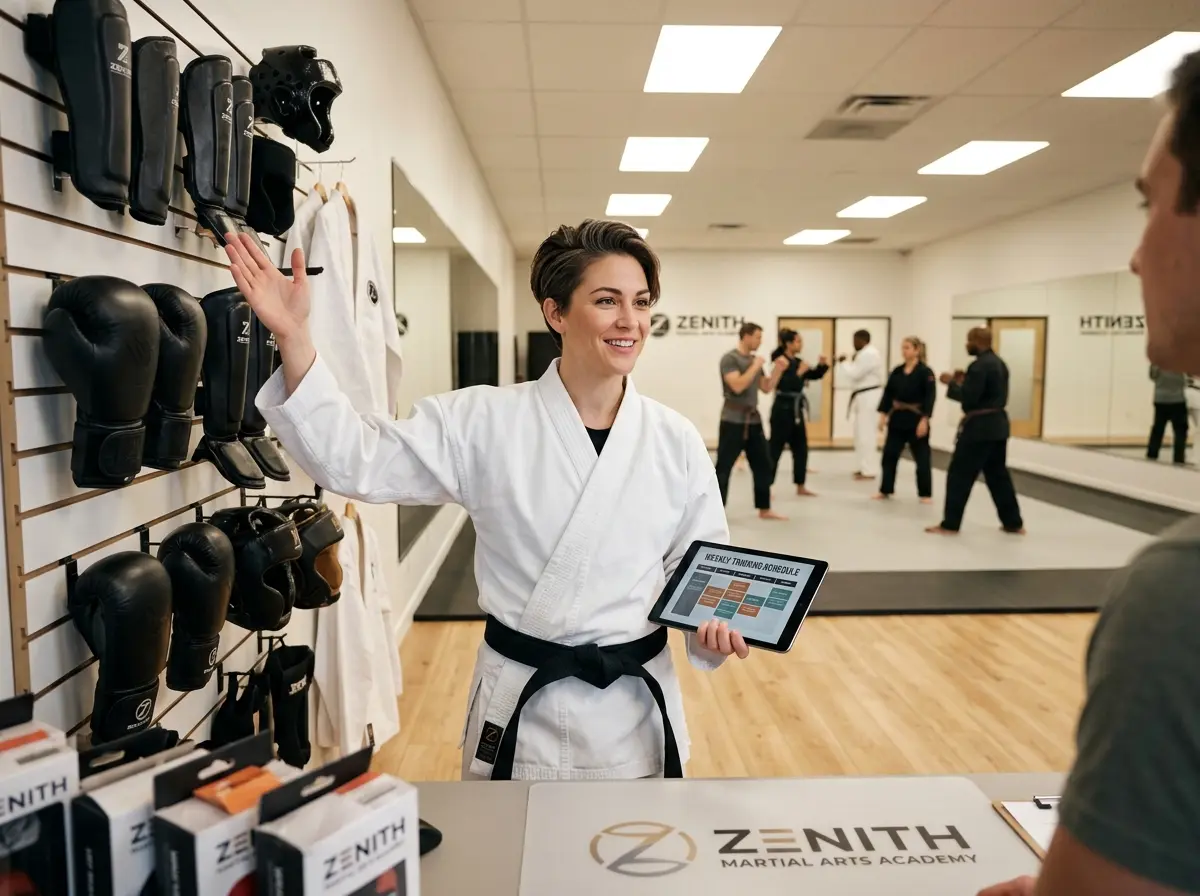
If your gear is shoved in a corner with no signage, no context, and no one talking about it, it will not sell itself. Your retail area should feel curated and intentional. Group items by use case — beginner essentials, sparring gear, competition equipment — and add short, handwritten-style signs that explain why each item matters. "This is the glove we recommend for students entering their first sparring class" is infinitely more persuasive than a price tag alone.
Tie gear recommendations to belt progression. When a student earns a new rank, it's a celebratory moment — and an organic opportunity to talk about the gear that goes with their next level. Some studios even build a small gear bundle into the cost of a belt promotion test. Students feel equipped and celebrated. You move inventory. Everyone wins.
Follow Up — Because Almost Nobody Does
Here's a stat that should motivate you: 80% of sales require at least five follow-up touchpoints, but most businesses give up after one or two. If a student expresses interest in private lessons and you mention it once and never bring it up again, you've done the hard part for nothing. Build a simple follow-up cadence — a text three days later, a quick word after class the following week, a reminder when registration opens for the next session cycle. Gentle, consistent, and rooted in their stated goals. That's not pushy. That's professional.
Quick Reminder About Stella
Stella is an AI robot employee and phone receptionist designed to greet walk-in customers, answer calls around the clock, promote your offerings, and manage customer information — all for just $99 a month with no upfront hardware costs. She's the reliable, consistent front-of-house presence that never calls in sick and never forgets to mention your private lesson packages. For a martial arts studio juggling classes, staff, and student relationships, she's a genuinely useful addition to the team.
Your Next Steps Start Today
You don't need to overhaul everything at once. Start with one change this week: identify three current students who would genuinely benefit from a private lesson and have a real, goal-focused conversation with each of them. Not a pitch — a conversation. See what happens.
Then, over the next month, work on the structural pieces: build out a gear display that explains its own value, package your private lessons around specific student outcomes, and put a follow-up system in place so interested students don't fall through the cracks. If you want to take the pressure off your front desk and make sure every inquiry — in person or over the phone — gets a consistent, professional response, look into what Stella can do for your studio.
Your students are already there. They're already committed. They're already looking for ways to get better faster. Give them a clear path to do exactly that — and make sure your studio is the one they spend that money with.