Your Phone Is Ringing. Again. And You're Elbow-Deep in a Balayage.
Let's paint a picture. It's a busy Saturday morning. Every chair is full, your shampoo bowls are occupied, and there's a client at the front desk waiting to check out. Your phone rings. Then it rings again. Then it rings a third time — probably the same person, now mildly annoyed. You can't answer it. Your receptionist is juggling three things at once. And somewhere out there, a potential new client just decided to call the salon down the street instead.
Sound familiar? You're not alone. The beauty industry runs on appointments, and appointments require communication — a lot of it. According to industry estimates, salons miss up to 40% of inbound calls during peak hours, and most callers won't leave a voicemail. They'll simply move on. That's not just a missed call. That's missed revenue, missed relationships, and missed opportunity — all wrapped in one unanswered ring.
The good news? You don't have to hire another full-time receptionist to fix this problem. You just need a smarter system.
Why Salons Struggle With Phone Volume (And Why It's Not Your Fault)
The Nature of the Beast
Salons are inherently high-touch, high-communication businesses. Clients want to ask about availability, pricing, specific stylists, color services, aftercare products, and whether you can fit them in before their cousin's wedding on Saturday. These aren't quick yes-or-no calls. They're conversations. And when your staff is actively serving clients in the chair, answering the phone isn't just inconvenient — it can compromise the in-person experience you've worked so hard to build.
The irony is cruel: the busier your salon gets, the harder it becomes to answer the phones, which means you risk losing the very growth you've worked to achieve. It's a bottleneck that feels almost designed to hold you back.
The Hidden Cost of Missed Calls
Most salon owners underestimate what a missed call actually costs. Think about it this way: if your average appointment value is $120, and you're missing even five calls per week, that's potentially $600 in lost revenue every week — or over $30,000 per year. That's not a rounding error. That's a real financial leak hiding in plain sight.
And then there's the reputation factor. In a world where clients expect instant responses and leave Google reviews based on their booking experience alone, a missed call or a frustratingly long hold time can quietly damage the perception of your business before someone even walks through your door.
Why Hiring More Staff Isn't Always the Answer
The knee-jerk solution is to hire a dedicated receptionist or add another part-time team member to manage the front desk. But let's be real about what that actually involves: recruiting, onboarding, training, scheduling, managing, and of course, paying — including taxes, benefits, and the ever-present risk of turnover. A single full-time receptionist can easily cost $30,000 to $45,000 per year, and there's no guarantee they'll stick around. For a small or mid-sized salon, that's a significant investment for a problem that technology can now solve at a fraction of the cost.
Smarter Systems That Take the Load Off Your Team
How AI Receptionists Are Changing the Game for Salons
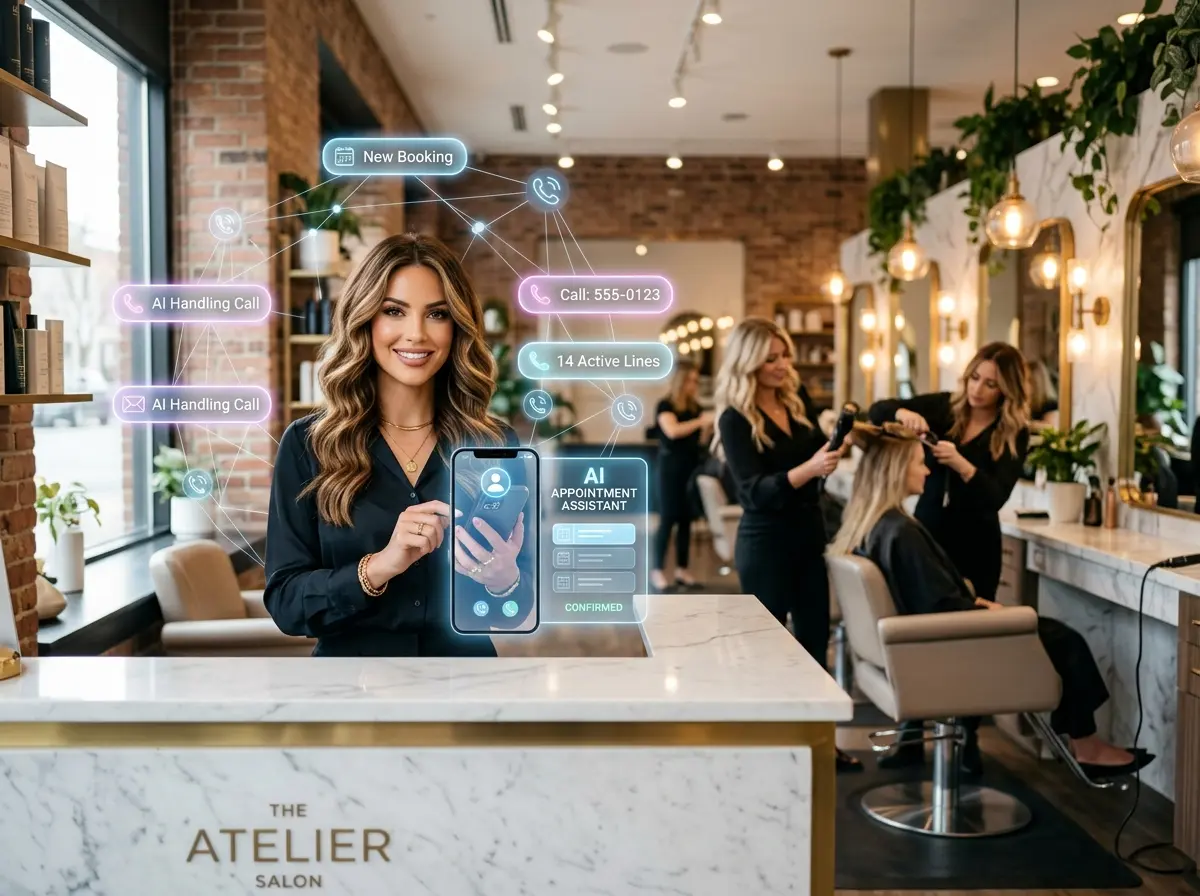
Stella is an AI robot employee and phone receptionist built for businesses like yours. She answers every call — day or night, weekday or weekend — with the same confident knowledge your best staff member would have. She knows your services, your pricing, your hours, your policies, and your current promotions. She can collect client information through conversational intake forms right over the phone, so by the time a new client books, you already have everything you need. And with a built-in CRM, every contact, interaction, and intake response gets stored, organized, and summarized automatically — no manual data entry required.
For salons with a physical location, Stella also serves as an in-store kiosk, greeting walk-in clients, answering product and service questions, and even promoting current specials — all without pulling your stylists away from their stations. Think of her as the front desk presence you always wished you could afford, available 24/7, never calling in sick, and never asking for a raise. At $99/month with no upfront hardware costs, she's also significantly easier on the budget than another hire.
Building a Call-Handling Strategy That Actually Works
Triage Your Calls Like a Pro
Not every call needs the same level of attention, and part of handling high call volume well is knowing how to route and prioritize. Urgent calls — a client running late, a same-day cancellation, a billing issue — should reach a human quickly. Routine calls — hours of operation, service pricing, product availability — don't need to. Building a system that automatically handles the routine and escalates the important will dramatically reduce the burden on your team without sacrificing service quality.
This means thinking carefully about what questions your clients ask most often and making sure those answers are always available — whether through an automated phone system, a well-trained AI, or a robust FAQ on your website. If your staff answers the same five questions on repeat every day, that's a process problem with a very solvable solution.
Set Expectations Proactively
One underrated strategy for reducing phone volume is giving clients fewer reasons to call in the first place. Automated appointment confirmations, reminder texts, and post-visit follow-up messages can eliminate a significant portion of inbound call traffic. When clients already know their appointment time, what to expect when they arrive, and how to reschedule if needed, they simply don't need to pick up the phone as often.
Pair this with a clear, updated website and an active presence on Google Business Profile — where hours, services, and FAQs are always current — and you've quietly deflected dozens of calls per week without lifting a finger.
Create a Call Coverage Plan for Peak Hours
If Saturday mornings are your busiest time on the floor, they're probably your busiest time on the phone too. Rather than hoping someone finds a free moment to answer, create a deliberate coverage plan. Designate a point person for phones during peak windows, build in scheduled check-ins for voicemail, and have a clear protocol for what gets returned immediately versus what can wait until end of day. Systems — even simple ones — beat improvisation every time in a fast-moving salon environment.
Quick Reminder About Stella
Stella is an AI robot employee and phone receptionist designed to help businesses handle customer communication without the overhead of additional staff. She answers calls around the clock, greets in-store visitors, promotes your services and specials, collects client information, and keeps everything organized in a built-in CRM — all for $99/month. If your phones are getting the better of you, she's worth a serious look.
Stop Letting Your Phone Work Against You
Your salon's phone line should be an asset, not a source of anxiety. The calls coming in represent real people, real appointments, and real revenue — and every one that goes unanswered is a small leak in a boat you've worked incredibly hard to build. The solution isn't to run yourself ragged trying to answer everything manually, and it isn't necessarily to hire more people. It's to build systems that handle the predictable so your team can focus on the exceptional.
Here's where to start:
- Audit your missed calls. Check your phone records for the past 30 days and identify when calls are being missed most frequently. The pattern will tell you where your biggest gaps are.
- Identify your top five most common call types. Document the questions and requests your staff handles over the phone most often, and figure out which ones can be automated or handled without human involvement.
- Implement proactive communication. Add automated appointment reminders and confirmations if you haven't already. Reduce the reasons people need to call you.
- Consider an AI phone receptionist. If call volume is consistently overwhelming your team, tools like Stella can handle the load at a cost far below a new hire — without the management overhead.
The clients who call your salon are ready to spend money with you. Make sure someone — or something — is always there to welcome them.