Your Clients Forgot. Again.
You scheduled the appointment. You confirmed it at booking. You even mentally prepared your team for a full day of wagging tails and nervous cat carriers. And then — silence. The client doesn't show. The exam room sits empty. And somewhere across town, a golden retriever named Biscuit is blissfully unaware that he had a dental cleaning scheduled.
No-shows are one of the most frustrating — and expensive — problems facing veterinary clinics today. Studies suggest that missed appointments cost the average veterinary practice thousands of dollars per month in lost revenue, wasted staff time, and appointment slots that could have gone to pets who actually needed care. And the kicker? Most no-shows aren't malicious. Clients aren't ghosting you on purpose. Life gets busy. Reminders get buried. And without the right system nudging them at the right moments, even the most devoted pet parents can drop the ball.
The good news: a well-timed, well-crafted pre-appointment text sequence can dramatically reduce your no-show rate — often by 30 to 50 percent or more. Let's walk through exactly how to build one that works.
The Anatomy of a No-Show (And Why Texts Work)
Why Clients Miss Appointments in the First Place
Before you can solve the problem, it helps to understand it. Clients miss veterinary appointments for a handful of predictable reasons: they forgot entirely, something came up and they didn't think to call, they felt awkward canceling last-minute, or they weren't sure what to bring or how to prepare. Notice what's not on that list — "they didn't care about their pet." In the vast majority of cases, no-shows are a logistics problem, not a loyalty problem.
That matters because it means you can actually fix it. A client who forgot genuinely appreciates being reminded. A client who feels unprepared becomes more confident — and more likely to show up — when you send them helpful prep info in advance. And a client who might be tempted to silently bail is much more likely to proactively reschedule if you've made it easy to do so.
Why Texts Beat Emails and Phone Calls
Text messages have an open rate hovering around 98 percent, compared to roughly 20 percent for email. More importantly, texts are read within minutes — not hours, not days, not "I'll get to that later" (which means never). Phone calls, while personal, are increasingly screened by clients who would rather interact on their own schedule. Texts give clients the information they need, when they need it, without interrupting their day. For appointment reminders specifically, they're the clear winner.
Building Your Pre-Appointment Text Sequence
Message 1: The Friendly Confirmation (Sent Immediately at Booking)
The first message should go out the moment an appointment is booked — either automatically through your practice management software or triggered manually. Its job is simple: confirm the appointment details, make the client feel good about scheduling, and give them an easy way to cancel or reschedule if needed.
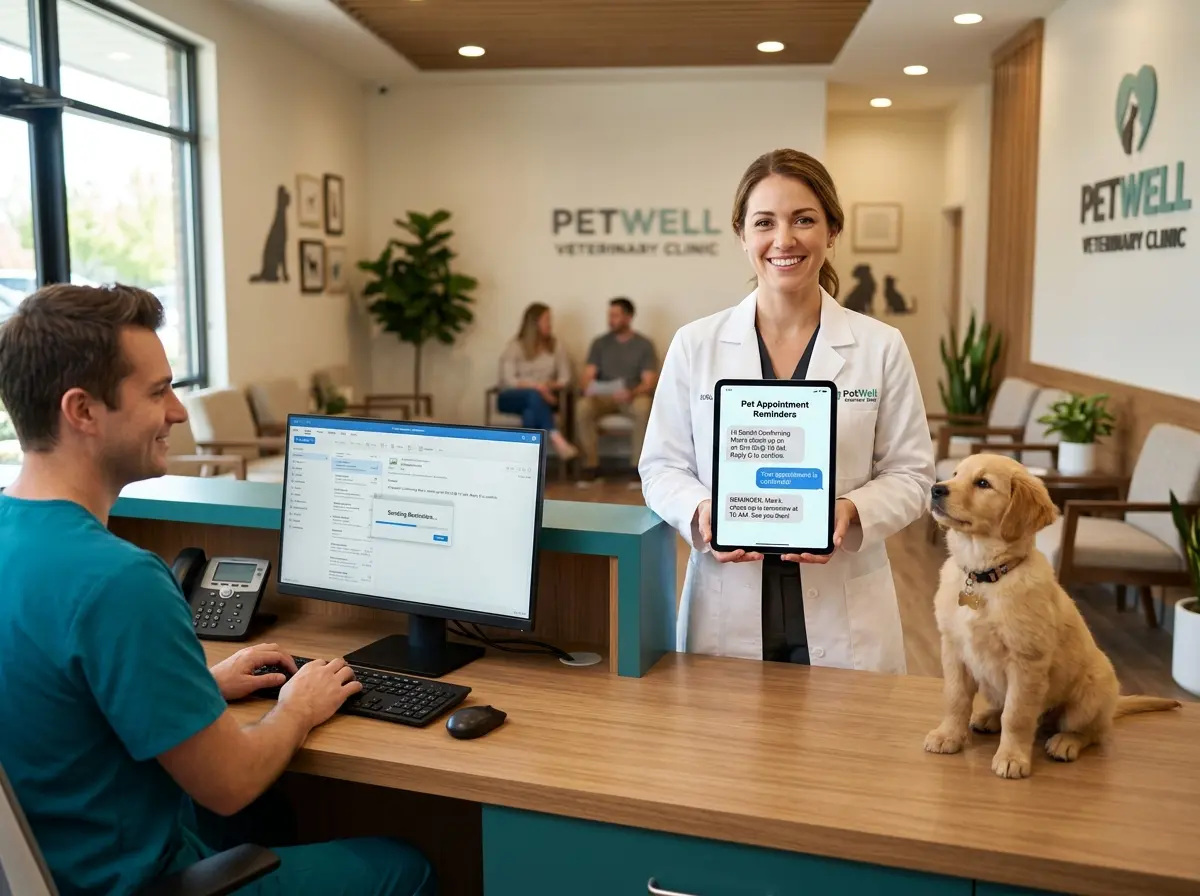
A sample message might look like this: "Hi [Name]! 🐾 This is [Clinic Name] confirming your appointment for [Pet Name] on [Day], [Date] at [Time]. We're looking forward to seeing them! Need to reschedule? Just reply to this message or call us at [Phone Number]."
Keep it warm, keep it short, and make the exit ramp easy to find. You'd rather know about a cancellation early than discover an empty room on the day of the appointment.
Message 2: The 48-Hour Reminder With a Prep Nudge
Two days before the appointment is your most important touchpoint. This is early enough to allow for rebooking if someone cancels, and close enough to actually jog their memory. This message should confirm the appointment again and add a small piece of helpful information — a prep tip relevant to the visit type.
For example: "Hi [Name]! Just a reminder that [Pet Name] has an appointment at [Clinic Name] this [Day] at [Time]. 🐕 If this is a wellness visit, no special prep needed — just bring your furry friend and any questions you have! Reply YES to confirm or call us at [Phone] to reschedule."
Asking for a confirmation reply does two things: it gives you actionable data on who's actually planning to show up, and it psychologically reinforces the commitment in the client's mind. A client who replies "YES" is significantly more likely to walk through your door.
Message 3: The Day-Before Final Reminder
One last nudge the evening before — or the morning of, depending on your appointment time — keeps the visit front of mind and handles any last-minute prep details. Keep this one brief. By now, they know the appointment exists. You're just making sure it doesn't slip through the cracks during a busy Tuesday morning.
"See you tomorrow, [Pet Name]! 🐾 Your appointment at [Clinic Name] is at [Time]. Please arrive 5 minutes early to complete any paperwork. Questions? Call us at [Phone]. We can't wait to see you!"
That final line — "we can't wait to see you" — is worth its weight in gold. It's a small emotional touch that reminds clients your team actually cares, which makes them feel accountable in the best possible way.
How Technology Makes This Effortless
Automating the Sequence Without Adding to Your Team's Workload
Here's where most clinics get tripped up: the sequence above works beautifully in theory, but manually sending three texts per client per appointment is simply not going to happen. Your front desk team is already juggling phones, check-ins, billing questions, and the occasional escaped cat in the waiting room. Adding "personal texting assistant" to their job description is a fast track to burnout — and inconsistency.
The solution is automation. Most modern practice management platforms offer built-in or integrated messaging tools that can trigger texts based on appointment status and timing. If yours doesn't, standalone tools like Podium, Weave, or even simple SMS automation platforms can fill the gap. The key is building the sequence once, setting the triggers, and letting the system handle the rest.
And while you're thinking about reducing the burden on your front desk, it's worth considering what else is eating their time. Stella — the AI robot employee and phone receptionist — can handle incoming calls around the clock, answer common questions about services, hours, and policies, and even collect intake information from clients before their visit through conversational forms. That means your human staff can focus on the clients actually standing in front of them, rather than fielding the same five questions by phone all day. Stella's built-in CRM also keeps client contact details organized and accessible, which makes managing follow-up communication significantly easier.
Reducing No-Shows Beyond the Reminder Sequence
Make Canceling and Rescheduling Ridiculously Easy
One underrated driver of no-shows is friction. When a client realizes they can't make an appointment but dreads the process of calling during business hours, waiting on hold, and explaining themselves to a receptionist, they sometimes do nothing. And nothing, in this context, is expensive for you.
Include a direct reply option in every text so clients can respond without making a call. Even better, include a link to your online scheduling tool so they can swap to a new time in 60 seconds. The easier you make it to reschedule, the more clients will do exactly that — rather than simply disappearing. A filled appointment at a different time is infinitely better than an empty slot.
Follow Up After a No-Show (Without Shaming Anyone)
When a client does miss an appointment, don't just write it off. A brief, non-judgmental follow-up text sent the same day — something like "We missed you and [Pet Name] today! Life happens. Ready to reschedule? Click here or give us a call." — can recover a surprising percentage of those appointments. It also demonstrates that your clinic is proactive and caring, which reinforces the relationship rather than damaging it.
Track your no-show rate by client over time. A client who misses appointments repeatedly may benefit from a phone call instead of a text, or a deposit requirement at booking. Most practice management systems can flag this pattern if you know what to look for.
Ask for Feedback to Continuously Improve
If you notice certain appointment types, certain time slots, or certain client demographics showing higher no-show rates, dig in. A brief post-visit or post-no-show survey can surface insights you'd never find otherwise. Maybe your morning slots work better for certain clients. Maybe a particular service needs clearer prep instructions. Small adjustments to your sequence based on real data can compound significantly over time.
Quick Reminder About Stella
Stella is an AI robot employee and phone receptionist that answers calls 24/7, greets walk-in clients, collects intake information, and manages customer contacts through a built-in CRM — all for $99/month with no upfront hardware costs. For veterinary clinics looking to reduce front desk overwhelm while keeping communication professional and consistent, she's a surprisingly practical addition to the team. No sick days, no bad moods, no accidentally putting someone on hold for eight minutes.
Start Reducing No-Shows This Week
You don't need to overhaul your entire operation to see results. Start with the three-message sequence outlined above — a confirmation at booking, a reminder with prep info 48 hours out, and a brief nudge the day before. If your practice management software supports automation, set it up today. If not, explore integrations or standalone SMS tools that can handle the triggers for you.
From there, plug the gaps: make canceling easy, follow up on no-shows with warmth instead of frustration, and use your data to refine the approach over time. And while you're building a more efficient client communication system, take a hard look at what else your front desk could hand off — because the less time your team spends answering the same questions by phone, the more time they spend delivering the kind of care that keeps clients coming back.
Biscuit deserves his dental cleaning. Let's make sure he gets it.