When "My AC Is Broken" Could Mean Anything From Mildly Inconvenient to Actually Dangerous
It's 2:00 AM on the hottest night of the year. Your phone rings. A panicked voice on the other end says their air conditioning is out and they need someone right now. So you drag yourself out of bed, wake up a technician, and dispatch them across town — only to discover that the customer's "emergency" was a tripped breaker that they could have reset themselves in thirty seconds.
Sound familiar? If you run an HVAC company, it probably sounds like last Tuesday.
Emergency dispatching is one of the most expensive and operationally chaotic parts of running an HVAC business. Every unnecessary truck roll eats into your margins, burns out your technicians, and creates scheduling chaos for actual emergencies. The fix isn't hiring more staff to answer phones at all hours — it's making sure the calls are properly qualified before anyone gets dispatched. That's exactly where AI-powered call handling is changing the game for HVAC companies of every size.
The Real Cost of Unqualified Emergency Calls
Before we talk about solutions, let's get honest about the problem. Unqualified emergency calls aren't just mildly annoying — they're quietly bleeding your business dry in ways that don't always show up cleanly on a profit and loss statement.
Technician Burnout Is a Real and Expensive Problem
According to industry data, HVAC technician turnover rates consistently hover around 20–30% annually — and that number climbs when technicians feel like their time isn't being respected. Getting called out at midnight for a non-emergency isn't just inconvenient; it erodes morale, shortens careers, and sends good people looking for employers who value their time. Replacing a skilled HVAC technician can cost anywhere from $5,000 to $15,000 when you factor in recruiting, onboarding, and lost productivity. That's a steep price for skipping a five-minute qualification call.
Unnecessary Truck Rolls Are Quietly Killing Your Margins
The average HVAC truck roll costs between $200 and $500 when you account for fuel, wear, labor, and opportunity cost. If you're dispatching on unqualified calls even three or four times a week, you're looking at potentially $30,000 to $100,000 in unnecessary expenses over the course of a year. Worse, those dispatches are pulling your technicians away from paying jobs they could have taken instead. Every unnecessary emergency call isn't just a cost — it's also a missed revenue opportunity sitting on your books as an invisible loss.
After-Hours Answering Services Often Make This Worse
Many HVAC companies rely on after-hours answering services to handle overnight calls. The problem is that most of these services follow a simple script: take the name, take the number, declare it an emergency, and pass it along. They have no technical knowledge, no authority to ask qualifying questions, and no accountability for whether the dispatch was actually warranted. They're not incompetent — they're just not equipped to do what actually needs to happen, which is a real conversation that figures out whether a furnace is truly failing or whether someone just forgot to change their air filter.
How AI Call Qualification Actually Works in Practice
This is where the practical magic happens, and it's simpler than most business owners expect. AI phone receptionists can be configured with a specific set of qualifying questions that guide callers through a logical triage process — the same way a knowledgeable front-desk employee would, except available at 3:00 AM without overtime pay and without ever having a bad day.
How Stella Fits Into Your HVAC Operation
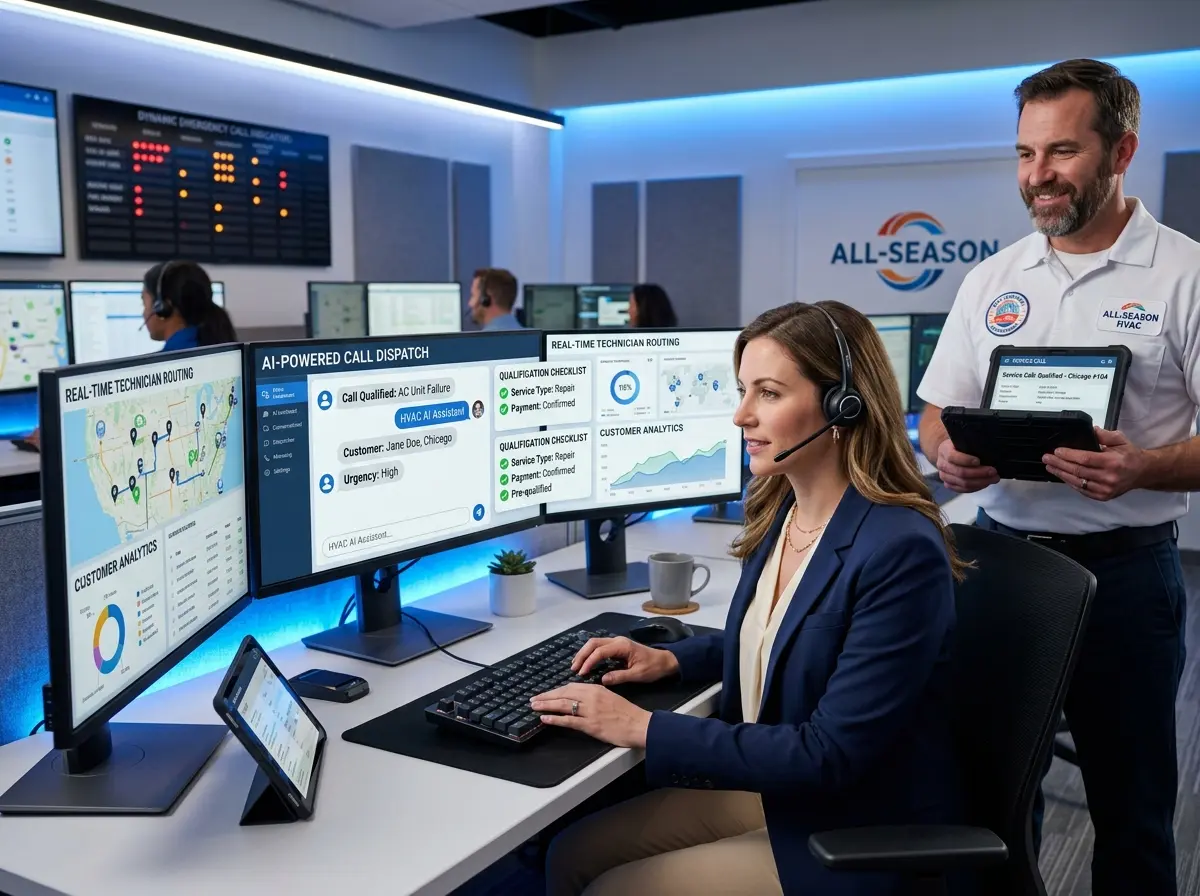
Stella is an AI robot employee and phone receptionist built for businesses exactly like yours. For HVAC companies, her phone answering capabilities are particularly valuable for after-hours call handling and emergency triage. She can be configured with your specific qualifying questions — asking callers about the nature of the problem, how long the issue has been occurring, whether safety concerns like gas smells or carbon monoxide alarms are present, and what the indoor temperature currently reads. Based on those answers, she can either escalate the call immediately to an on-call technician, schedule a next-day appointment, or walk the customer through basic self-service steps for common non-emergencies.
Stella also captures all of that intake information through her built-in CRM and conversational intake forms, so when a technician does get dispatched, they're not walking in blind. The job details, customer contact information, and problem description are already logged and accessible — no sticky notes, no garbled voicemails, no "I think he said something about the compressor." For HVAC companies managing a high volume of service calls, that kind of structured data capture is genuinely transformative.
Building an Effective Emergency Triage Framework
Whether you're using AI or training a human dispatcher, the quality of your emergency qualification process comes down to having a clear, consistent framework. Here's how to build one that actually works.
Define What Constitutes a True Emergency
This sounds obvious, but most HVAC companies have never written it down. A true emergency typically involves a safety risk — gas leaks, carbon monoxide detection, complete heating failure during freezing temperatures, or a refrigerant leak in an occupied space. It might also include commercial situations where equipment failure is causing significant financial loss, like a restaurant walk-in cooler going down. Everything else, while genuinely frustrating for the customer, is a high-priority service call that can be addressed first thing in the morning.
Document your emergency criteria clearly, communicate them to your call handling system or staff, and make sure the criteria are reviewed seasonally — what counts as an emergency in January in Minnesota is different from what counts as one in July in Texas.
Design a Triage Script That Guides, Not Interrogates
The goal of qualifying questions isn't to make customers feel like they're being cross-examined at 2:00 AM — it's to efficiently gather the information needed to make a good dispatching decision. A well-designed triage script starts with empathy, moves quickly to the most critical safety questions, and then works through the diagnostic details. Questions should be simple, direct, and sequenced logically. Start with: Is anyone in the home experiencing any health symptoms, or are there any unusual smells or alarms going off? That single question handles the safety triage before anything else. From there, you move to equipment type, symptom description, and timeline.
Create Clear Escalation Paths Based on Responses
Not every call needs the same response, and your framework should reflect that. Consider building at least three response tiers: immediate dispatch for confirmed safety emergencies, same-day priority scheduling for urgent but non-dangerous situations, and standard next-available scheduling for everything else. When callers understand that their call is being handled appropriately — not just brushed off — they're far less likely to push back against a non-emergency classification. Communicate the expected response time at every tier, and make sure the customer leaves the call with a confirmation and a clear next step.
Quick Reminder About Stella
Stella is an AI robot employee and phone receptionist available for just $99 per month with no upfront hardware costs. She answers calls 24/7, collects customer information through built-in intake forms and CRM tools, and handles emergency triage with the same professionalism every single time — whether it's noon or 3:00 AM. For HVAC companies looking to stop the bleeding on unnecessary dispatches, she's worth a serious look.
Stop Dispatching on Hope and Start Dispatching on Data
The HVAC industry runs on response time and reputation. Customers remember who showed up when they needed help, and they also remember who wasted their technician's time on a call that turned out to be a tripped breaker. Building a smarter emergency qualification process isn't about being less responsive — it's about being more intelligent with your resources so you can actually show up better when it truly counts.
Here's how to get started this week:
- Audit your last 30 emergency dispatches. How many were genuine emergencies? How many could have been resolved with a phone conversation or a next-day appointment? The data will tell you exactly how much this problem is costing you.
- Write down your emergency criteria. Define the scenarios that warrant an immediate after-hours dispatch, and make sure that definition is shared with everyone handling your phones.
- Build or adopt a triage script. Whether you're training a human, configuring an AI receptionist, or both, document the qualifying questions and escalation paths so the process is consistent and repeatable.
- Evaluate your after-hours call handling solution. If your current setup can't ask qualifying questions and make intelligent routing decisions, it's time to look at what AI can do for your operation.
Your technicians are your most valuable and most finite resource. Protect their time, protect your margins, and let smarter call qualification do the work that no amount of caffeine and goodwill can sustain over the long run. Your 2:00 AM self — and your entire team — will thank you.