Introduction: The Walk-In Dilemma Every Nail Salon Owner Knows Too Well
Picture this: It's a busy Saturday afternoon. Your stylists are heads-down on appointments, the phone is ringing, someone at the front desk is trying to check out a client, and three walk-in customers just strolled through your door with fresh manicure money burning a hole in their pockets. What happens next? In a perfect world, they're greeted, added to a waitlist, given an accurate wait time, and happily seated with a complimentary beverage. In the real world? They stand there awkwardly for two minutes, make uncomfortable eye contact with a technician who's in the middle of a full set, and quietly leave to book an appointment at the salon down the street.
Walk-in customers are one of the most valuable — and most underserved — revenue streams for nail salons. They showed up with zero prompting, no advertising spend, and immediate purchase intent. And yet, without a structured walk-in management system, salons lose a staggering number of these drop-in clients every single week. According to industry research, businesses that fail to acknowledge a customer within the first few minutes of their arrival see dramatically higher abandonment rates. In a nail salon setting, that translates directly to lost revenue, and worse, lost loyalty.
The good news? Fixing this doesn't require a complete operational overhaul. It requires a structured approach to managing walk-ins — one that respects your staff's bandwidth, keeps customers informed and engaged, and converts more of those spontaneous visitors into paying, returning clients. Let's break it down.
Understanding Why Walk-In Revenue Leaks Happen
The "Everyone's Busy" Bottleneck
The most common reason nail salons lose walk-in customers is deceptively simple: nobody has time to handle them properly. Your front desk associate is juggling phone calls, scheduling, and checkout simultaneously. Your technicians are mid-service and can't pause to assess capacity or quote wait times. The result is a chaotic first impression that signals to walk-in clients — consciously or not — that their business isn't particularly wanted.
This isn't a staffing failure; it's a systems failure. When the front-of-house process isn't designed to absorb walk-ins smoothly, every drop-in customer becomes an interruption rather than an opportunity. The fix starts with acknowledging that walk-ins need their own dedicated workflow, separate from the appointment pipeline.
Inconsistent Communication Creates Walk-Out Moments
Even when a walk-in customer is acknowledged, inconsistent communication can still cost you the sale. If one staff member quotes a 20-minute wait and another says 45 minutes, you've planted a seed of distrust before a single nail has been shaped. Customers who feel uncertain about wait times are far more likely to leave "just to grab a coffee" and never come back.
A structured system removes the guesswork. When every walk-in receives the same professional intake process — name collected, service preference noted, accurate wait time communicated, and a clear expectation set — your abandonment rate drops significantly. Consistency is not glamorous, but it is profitable.
Missed Opportunities to Upsell During the Wait
Here's the part that most salon owners overlook entirely: the wait itself is a revenue opportunity. A customer sitting in your waiting area for 15 to 20 minutes is a captive audience. If your only strategy is a stack of outdated magazines and a television playing cable news, you're leaving serious money on the table. This is the perfect moment to promote add-on services, seasonal specials, loyalty programs, or retail products. A well-structured walk-in process includes an intentional "while you wait" experience that primes customers to spend more before they even sit down at a station.
How Modern Tools — Including AI — Can Streamline Your Walk-In Process
Letting Technology Handle the First Impression
One of the most practical upgrades a nail salon can make is introducing an in-store presence that greets and engages walk-ins automatically — without pulling your staff away from paying clients. This is exactly where Stella, the AI robot employee and kiosk, earns her keep. Stationed near your entrance, Stella greets every customer who walks in, answers questions about services and pricing, communicates current wait times, promotes any active specials, and collects customer intake information — all without requiring a single staff member to look up from a nail file.
Beyond the in-store experience, Stella also answers your salon's phone calls around the clock. So when someone calls to ask about walk-in availability on a Tuesday evening, they get an immediate, informed, professional response — not a voicemail. For salons that lose walk-in revenue because potential customers couldn't get a quick answer on the phone before deciding to show up, this alone can be a meaningful improvement. At $99 per month with no upfront hardware costs, she's considerably cheaper than the alternative of hiring additional front desk staff.
Building Your Walk-In Management System From the Ground Up
Step One — Create a Dedicated Walk-In Intake Process
Every walk-in customer should go through a brief, consistent intake process the moment they arrive. This means collecting their name, desired service, and any relevant preferences before they wait. Not only does this make your operation feel more professional and organized, it gives your technicians advance notice so they can mentally prepare for the next client in queue. It also creates a customer record — even for first-time visitors — that can be used to build loyalty over time.
Whether this intake is handled by a staff member, a digital kiosk, or an AI-powered assistant, the key is that it happens every time, without exception. Sporadic implementation is almost as bad as no system at all, because it creates the same inconsistency problem you're trying to solve.
Step Two — Set and Manage Wait Time Expectations Proactively
Customers can handle a 30-minute wait. What they cannot handle is uncertainty. The moment a walk-in customer receives a clear, honest wait time estimate — and believes it — their likelihood of staying increases substantially. Build a simple internal process for tracking open technician slots and service durations so that whoever is communicating wait times is working from real data rather than guessing optimistically.
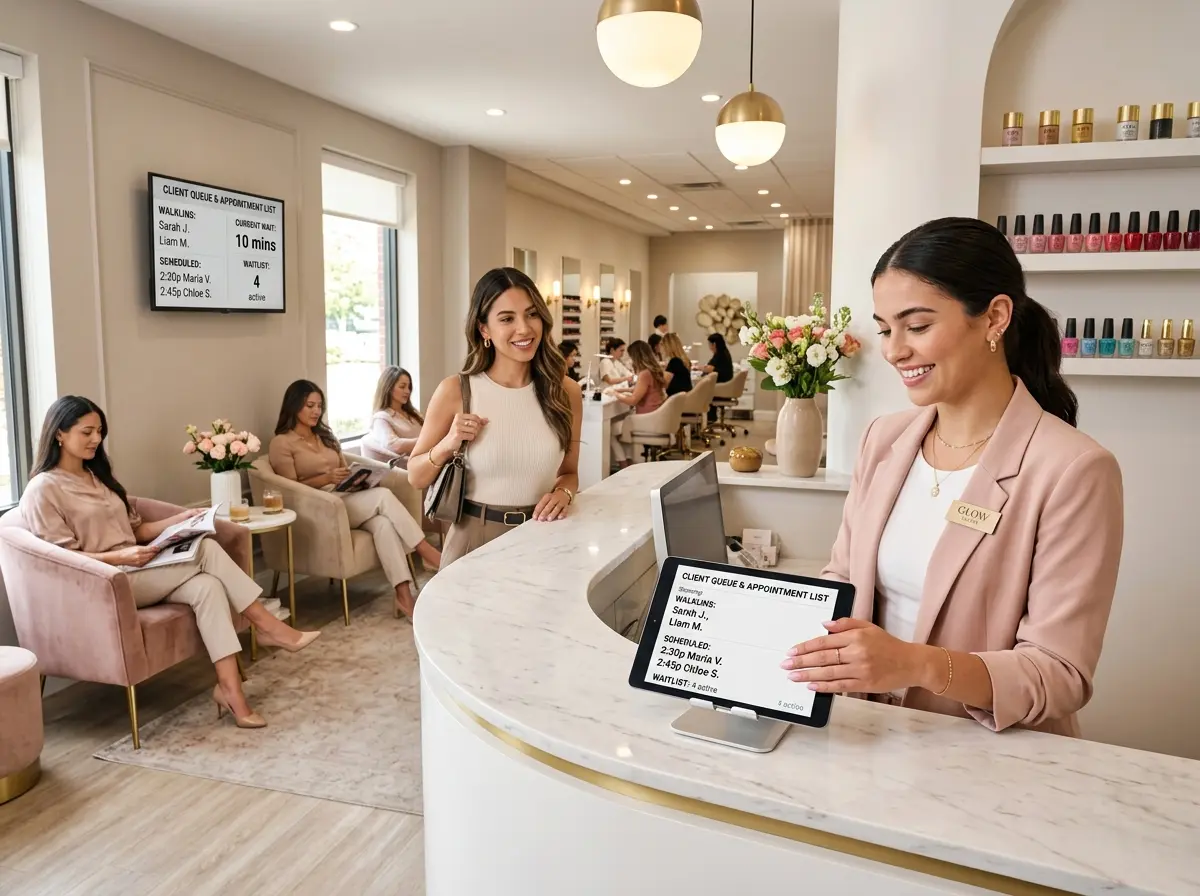
Consider posting real-time wait status at your front entrance, whether digitally or through a simple physical board. Transparency signals confidence, and confidence keeps customers in their seats. If your wait time changes, communicate the update proactively. A quick "just wanted to let you know it'll be about 10 more minutes" does more for customer retention than any loyalty punch card.
Step Three — Design the Waiting Experience as a Revenue Channel
Once you have customers in your waiting area, put that time to work. Display your service menu prominently and make it easy to browse add-ons like nail art upgrades, paraffin treatments, or gel top coats. Train your front desk staff or configure your kiosk to mention current promotions during intake. Offer retail product samples or small testers for customers to explore while they wait. The goal is to shift the waiting experience from passive to engaging, so that by the time a customer sits down at the station, they've already decided to add something to their service.
Salons that treat the waiting area as dead time are effectively giving away free floor space. Salons that treat it as a soft sales floor see measurable increases in average ticket size — often without any additional marketing spend.
Quick Reminder About Stella
Stella is an AI robot employee and phone receptionist designed to help businesses like nail salons deliver a consistent, professional customer experience without overloading their human staff. She greets walk-ins in-store, answers phone calls 24/7, promotes specials, handles customer intake, and keeps your front-of-house running smoothly — all for $99 per month with no complicated setup or upfront hardware costs.
Conclusion: Stop Letting Walk-In Revenue Walk Out the Door
Walk-in customers are not a nuisance to manage around your appointment book — they are a meaningful revenue stream that, with the right systems in place, can significantly boost your weekly and monthly numbers. The salons that thrive long-term are the ones that treat every person who crosses their threshold, whether scheduled or spontaneous, as a valued guest who deserves a professional, consistent experience.
Here are your actionable next steps to get started today:
- Audit your current walk-in process. Walk through your own front door as if you were a first-time customer and observe what happens. You may be surprised — and not pleasantly.
- Create a standardized intake checklist for walk-in customers that every front desk staff member follows without exception.
- Establish a real-time wait tracking method that allows you to give honest, accurate time estimates — and communicate updates proactively.
- Redesign your waiting area with intention. Add service menu displays, highlight current promotions, and give customers something meaningful to engage with while they wait.
- Evaluate whether technology can help fill the gaps — particularly during peak hours or when staffing is lean. Tools like an AI kiosk and phone receptionist can handle first-contact responsibilities reliably, so your human team can focus on delivering excellent services.
Your walk-in customers showed up for a reason. Give them a reason to stay — and an even better reason to come back.