Introduction: Because Word-of-Mouth Shouldn't Require You to Beg
Let's be honest — as a cleaning company owner, you've probably heard some version of this advice before: "Just ask your happy customers for referrals!" Great tip. Super specific. Very actionable. Thanks for nothing.
The truth is, referral programs are one of the most powerful growth engines a service business can build. According to Nielsen, 92% of consumers trust recommendations from friends and family over any other form of advertising. And referred customers tend to have higher lifetime value, convert faster, and complain less. Basically, they're the dream clients you didn't have to chase down on Facebook at 11 PM.
The problem isn't that referrals don't work — it's that most cleaning businesses run their referral programs the same way they run their sock drawers: loosely, inconsistently, and with vague intentions to "organize it later." The result? A few random referrals trickle in, nothing is tracked, and you have no idea if your "program" is actually working or if it's just dumb luck.
This guide is here to change that. We're going to walk you through how to build a referral program that's structured, automated where possible, and actually runs without requiring your constant attention. Because you have floors to clean. Or at least, a business that cleans floors. You know what we mean.
Laying the Foundation: Building a Referral Program Worth Talking About
Start With a Service That Earns the Referral
Before we talk about incentives, tracking, or automation, let's address the elephant in the (freshly mopped) room: no referral program in the world will save a mediocre cleaning service. The foundation of any successful referral program is a customer experience so consistently good that people want to tell their neighbors about you.
This means showing up on time, communicating proactively, delivering consistent results, and handling the occasional complaint with grace. Standardize your service quality with checklists, train your team thoroughly, and follow up after appointments. A simple post-service text or email asking "How did we do?" does double duty — it shows customers you care, and it gives you a natural opening to ask for a referral from satisfied clients.
Design an Incentive Structure That Actually Motivates
Here's where most cleaning companies get it wrong: they offer a $5 discount as a referral reward and then wonder why nobody is beating down their door with leads. Your incentive needs to be meaningful enough to spark action — but it also needs to make business sense.
A commonly effective structure for cleaning businesses looks something like this: offer the referring customer a $25–$50 credit toward their next cleaning, and give the new customer a discount on their first booking (say, 15–20% off). Both parties win, and you've just acquired a new customer for the cost of a modest discount — which is almost always cheaper than paid advertising.
You can also experiment with tiered rewards for repeat referrers. A customer who sends you three clients in a year deserves something more exciting than another coupon — maybe a free cleaning, a branded gift basket, or a partnership with a local business for a gift card. A little creativity goes a long way in making people feel genuinely appreciated rather than transactionally rewarded.
Make It Ridiculously Easy to Refer
Friction is the enemy of referrals. If a customer has to fill out a three-page form, remember a special code, and mail something in to refer a friend, they're not going to do it — no matter how much they love your service. Reduce the steps to the absolute minimum.
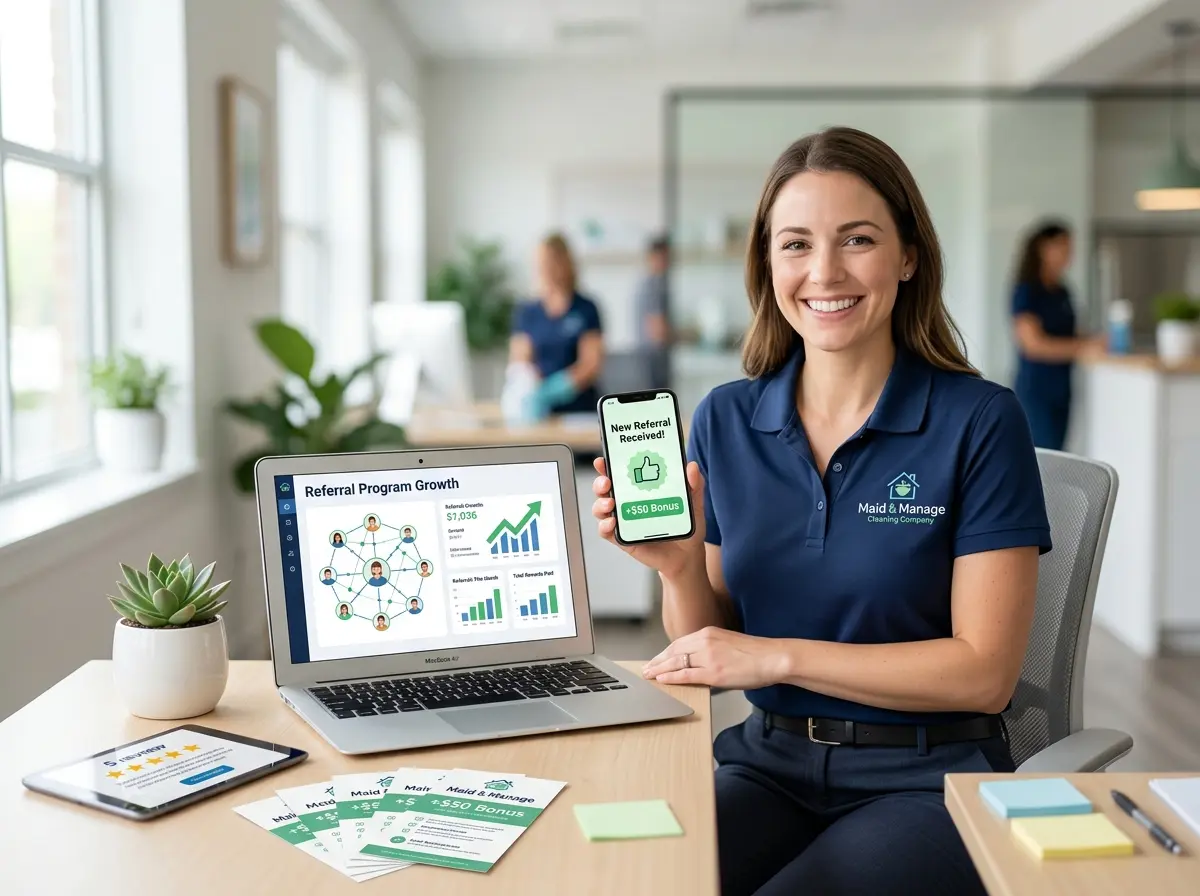
Give customers a unique referral link they can text or share on social media. Create simple referral cards your team can leave behind after a cleaning. Set up a one-click referral request in your post-service follow-up emails. The easier you make the process, the more referrals you'll collect — and the more your program will start to feel like it's running itself.
Automating the Follow-Up: Let Technology Do the Awkward Part
Using Tools to Track, Remind, and Reward Without Lifting a Finger
Once your referral program is designed, automation is what transforms it from a good idea into a well-oiled machine. Set up automated email or SMS sequences that go out after every completed job, gently reminding satisfied customers about your referral program. Use scheduling or CRM software to tag referred customers, track who sent them, and automatically trigger the reward once the new customer completes their first cleaning.
This is also where Stella — the AI robot employee and phone receptionist — can quietly become one of your best team members. When customers call to book, reschedule, or ask questions, Stella handles those conversations 24/7 with consistent professionalism, which means your referral program details are always communicated accurately, no matter when someone calls. She can also mention current promotions during phone interactions — including your referral offer — so no opportunity slips through the cracks simply because it was after business hours or your staff was busy.
Stella's built-in CRM and conversational intake forms also make it easy to capture and tag referred customers right at the point of first contact, whether they call in or engage via the web. No more sticky notes on the fridge labeled "Karen referred by Linda???" — every referral is documented, organized, and ready for follow-up.
Spreading the Word: Promoting Your Referral Program Without Being Annoying
Integrate Referral Mentions Into Your Existing Customer Touchpoints
You don't need a separate marketing campaign to promote your referral program — you just need to weave it into the communication you're already doing. Add a line about your referral program to your post-service emails. Include it in your invoice footer. Mention it in your on-hold message. Post about it on social media once a month. Train your team to say something simple at the end of every job, like "By the way, if you know anyone else looking for a reliable cleaning service, we have a referral program that rewards you both."
These small, consistent touchpoints compound over time. You're not begging — you're simply making sure your happy customers know the option exists. Most people are genuinely glad to help a small business they like; they just need a gentle nudge and a clear path forward.
Leverage Social Proof to Amplify Organic Referrals
Referrals don't only happen one-on-one. Online reviews, social media posts, and neighborhood app recommendations (Nextdoor, for example, is a goldmine for local cleaning businesses) are essentially public referrals — and they work around the clock. Encourage satisfied customers to leave Google or Yelp reviews as part of your post-service follow-up sequence. When someone tags your business in a glowing social media post, reshare it and thank them publicly. This kind of social proof not only reinforces trust for prospective customers but also signals to your existing clients that you're a business worth recommending.
A cleaning company in Austin reportedly grew its residential client base by 40% in under a year largely through a combination of a structured referral program and a proactive online review strategy. The investment? Mostly time, a simple email automation, and a commitment to consistently excellent service. The ROI? Considerably better than whatever they would have spent on Google ads for the same period.
Track What's Working and Adjust Without Drama
A referral program that isn't measured is just hope with a discount code. Set up basic tracking from day one: how many referrals came in this month, how many converted to paying customers, what was the average value of referred customers versus non-referred ones, and which incentive structures are driving the most action.
Review these numbers quarterly — not obsessively, but consistently. If your referral rate is flat despite great service, maybe the incentive needs a refresh. If you're getting referrals but low conversions, the problem might be in your follow-up process. Let the data guide your adjustments, and don't be afraid to try something new. Referral programs, like clean kitchens, benefit enormously from the occasional deep scrub and reorganization.
Quick Reminder About Stella
Stella is an AI robot employee and phone receptionist that answers calls 24/7, manages customer intake, promotes your services and offers, and keeps your CRM organized — all for just $99/month with no upfront hardware costs. Whether a referred customer calls at 7 AM or 10 PM to ask about your pricing, Stella handles it with the same professionalism every single time. For a cleaning company working hard to make every customer touchpoint shine, she's the kind of hire that never calls in sick and never forgets to mention the referral program.
Conclusion: Build It Once, Then Let It Work for You
Building a referral program that runs on autopilot isn't about finding a magic button — it's about making smart decisions up front so the system does the heavy lifting later. Start with exceptional service. Design an incentive that feels genuinely rewarding. Remove every possible point of friction. Automate your follow-up. Integrate referral mentions naturally into your existing communications. Track what's working, and refine as you go.
Here are your concrete next steps to get started this week:
- Audit your current customer communication flow — identify two or three places where a referral mention would feel natural and add it in.
- Choose your incentive structure — decide on a reward for the referrer and an offer for the new customer, and make sure the math works for your margins.
- Set up basic tracking — whether it's a CRM, a spreadsheet, or a dedicated referral platform, you need somewhere to log referrals and attribute new customers correctly.
- Automate your post-service follow-up — even a simple two-email sequence asking for feedback and mentioning your referral program can dramatically increase participation.
- Train your team — make sure every cleaner knows the program exists and knows how to mention it naturally at the end of a job.
Your best customers already want to help you grow. Give them a reason, give them a path, and then — crucially — get out of the way and let the program run. Your mop bucket will thank you.