Introduction: Because "Just Post Pretty Pictures" Is Not a Marketing Strategy
Let's be honest — Pinterest has a reputation problem in the business world. Most spa owners either dismiss it as a glorified scrapbook for wedding planners and DIY enthusiasts, or they create an account, pin a few stock photos of candles and cucumber water, and then wonder why their appointment book isn't suddenly overflowing. Neither approach is doing you any favors.
Here's the thing: Pinterest is quietly one of the most powerful booking-drivers in the wellness industry, and your competitors who figured that out are already reaping the rewards. Unlike Instagram or TikTok, Pinterest functions as a visual search engine — people come to it with intent. They're actively searching for "relaxing spa day ideas," "best facial treatments for sensitive skin," or "what to expect at a couples massage." These are not passive scrollers. These are people with credit cards and a serious need to unwind.
According to Pinterest's own business data, 97% of top searches on the platform are unbranded — meaning people are searching for experiences and ideas, not specific businesses. That's your opportunity. With the right strategy, your day spa can show up exactly when someone is ready to treat themselves (or finally book that gift for their mother-in-law's birthday they've been procrastinating on for three weeks).
This guide will walk you through how to build inspiration boards that don't just collect saves — they drive actual bookings. Let's get into it.
Building a Pinterest Presence That Actually Works
Setting Up Your Business Account Like You Mean It
If you're still using a personal Pinterest account for your spa, it's time for an upgrade. A Pinterest Business Account is free and gives you access to analytics, rich pins, and the ability to run ads — all things you'll eventually want. More importantly, it signals to Pinterest's algorithm that you're a legitimate business, which affects how your content is distributed.
Start by claiming your website, filling out your profile completely with your spa's name, location, and a keyword-rich bio. Think about what your ideal client would type into a search bar: "luxury day spa in [your city]," "organic facial treatments," "prenatal massage near me." Weave those phrases naturally into your profile description. This is SEO work, not poetry — accuracy and clarity win here.
Then set up your boards with the same intentionality. Don't just create a board called "Spa Stuff." Create boards like "Relaxing Facial Treatments We Offer," "The Ultimate Self-Care Day Guide," or "What to Expect During Your First Massage." These board titles are searchable, and they immediately communicate value to a potential client browsing your profile.
Creating Pins That Convert, Not Just Inspire
A beautiful pin that leads nowhere is just digital art. Every pin you create should have a purpose, and ideally that purpose involves someone clicking through to your website and booking an appointment. That means each pin needs three things: a compelling visual, a clear description with keywords, and a direct link to a relevant landing page — not just your homepage.
For a spa, your visual options are genuinely wonderful. High-quality photos of your treatment rooms, products you use, before-and-after skin results (with client permission, obviously), and serene lifestyle imagery all perform well. Video pins and idea pins are getting significant algorithmic love right now, so short clips of a relaxing stone massage or a step-by-step skincare tip can dramatically expand your reach.
A good rule of thumb: every service you offer should have at least one dedicated pin. Your Swedish massage package, your seasonal pumpkin spice facial (yes, people search for these), your membership tiers — all of it deserves its own pinnable moment. And don't forget to include a subtle call to action in your pin descriptions, like "Book your appointment at [your website]" or "Tap to see our current specials."
The Power of Seasonal and Trending Boards
Pinterest users plan ahead — way ahead. Research shows that holiday-related searches on Pinterest begin six to eight weeks earlier than on other platforms. That means your Valentine's Day couples massage content should be live in early January, your summer glow facial content should debut in April, and your holiday gift certificate campaign should absolutely be running before Thanksgiving.
Create dedicated seasonal boards and refresh them every year with new content. "Mother's Day Spa Gift Ideas," "New Year New Skin," and "Summer Glow Treatments" are perpetually searchable boards that can drive consistent traffic year after year with minimal ongoing effort. Pinterest rewards consistency, and seasonal content gives you a natural editorial calendar to follow — which is frankly more structure than most spa owners have in their social media approach.
Turning Pinterest Traffic Into Booked Appointments
The Gap Between Interest and Action (And How to Close It)
You've done the work — beautiful boards, keyword-rich descriptions, strategic seasonal content. Someone clicks through from Pinterest to your website, looks around, and then... leaves. This is the part where a lot of spas lose potential clients, and it's entirely preventable. The bridge between a Pinterest browser and a confirmed booking is a frictionless booking experience combined with responsive customer communication.
Your Pinterest strategy needs to connect to your real-world operations, and that includes how you handle inquiries. Many potential clients who discover you through Pinterest will want to ask a quick question before committing — about pricing, what a treatment involves, whether you offer a specific product, or what your availability looks like. If they call and get voicemail, or if your website doesn't make it immediately obvious how to reach someone, you've just lost a warm lead to a competitor with a more accessible front desk.
This is exactly where Stella steps in. Stella is an AI robot employee and phone receptionist that answers calls 24/7 with full knowledge of your spa's services, pricing, specials, and policies — so when that curious Pinterest browser calls at 9pm on a Tuesday to ask about your aromatherapy package, they get a real, helpful answer instead of voicemail. For spas with a physical location, Stella also stands inside your space as a friendly kiosk that proactively greets clients, answers questions, and promotes current offers — so your human staff can stay focused on delivering exceptional treatments rather than fielding the same questions repeatedly.
Measuring What Matters and Iterating Like a Pro
Pinterest Analytics: Your New Best Friend
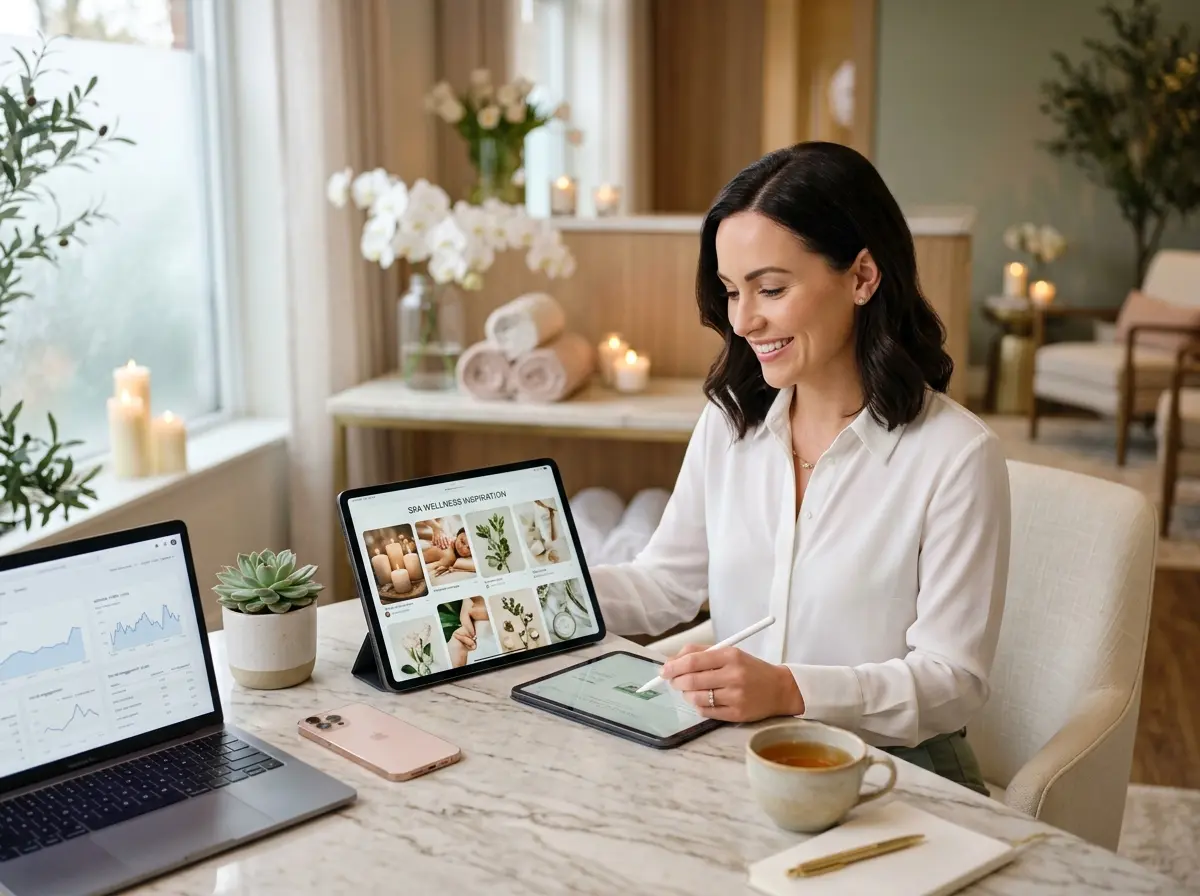
Pinterest's built-in analytics dashboard is genuinely useful, and most business owners barely glance at it. Your analytics will show you which pins are getting the most impressions, saves, and outbound clicks — and that last metric is the one you should care about most. Saves are flattering; clicks mean someone actually visited your website. Focus your energy on creating more content that resembles your top-performing click-drivers.
Pay particular attention to your audience insights section, which tells you about the demographics and interests of people engaging with your content. If you discover that a significant portion of your Pinterest audience is interested in "clean beauty" and "organic skincare," that's a signal to lean into those themes in your content — and possibly in your service offerings. Pinterest is giving you market research data for free. Use it.
A/B Testing Your Way to Better Performance
Pinterest makes it relatively simple to test variations of your content. Try creating two versions of a pin for the same service — one with a lifestyle photo and one showing a close-up of a treatment in progress — and see which performs better over 30 days. Test different descriptions, different calls to action, and different destination URLs (your booking page versus a service detail page, for example).
This doesn't have to be elaborate or scientific. Even informal testing gives you directional data that makes your future content decisions smarter. Over time, you'll develop an intuitive sense of what your specific audience responds to, and your Pinterest strategy will get more efficient as a result. The goal is to stop guessing and start iterating — which is how real marketing works, regardless of the platform.
Integrating Pinterest Into Your Broader Marketing Ecosystem
Pinterest shouldn't exist in isolation from the rest of your marketing. Your best-performing pins should be repurposed across Instagram and Facebook. Your blog posts about skincare tips or self-care routines should be pinned with rich pins enabled so they show up with full titles and descriptions. Your email newsletter can highlight your Pinterest boards as a resource for clients who want inspiration between visits.
Think of Pinterest as the top of your funnel — it attracts people who are in the inspiration phase and nudges them toward the consideration phase. Your website, your booking system, your email follow-ups, and your in-spa experience then do the work of converting and retaining them. When all of these pieces work together, you're not just running a Pinterest account — you're running a marketing system.
Quick Reminder About Stella
Stella is an AI robot employee and phone receptionist designed to help businesses like yours never miss a customer interaction — whether that's a call coming in from a curious Pinterest browser after hours or a walk-in client who has questions before committing to a treatment. She answers phones 24/7, greets in-store guests proactively, promotes your current specials, and keeps your staff free to do what they do best. At just $99/month with no upfront hardware costs, she's the kind of team member who never takes a sick day and never forgets your pricing.
Conclusion: Pin With Purpose, Book With Confidence
Pinterest marketing for day spas isn't complicated — but it does require intention. The spas that succeed on the platform aren't necessarily the ones with the biggest budgets or the most followers. They're the ones who understand that Pinterest is a search engine, treat their content as a long-term asset, and make sure the path from pin to booking is as smooth as a hot stone massage.
Here's your action plan to get started:
- Convert to a Pinterest Business Account if you haven't already, and optimize your profile with location-specific, service-specific keywords.
- Create boards for each of your core services and at least two or three seasonal boards relevant to your busiest booking periods.
- Pin consistently — even three to five pins per week compounds significantly over time.
- Link every pin to a specific landing page that makes it easy to learn more or book an appointment directly.
- Check your analytics monthly and double down on what's working.
- Make sure your phone and front desk experience matches the quality of your Pinterest presence — because a great first impression online deserves an equally great follow-through in real life.
Your Pinterest boards are your spa's digital mood board for potential clients. Make them beautiful, make them strategic, and make sure that when someone finally decides to take the leap and reach out, you're ready to welcome them warmly — whether that's through your website, your front door, or your phone line at 10:30 on a Wednesday night.