So You've Decided to Hit the Streets (Literally)
Door hangers. In an era of TikTok ads, Google PPC, and AI-generated everything, you're going to print some cardstock, drive around a neighborhood, and hang little cards on doorknobs. And honestly? Good for you. Because while every other roofing company is bidding against each other into oblivion on Google Ads, a well-executed door-hanger campaign can deliver some of the most cost-effective local leads in the business — if you do it right.
The problem is, most roofing companies don't do it right. They print a generic flyer, hire a teenager to toss them at random houses, and then wonder why the phone isn't ringing. The result is a pile of wasted paper and a healthy dose of existential dread. This guide is here to fix that. We're going to walk you through how to design, deploy, and follow up on a door-hanger campaign that actually converts — because a lead that never calls you back is just a very expensive piece of litter.
Building a Campaign Worth Hanging
Target Smarter, Not Just Harder
The single biggest mistake roofing companies make with door-hanger campaigns is treating every neighborhood like an equal opportunity. They are not. Before you print a single card, do your homework. Focus your distribution on areas that have seen recent storm activity, neighborhoods with homes that are 15–25 years old (prime re-roofing territory), or streets where you've recently completed a job. That last one is particularly powerful — nothing sells a roof like a truck parked in a neighbor's driveway and a freshly installed product they can see from the street.
Use tools like Google Maps, county permit records, and even local insurance claim data to identify high-probability zones. Some roofing CRMs and field service platforms can help you map completed jobs so you can build "halo campaigns" — targeting homes within a few blocks of every project you finish. A neighbor who already watched your crew work professionally for three days is a very warm lead. Treat them that way.
Design That Doesn't End Up in the Trash
Your door hanger has approximately two seconds to make an impression before it joins the recycling bin. That means your design needs to lead with a clear, compelling offer — not your logo, not a stock photo of clouds, and definitely not a paragraph of company history. Nobody cares that you were founded in 1987 while someone is trying to get their groceries inside.
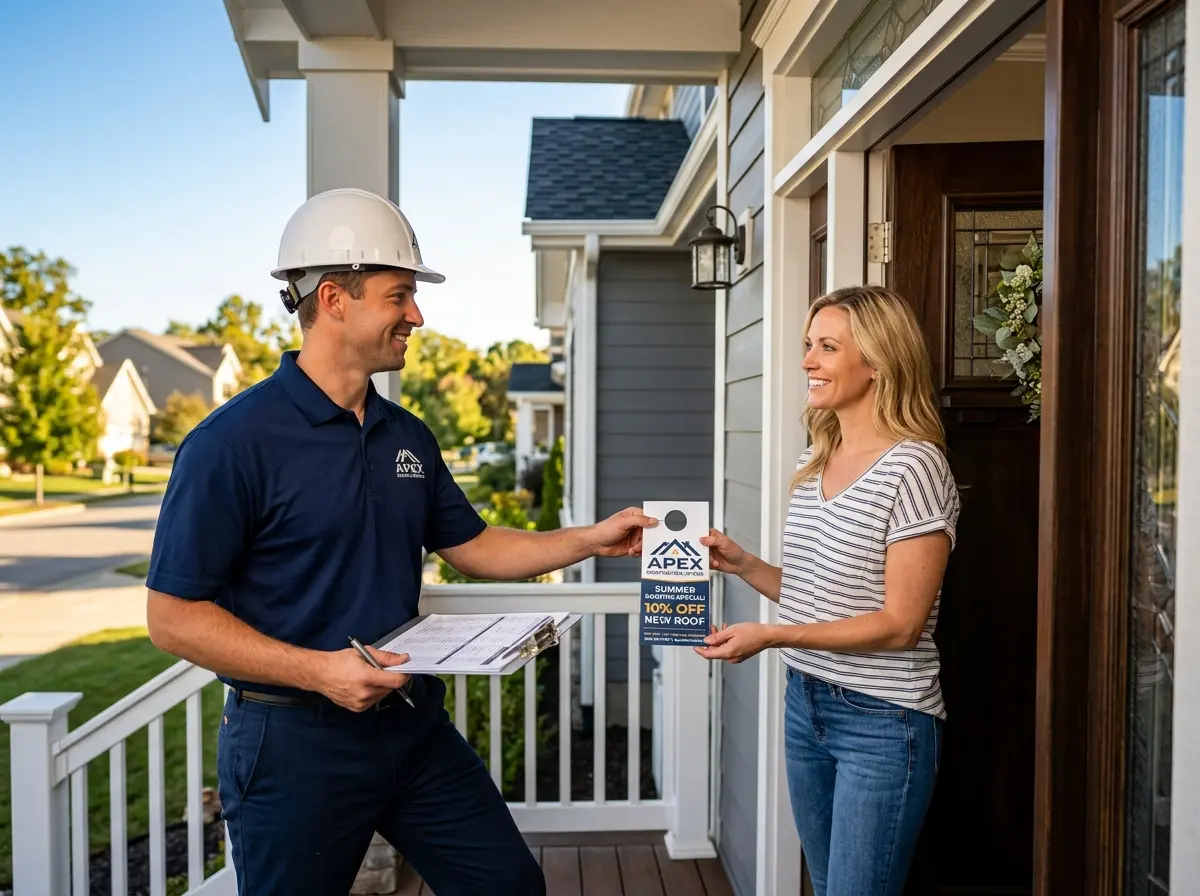
The best-performing roofing door hangers tend to share a few traits: a bold headline focused on a specific problem or offer (think "Hail Damage? Free Inspection — No Obligation"), a single strong call to action, a QR code that goes to a dedicated landing page (not your homepage), and real social proof like a star rating or a short customer quote. Keep it clean, keep it local, and for the love of all things holy, proofread it before you print 5,000 copies.
The Offer Has to Actually Be Good
A discount on something the homeowner wasn't thinking about isn't really an offer — it's noise. The most effective door-hanger offers solve a real problem the homeowner already has, or create urgency around one they didn't know they had. Free storm damage inspections work extremely well in roofing because they lower the barrier to engagement to almost zero. A financing offer with a clear monthly payment can be powerful too, especially in neighborhoods where price sensitivity is a factor.
Whatever you offer, make sure your team can deliver on it quickly and professionally. A great offer that leads to a frustrating customer experience is worse than no offer at all — you've now successfully generated a lead and then burned it, which takes real talent.
What Happens When They Actually Call
Don't Let a Good Campaign Die at the Phone
Here's a scenario that plays out constantly in the roofing industry: a homeowner walks inside, pulls out your door hanger, decides to call, and gets voicemail. So they hang up and call the next company on their list. Your beautifully designed, strategically distributed door-hanger campaign just fed a lead to your competitor. Congratulations on the marketing spend.
The fix is simple but often overlooked — make sure someone (or something) is always ready to answer. Stella, the AI robot employee and phone receptionist, answers every call 24/7 with full knowledge of your services, current offers, and business information. When a homeowner calls at 9 PM after finally looking at the door hanger they grabbed off the knob three days ago, Stella picks up, answers their questions, collects their contact info, and gets them into your pipeline — no missed calls, no lost leads. She can also forward calls to human staff based on conditions you configure, so your best salespeople are handling the conversations that need a personal touch, not fielding basic questions about whether you work in their zip code.
Deploying and Tracking Your Campaign Like a Pro
Train Your Distribution Team (Yes, Really)
Whether you're using your own crew, a part-time hire, or a professional distribution service, the people hanging your cards are representing your brand. A crumpled door hanger shoved through a mail slot, a card left on a doorstep in the rain, or — worst of all — a card placed on a home that already has visible roof damage and an active claim, can all create problems. Train your team on proper placement, which homes to skip (gated communities, no-solicitation signs, active construction sites), and how to behave professionally if a homeowner comes to the door.
It's also worth having your distributors take notes or use a simple app to log which streets were covered and when. This sounds tedious until you've accidentally canvassed the same neighborhood three times and skipped the one you actually needed to hit.
Track Everything With Dedicated Numbers and Landing Pages
If you're not tracking your door-hanger campaigns separately from your other marketing efforts, you're essentially flying blind and hoping for the best. Set up a unique phone number for each campaign using a service like CallRail or Google Voice — this lets you see exactly how many calls your door hangers are generating. Pair that with a dedicated landing page linked through your QR code, and you'll have clean data on both call volume and web conversions.
After your campaign runs, measure cost per lead, cost per appointment set, and ultimately cost per job closed. Most roofing companies that do this carefully find that door hangers in the right neighborhoods, with the right offer, can generate leads for a fraction of what paid digital advertising costs — especially when combined with a strong follow-up process. Data turns a good campaign into a repeatable system, and repeatable systems are how roofing companies scale.
Follow Up Until They Say Yes or Never Call Me Again
The fortune, as they say, is in the follow-up. Studies suggest that up to 80% of sales require five or more follow-up contacts, yet the majority of sales reps give up after one or two attempts. Don't be that company. When a homeowner responds to your door hanger — whether by calling, scanning your QR code, or filling out a form — they go into a follow-up sequence immediately. That means a call the same day, a text the next morning, an email follow-up by day three, and a check-in call by the end of the week.
It sounds aggressive in writing, but in practice, a homeowner who expressed interest and then went quiet isn't annoyed by follow-up — they're busy. Life happens. The roofing company that stays politely persistent is usually the one that gets the appointment. Automate what you can, personalize where it matters, and don't let a warm lead go cold because nobody remembered to call back.
A Quick Reminder About Stella
Stella is an AI robot employee and phone receptionist that answers calls 24/7, handles customer questions, promotes your services, and captures lead information — all for just $99 a month with no upfront hardware costs. For roofing companies running door-hanger campaigns, she's the piece that makes sure no incoming call goes unanswered and no lead slips through the cracks while your crew is on a job site. She's always on, always professional, and never calls in sick the morning after a big storm generates a flood of inquiries.
Go Hang Some Doors (The Right Way)
A well-executed door-hanger campaign is one of those rare marketing tactics that still punches well above its weight — but only when every piece of the system is working together. That means smart targeting, a compelling offer, professional design, a reliable way to handle incoming calls, disciplined tracking, and relentless follow-up. Miss any one of those steps and you've got an expensive neighborhood littering program.
Here's your action plan: Start by identifying two or three target neighborhoods using the criteria above. Design one clean, offer-driven door hanger with a unique tracking number and QR code. Deploy it with a trained team, log your coverage, and make sure your phone answering is locked down before a single card hits a doorknob. Then track your numbers, follow up aggressively, and iterate based on what the data tells you.
The roofing companies winning in local markets right now aren't necessarily the ones with the biggest ad budgets — they're the ones with the tightest systems. Build yours, and let the results speak for themselves.