When Your Phone Won't Stop Ringing (But Your Staff Kind of Wishes It Would)
Let's paint a familiar picture: it's 4:45 PM on a Tuesday. Your tutoring center staff is elbow-deep in after-school sessions, a parent is waiting at the front desk, and the phone is ringing — again. It's probably another enrollment inquiry. And it's probably going to voicemail. And that parent is probably going to call your competitor next.
Enrollment inquiries are the lifeblood of any tutoring center, but they're also one of the most logistically awkward challenges the industry faces. Parents don't schedule their curiosity around your business hours. They think about signing their kid up for math tutoring at 9 PM when homework becomes a family crisis, or during their lunch break, or frankly whenever the anxiety about their child's grades hits peak levels. If you're not available to answer — and let's be honest, you can't always be — that lead walks right out the door before it ever walks in.
This is exactly the problem that a tutoring center in the midwest decided to solve. And the solution, as it turns out, was available around the clock, never called in sick, and didn't need a coffee break to function properly.
The Enrollment Inquiry Problem Is Bigger Than You Think
The Missed Call Is a Missed Student
Here's a stat worth sitting with: research consistently shows that businesses responding to leads within five minutes are dramatically more likely to convert them than those who respond even an hour later. For tutoring centers, where parents are often making emotional, time-sensitive decisions about their child's academic future, the window is even narrower. A missed call isn't just an inconvenience — it's a missed enrollment, multiplied across weeks and months.
The tutoring center in our case study was averaging a respectable number of weekly inquiries, but their staff noticed a troubling pattern: voicemails were piling up, callbacks were happening the next morning, and some parents had already enrolled elsewhere by the time a human got back to them. The front desk team was doing their best, but between managing in-person sessions, coordinating tutors, and handling administrative tasks, answering every single call just wasn't realistic.
The After-Hours Blind Spot
The problem wasn't just staffing — it was timing. A significant chunk of their incoming calls came in after 6 PM, on weekends, and during the summer enrollment rush when the office was operating with reduced hours. These are prime decision-making moments for families, and the tutoring center was essentially invisible during all of them. No after-hours answering service, no chatbot, no fallback — just a voicemail greeting and a promise to call back tomorrow.
This isn't unique to this one business. Tutoring centers across the country run lean on administrative staff, and the idea of hiring a dedicated receptionist to cover extended hours is a budget conversation nobody wants to have. There had to be a smarter way.
What Parents Actually Want When They Call
When the center surveyed parents who had enrolled, they found something interesting: most callers weren't looking for a hard sell. They wanted straightforward answers. What subjects do you tutor? What are your hours? How does the assessment process work? What does it cost? These are questions that don't require a human educator to answer — they require someone (or something) knowledgeable, friendly, and available. The information was already there. The problem was delivery.
How AI Stepped In to Handle the Conversation
A 24/7 Enrollment Assistant That Actually Knows What It's Talking About
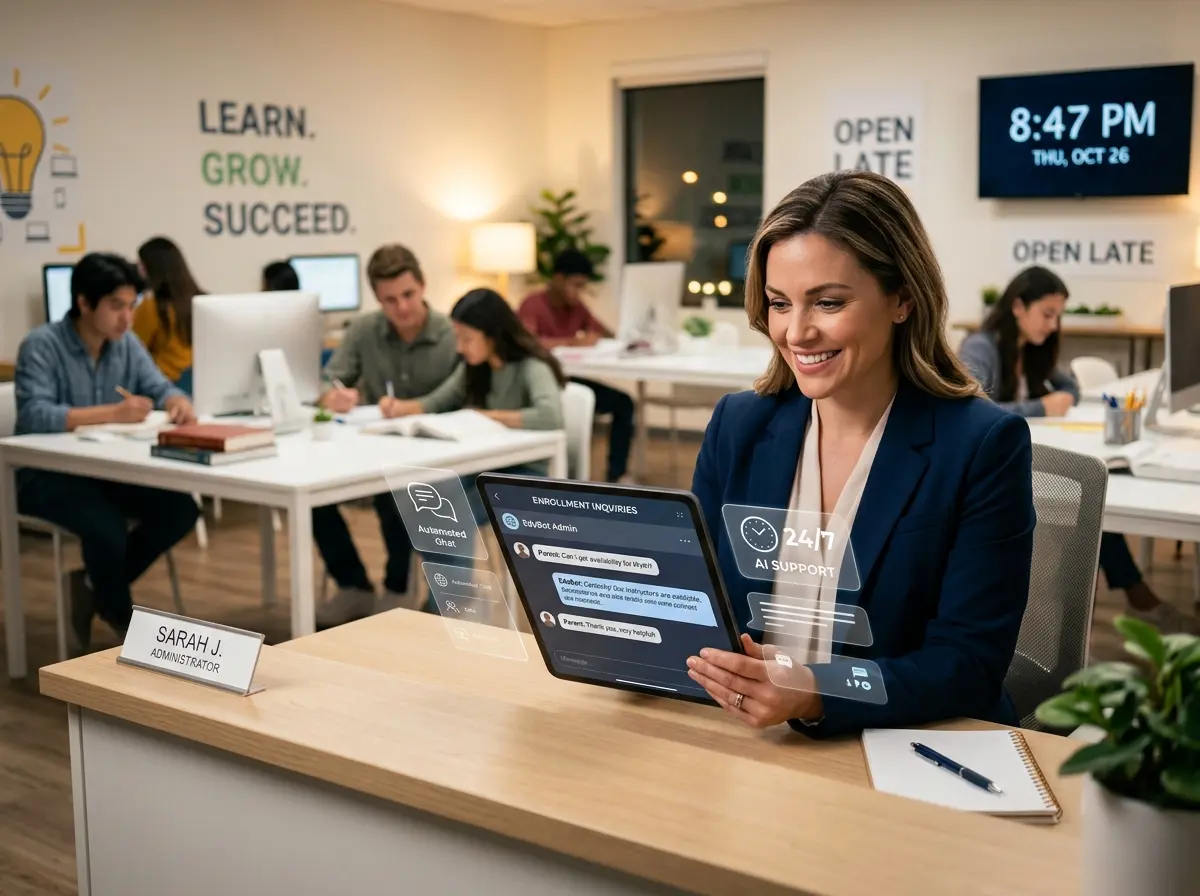
The tutoring center implemented Stella, an AI robot employee and phone receptionist, to handle incoming calls around the clock. Stella was configured with the center's full knowledge base — every subject offered, tutor qualifications, session formats, pricing tiers, the enrollment process, and even current promotional discounts for new families. From the first ring, callers were greeted warmly, given accurate information, and walked through the inquiry process without ever hitting a dead end.
The results were immediate. After-hours calls that previously went to voicemail were now being answered, with Stella collecting key intake information directly in the conversation — the student's grade level, subjects of concern, scheduling preferences, and parent contact details. By the time a staff member arrived the next morning, they didn't have a pile of vague voicemails to return. They had a CRM full of organized, AI-summarized profiles ready for follow-up. The intake forms Stella used during calls fed directly into the built-in CRM, giving the team a clear picture of each prospective family before the first human conversation ever took place.
Freeing Up Staff to Do What Humans Do Best
Perhaps the less obvious benefit was what happened to the staff. When routine inquiry calls were handled automatically, front desk team members could focus entirely on the families in front of them, on coordinating tutors, and on the higher-value conversations that actually require a human touch. The phone stopped being an interruption and started being a quietly managed asset running in the background. Enrollment follow-up became proactive instead of reactive, and the team stopped losing the mental overhead of tracking which callbacks had happened and which hadn't.
Setting Up an AI Phone System That Actually Works for a Tutoring Center
The Knowledge Base Is Everything
The single most important factor in making an AI phone receptionist effective is the quality of information it's given. Before going live, the tutoring center spent time building out a comprehensive knowledge base: every program, every policy, every FAQ they'd ever answered by hand. The more thorough this foundation, the more confidently the AI can handle inquiries without awkward gaps or frustrating dead ends. Think of it like onboarding a very attentive new employee who memorizes everything on day one and never forgets any of it.
Practically speaking, this means pulling together your program descriptions, pricing, enrollment steps, assessment process, cancellation policies, tutor bios if relevant, and any ongoing promotions. If you've ever written a welcome packet or an FAQ page for your website, you're most of the way there.
Configuring Smart Call Routing
Not every call needs to be handled entirely by AI, and the best setups acknowledge this honestly. The tutoring center configured their system so that routine inquiries were handled start to finish, but calls involving existing student concerns, billing disputes, or specific tutor requests were flagged for forwarding to a live staff member. This tiered approach meant the AI wasn't overreaching, and parents who needed a human got one — just not for questions that didn't require one.
Smart call routing also meant that if a parent called mid-session when nobody was free to pick up, the call was handled gracefully rather than dropped. Push notifications to the manager's phone for voicemails with AI-generated summaries meant nothing slipped through unnoticed, even on the busiest afternoons.
Measuring What's Actually Working
One underrated benefit of an AI phone system is the data it generates. The tutoring center could see exactly how many calls were coming in after hours, which questions came up most frequently, how many callers were inquiring about specific subjects, and how effective their current enrollment promotion was based on how often it was mentioned in conversations. This kind of insight used to require a dedicated person tracking calls manually. Now it was just part of the system.
Use this data actively. If a specific subject is generating a high volume of inquiries, that's a signal to feature it more prominently in your marketing. If a particular policy question keeps coming up, that's a sign your website might need a clearer FAQ. The AI becomes a passive market research tool on top of everything else it's doing.
A Quick Reminder About Stella
Stella is an AI robot employee and phone receptionist built for businesses exactly like yours — whether you need a friendly, knowledgeable presence standing inside your physical location or a 24/7 phone answering solution that never misses a call. She runs on a simple $99/month subscription with no upfront hardware costs, is easy to set up, and comes ready to represent your business professionally from day one. For tutoring centers, service businesses, and really any operation that lives and dies by customer communication, she's the team member who's always on shift.
Conclusion: Stop Letting After-Hours Calls Become Someone Else's Enrollments
The tutoring center's experience isn't a miracle story — it's a practical one. They had a real problem: inquiry calls going unanswered, leads going cold, and staff stretched too thin to cover every communication channel. The solution wasn't hiring more people or extending business hours by hand. It was putting the right technology in place and letting it work consistently in the background while the humans focused on what actually required them.
If you run a tutoring center — or honestly any education-adjacent business where enrollment windows are time-sensitive and parents are the decision-makers — here's your actionable takeaway list:
- Audit your missed calls. Pull the last 30 days of call data and identify how many came in after hours or went to voicemail. That number is your baseline for what you're currently losing.
- Build your knowledge base before you build your system. Gather every FAQ, policy, program description, and pricing detail in one place. This is the fuel the AI runs on.
- Set clear call routing rules. Decide which call types can be handled autonomously and which should be escalated. Start conservative and loosen as you build confidence in the system.
- Use intake data actively. Don't just let the CRM collect contacts — review AI-generated summaries daily and use them to prioritize follow-up calls.
- Track the metrics. After 60 days, compare your inquiry-to-enrollment conversion rate against your pre-AI baseline. The numbers will tell you everything you need to know.
Parents are going to keep calling at inconvenient hours. The question is just whether you're going to be the tutoring center that answers — or the one they call after you don't.