Introduction: Because "We Miss You!" Emails Sent at Random Are Not a Strategy
Let's be honest — most salon owners have, at some point, sent a "Hey, we miss you!" text to a client they haven't seen in six months, only to realize that client actually came in last week. Awkward. The truth is, client retention in the salon industry is less about how much you care and more about when you show that you care. Timing, as they say, is everything.
According to research from the Professional Beauty Association, retaining an existing salon client costs significantly less than acquiring a new one — yet most salons pour the majority of their marketing energy into attracting new faces rather than keeping the ones already in their chairs. A well-structured retention calendar changes that equation. It turns your outreach from a shot in the dark into a deliberate, repeatable system that feels personal to clients and effortless for you.
In this post, we're going to walk through how to build a retention calendar that actually works — one that accounts for service cycles, seasonal behavior, and the kind of timely follow-up that keeps clients loyal without making you feel like a telemarketer with a blow dryer.
Building the Foundation of Your Retention Calendar
Start With Service Cycles, Not the Calendar
The biggest mistake salon owners make when building a retention calendar is organizing it around their business schedule — slow weeks, holiday promotions, back-to-school specials — rather than around their clients' natural service cycles. Your clients don't care that you need to fill Tuesday afternoon slots. They care about their hair.
Every service you offer has a natural rebooking window. A client who gets a full highlight typically needs a touch-up in 6–10 weeks. A Brazilian blowout lasts about 12 weeks. A haircut client might come back every 4–6 weeks if they're keeping a precise style, or every 8–12 weeks if they're more casual about it. The foundation of any smart retention calendar is mapping these cycles for each service you offer and using them as the trigger for outreach — not a generic monthly newsletter blast.
Create a simple reference chart for your team that lists every primary service alongside its average rebooking window. This becomes the engine of your entire retention system.
Segment Your Clients Before You Reach Out
Not all clients are created equal, and your outreach shouldn't treat them as if they are. A first-time client who came in for a trim is a very different conversation than a longtime color client who's been with you for three years. Segmenting your client list is a non-negotiable step before you send a single message.
Consider building at least four basic client segments: new clients (first visit within the last 30 days), active clients (visited within their expected service cycle), at-risk clients (approaching or slightly past their expected return window), and lapsed clients (significantly overdue — typically 90+ days past their service cycle). Each segment deserves its own messaging tone, offer type, and urgency level. Sending a "we miss you" discount to someone who just left your salon is either a red flag or a very confident move. Either way, don't do it.
Map Out Your Outreach Touchpoints
Once you've established service cycles and client segments, it's time to define your actual touchpoints — the specific moments in time when you reach out and what you say. A solid retention calendar for a salon typically includes a post-visit thank-you message (sent within 24–48 hours), a rebooking reminder (sent about one week before the client's expected return window closes), an at-risk nudge (sent when a client is 2–3 weeks overdue), and a lapsed client win-back (sent at 60–90+ days with a compelling reason to return).
The goal is to create a communication rhythm that feels natural, not desperate. A client who receives a well-timed "Your color is probably ready for a refresh!" message at week eight will feel like you know them. A client who gets four promotional emails in the same month will feel like a number. Keep the calendar intentional and human.
How Technology — Including Stella — Can Do the Heavy Lifting
Automating Outreach Without Losing the Personal Touch
Here's the part where we acknowledge reality: you are running a salon, managing a team, handling inventory, and probably shampooing someone while simultaneously answering a scheduling question. The idea of manually tracking every client's service cycle and sending personalized messages at exactly the right moment is, to put it kindly, a fantasy. This is where the right tools stop being a luxury and start being a survival mechanism.
Stella, the AI robot employee and phone receptionist, can play a genuinely useful role here — particularly when it comes to capturing client information accurately in the first place. When clients call to book or inquire about services, Stella answers the phone 24/7, collects relevant intake information through natural conversation, and logs everything into her built-in CRM with custom fields and tags. That means your retention calendar is only as strong as your client data, and Stella helps make sure that data is complete, organized, and actually usable. For salons with a physical location, her in-store kiosk presence also allows her to engage walk-in clients, capture contact details, and flag new customers for your team — so no one slips through the cracks before they've even had their first appointment.
Writing Outreach That Actually Gets a Response
Match Your Message to the Moment
Retention outreach lives or dies by how relevant it feels at the exact moment a client receives it. The post-visit thank-you message should be warm and low-pressure — a genuine expression of appreciation with a soft mention that you'd love to see them again. The rebooking reminder should be practical and specific: reference the actual service they received, and suggest a timeframe. "Your highlights are probably around the eight-week mark — want to grab a spot before we fill up?" is infinitely more effective than "Book your next appointment today!"
The at-risk message is where you have a little more room to add urgency or incentive. This doesn't have to mean discounting — urgency can come from scarcity ("Our fall availability is filling up fast") or relevance ("The season is changing, and your color might be ready for something new"). Save your actual offers — discounts, value-adds, referral bonuses — for your lapsed client win-back messages, where the barrier to return is highest and the nudge needs to be stronger.
Channel Strategy: Text, Email, or Both?
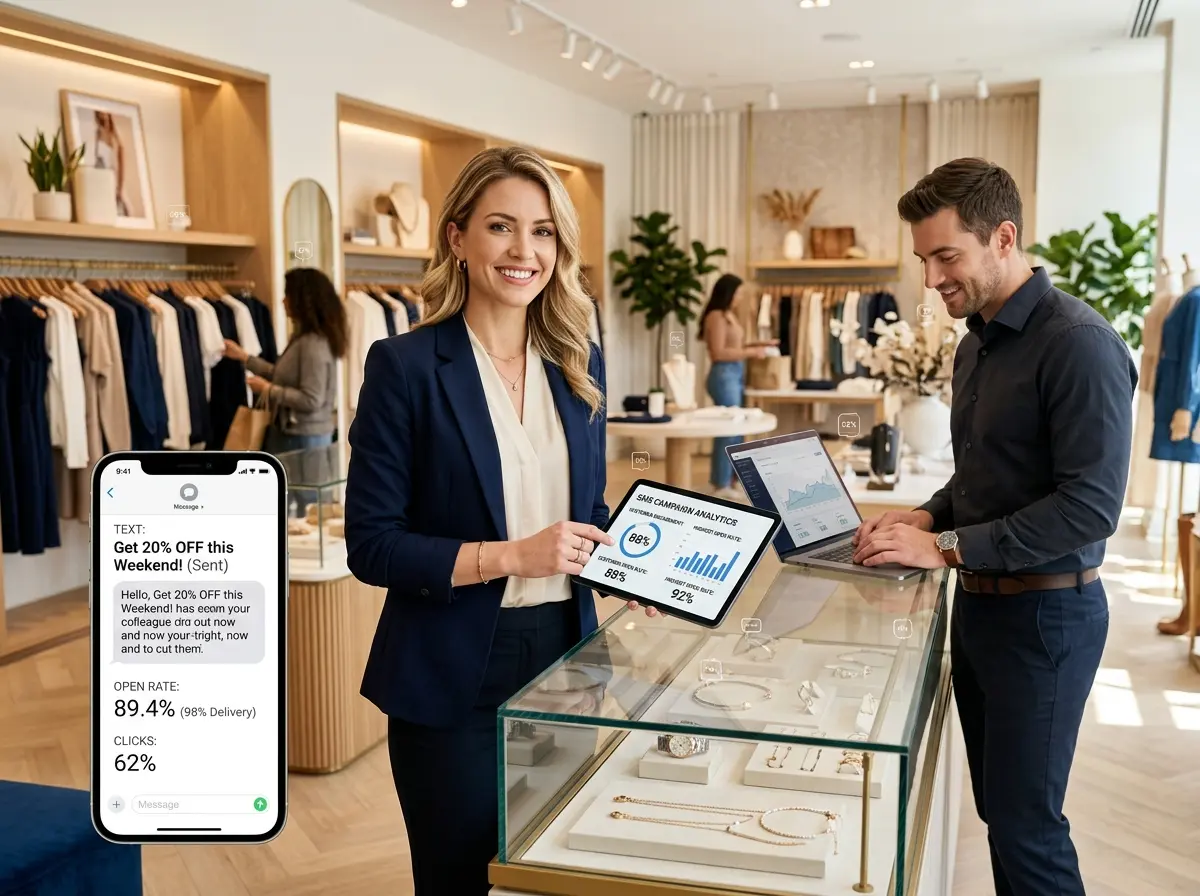
The data on this is fairly consistent: SMS open rates hover around 90–98%, while email open rates in the beauty industry average closer to 20–30%. That's not an argument for abandoning email — it's an argument for being deliberate about which channel carries which message. Short, time-sensitive messages (rebooking reminders, appointment confirmations, at-risk nudges) belong in text. Longer, richer content — seasonal lookbooks, product spotlights, loyalty program updates — can live comfortably in email.
The worst thing you can do is duplicate your messaging across both channels simultaneously and hope something sticks. That's not a strategy; that's noise. Build your retention calendar so each channel has a distinct role, and your clients will respond to each without feeling bombarded.
Test, Track, and Adjust Quarterly
A retention calendar isn't a set-it-and-forget-it document. Treat it like a living system that gets reviewed every quarter. Track which messages are driving rebookings, which win-back offers are actually converting lapsed clients, and where clients are most commonly dropping off. If your at-risk segment keeps growing despite consistent outreach, the problem might not be the timing — it might be the message, the channel, or something about the in-salon experience that no amount of clever copywriting will fix.
Set aside time every 90 days to look at your numbers, talk to your team about patterns they're seeing, and make small, deliberate adjustments. Retention isn't a campaign. It's a discipline.
Quick Reminder About Stella
Stella is an AI robot employee and phone receptionist built for businesses like yours — standing in-store to engage walk-in clients and answering every phone call 24/7 with the same warmth and knowledge as your best team member. She manages a built-in CRM, collects client information through conversational intake, and makes sure no lead or loyal client falls through the cracks. At $99/month with no upfront hardware costs, she's the kind of employee who never calls in sick and never forgets to ask for a name and number.
Conclusion: Your Retention Calendar Starts With One Decision
The good news is you don't need to build a perfect retention calendar on day one. You need to build a better one than what you have right now — which, for many salon owners, means moving from "we'll reach out when we remember" to something with even a basic structure and consistent follow-through.
Start here: pull your client list and identify everyone who is 30 or more days past their expected service cycle. Those are your at-risk clients. Draft a single message for that segment this week. Send it. See what happens. That small action, repeated and refined over time, is how a retention calendar gets built — not in a weekend planning session, but in the daily habit of reaching out at the right moment with the right message.
From there, layer in your other touchpoints one at a time. Build your service cycle reference chart. Segment your list. Define your channels. Review your results quarterly. And wherever possible, use tools — whether that's your booking software, your CRM, or an AI receptionist like Stella — to make sure the data you're working with is accurate and the outreach you're sending actually reaches people.
Your clients didn't stop coming back because they stopped liking you. Most of the time, they just got busy and forgot to rebook. Your retention calendar is simply a polite, well-timed reminder that you haven't forgotten about them — and that their chair is waiting.