Free Press? Yes, Please — Here's How to Actually Get It
Let's be honest: advertising is expensive. Between social media ads, sponsored posts, mailers, and whatever that radio spot cost you in 2019, your marketing budget has taken a beating. So when someone tells you that you can get your local retail business featured on the news — for free — you're understandably skeptical. And fair enough. But here's the thing: local news outlets are constantly hungry for stories, and they aren't always finding them. Your job is simply to make yourself impossible to ignore.
Getting media coverage isn't about luck or knowing the right people (though that never hurts). It's about understanding what journalists need, giving it to them on a silver platter, and positioning your business as the most interesting thing happening in your zip code. This guide will walk you through exactly how to do that — no publicist required.
Understanding What Local Media Actually Wants
Before you fire off a press release about your new loyalty program to every news station in town, take a breath. Journalists aren't interested in what's good for your bottom line. They're interested in what's good for their audience. The sooner you internalize that, the better your pitch success rate will be.
Stories, Not Announcements
There's a big difference between an announcement and a story. "Local pet store now carries organic dog food" is an announcement. "Local pet store owner quit her corporate job to rescue aging shelter dogs — and built a business around keeping them healthy" is a story. The first one gets deleted. The second one gets a camera crew.
Think about what's genuinely compelling about your business. Your origin story, a quirky niche you fill, a community problem you're solving, or a dramatic pivot you made — these are the raw materials of good stories. Retailers often undersell themselves here. You don't have to be saving the rainforest to be newsworthy. You just need a human angle that connects with real people in your community.
Timeliness and Local Relevance Are Your Best Friends
Journalists work on deadlines and trends. If you can tie your business to something that's already in the news cycle — a local economic trend, a seasonal hook, a viral topic — you dramatically improve your chances of getting coverage. A bookstore running a "banned books" event during Banned Books Week isn't just doing good marketing; it's pitching itself as the natural local angle on a national conversation.
According to a study by Cision, nearly 70% of journalists say the most important factor in a story idea is local or regional relevance. That's your home turf advantage. Use it. Keep a running list of local events, city council decisions, seasonal moments, and trending topics where your business could serve as a relevant, accessible example.
What Makes a Pitch Easy to Say Yes To
Journalists are busy. If your pitch requires them to do significant research, arrange complicated logistics, or sit through a lengthy phone explanation, it's going to get passed over. Make it easy. A compelling subject line, two or three short paragraphs explaining the story and its local relevance, a high-quality photo, and your direct contact information — that's it. You're not writing a novel. You're opening a door.
Give Your Business a Newsworthy Edge
Sometimes the story is already there, and you just need to surface it. Other times, you need to create the hook. Here's where a little strategic thinking — and the right tools — can make a genuine difference.
Become Part of Your Community's Story
Businesses that show up for their communities tend to get coverage because community engagement is inherently visual and emotionally resonant. Sponsor a Little League team. Partner with a local charity. Host a free workshop or pop-up event. These activities generate goodwill and give journalists something to photograph, quote, and share. A salon that hosts a free haircut day for job seekers isn't just doing something kind — it's doing something newsworthy.
And while you're out there being a pillar of the community, don't forget to actually run your business smoothly. This is where Stella, the AI robot employee and phone receptionist, quietly earns her keep. While you're at the charity event or prepping for the media visit, Stella is greeting customers in-store, answering the phone, promoting your current deals, and making sure nobody has a bad experience just because you stepped away for five minutes. She handles the floor and the phones so you can handle the big picture — and look great doing it.
Crafting and Distributing Your Pitch
You've got a great story. Now you need to actually get it in front of the right people without it disappearing into an overflowing inbox. This part is more craft than luck.
Build Your Local Media List
Start by identifying who covers local business, lifestyle, and community stories at your area's TV stations, newspapers, and online publications. Follow them on social media. Read or watch their recent work. When you pitch them, reference something specific they've covered. "I saw your piece on Main Street revitalization last month — I think my story connects directly to what you were exploring" is infinitely more effective than a cold, generic email blast.
Don't overlook smaller outlets, either. Local blogs, neighborhood Facebook groups, community newsletters, and hyperlocal news sites like Patch often have highly engaged audiences and are much easier to get coverage from. Starting small builds your credibility and creates clips you can reference when pitching bigger outlets later.
The Art of the Follow-Up
Most pitches don't get a response on the first try. That's not rejection — it's just the reality of a journalist's inbox. A polite, brief follow-up email three to five days after your initial pitch is completely appropriate and often necessary. Keep it short: reference your original pitch, offer to make the story easier in any way (a phone call, an in-person visit, additional photos), and leave the door open without being pushy. One follow-up is professional. Five is how you get blocked.
Make the Interview Unforgettable
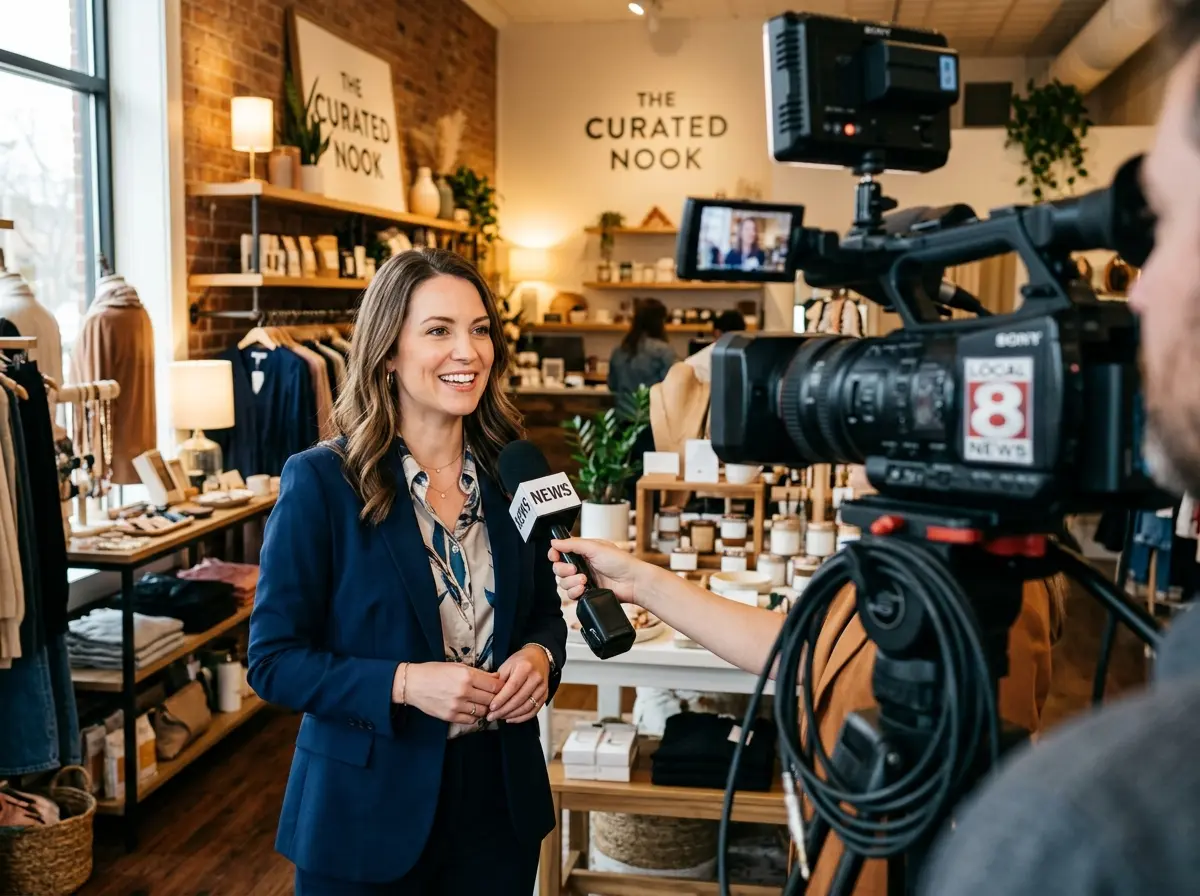
If you land the interview or the site visit, prepare. Know your three key talking points. Have a visually interesting space for them to film. Bring energy, authenticity, and a clear sense of why your business matters to the community. Journalists often decide whether to pursue a follow-up story based entirely on how compelling and quotable a subject is. Be the person they want to call back the next time a local business angle comes up.
Quick Reminder About Stella
Stella is an AI robot employee and phone receptionist designed for businesses of all types — retail, restaurants, gyms, salons, medical offices, and more. She greets customers in-store, answers phones 24/7, promotes deals, handles FAQs, and keeps your business running professionally whether you're in the building or out making headlines. At just $99/month with no upfront hardware costs, she's the team member who never calls in sick and never misses a customer.
Turning One Story Into a Media Presence
Getting featured once is great. Building a reputation as the go-to local business voice is better. After your first coverage hits, don't let the momentum die. Share it everywhere — your website, social channels, email list, and even in-store. "As seen on [Local News Station]" is a credibility signal that compounds over time.
Reach back out to the journalist who covered you after three to six months with a genuine update. Did the event you talked about grow? Did you hire locally? Did a customer's life change because of your business? These are follow-up stories waiting to happen, and journalists love sources they already know and trust.
Local media coverage is not a one-and-done marketing tactic. It's a relationship — with journalists, with your community, and with the story of what your business is actually about. Build that story deliberately, make it easy for others to tell, and then show up consistently. The cameras will find you.