So You're Tired of Watching Customers Walk Into the Big Box Store Next Door
You've put in the work. You've curated your inventory, trained your staff, built a real community around your business — and yet, somehow, customers keep gravitating toward the fluorescent-lit warehouse down the street that sells everything from lawn furniture to frozen burritos. It's frustrating. But here's the good news: you have something they don't. Personality. And with geo-fenced advertising, you also have the ability to intercept those customers before they ever walk through those automatic sliding doors.
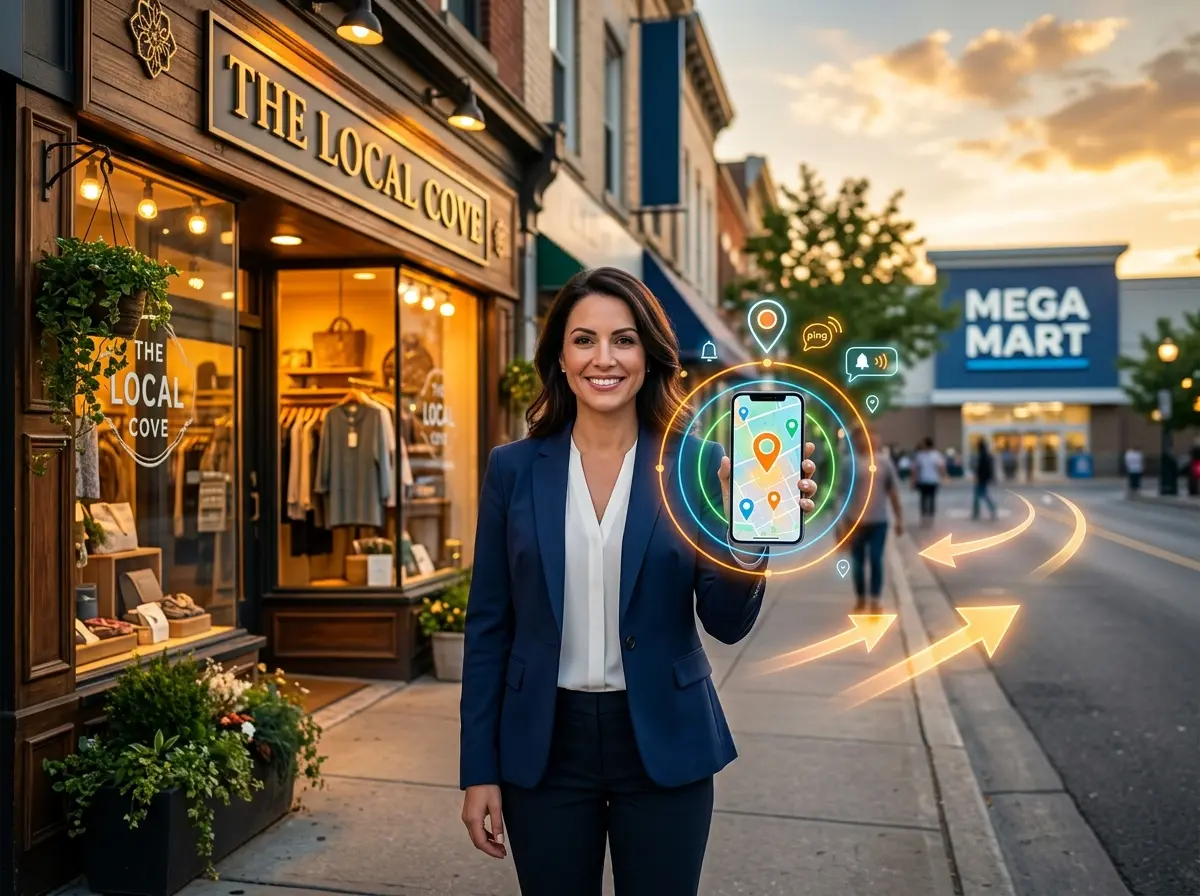
Geo-fenced ads are one of the most underutilized tools in the small business marketing toolkit. They let you draw a virtual boundary around a specific geographic area — say, your competitor's parking lot — and serve targeted ads to anyone whose smartphone enters that zone. Think of it as digital fishing, except the pond is your competitor's location, and your bait is a genuinely better offer. Done right, this strategy can pull curious shoppers out of the big box orbit and into your front door. Let's break down exactly how to do it.
Understanding Geo-Fencing and Why It Works
What Geo-Fencing Actually Is (Without the Jargon)
Geo-fencing uses GPS, Wi-Fi, and cellular data to create a virtual perimeter around a real-world location. When someone with location services enabled on their phone enters that perimeter, they become eligible to see your ads — on social media, in apps, on mobile browsers, or through push notifications if they've installed a relevant app. The targeting can be incredibly precise, sometimes down to a radius of just 100 meters.
For small businesses, this means you can essentially advertise to people who are already in "shopping mode" near a competitor's location. According to research from xAd (now GroundTruth), 53% of consumers have visited a store after seeing a geo-targeted ad. That's not a small number. That's more than half of your target audience actively responding to location-based marketing.
Why Small Businesses Have the Advantage Here
Here's the irony: big box stores have massive marketing budgets, but geo-fencing is one area where the little guy actually wins. Why? Because you can fence their location. A large retailer can't easily run a hyper-local campaign saying "Hey, come visit the charming boutique two blocks away" — that's not their game. But you can absolutely run ads targeting shoppers in their parking lot, promoting your unique products, better prices on specific items, or the simple fact that your staff actually knows what they're talking about.
You're not trying to out-spend them. You're trying to out-smart them. Geo-fencing levels that playing field considerably.
Setting Up Your First Geo-Fenced Campaign
Choosing the Right Platforms and Tools
You don't need an enterprise marketing team to run geo-fenced ads. Several platforms make this accessible for small business owners with modest budgets. Google Ads offers radius targeting that works well for local campaigns. Facebook and Instagram Ads allow you to target by location with fairly granular control. For more advanced geo-fencing with competitor targeting specifically, platforms like GroundTruth, Simpli.fi, and Propellant Media specialize in this exact strategy and offer self-serve options for smaller budgets.
When setting up your fence, consider targeting not just your direct competitors but also complementary locations — shopping centers where your ideal customer already spends time, event venues, or neighborhoods with the right demographic profile. Cast a thoughtful net, not just a desperate one.
Crafting Ads That Actually Convert
Here's where most small businesses drop the ball. They set up geo-fencing correctly, then run generic ads that say something like "Visit Us Today!" Friend, that's not going to pull anyone away from a store they're already standing in. Your ad needs to give them a specific, compelling reason to change course — right now.
Consider these high-converting approaches:
- Time-sensitive offers: "Show this ad today for 20% off your first purchase." Urgency creates action.
- Direct comparisons: "We carry [specific brand] — and our staff actually knows how to use it." Confidence is attractive.
- Convenience messaging: "No lines. No hunting for help. Just great service, two blocks away." You're selling the experience, not just the product.
- Hyperlocal relevance: Reference a local event, a seasonal moment, or something genuinely tied to that neighborhood. It signals authenticity.
Keep your ad copy short, your visuals bold, and your call-to-action crystal clear. Mobile screens are small, and attention spans are shorter. You have about three seconds.
How Stella Can Help Once They Actually Show Up
Geo-fencing gets customers through the door — or gets them calling. But what happens next matters just as much as the ad that brought them in. This is where Stella, the AI robot employee and phone receptionist, quietly becomes one of your best assets.
When a new customer walks in after seeing your geo-fenced ad, they often arrive curious but not yet committed. Stella greets them proactively, answers their questions about products, services, and current promotions, and can upsell or cross-sell in a natural, conversational way — without making your human staff drop everything to run interference. She's consistent, knowledgeable, and available every single hour you're open. For customers who call after seeing a mobile ad, Stella answers 24/7, handles inquiries with the same depth of business knowledge she uses in person, and ensures no lead slips through the cracks because someone was too busy to pick up the phone. At $99/month with no hardware costs, she's also a genuinely practical addition to any small business trying to punch above its weight class.
Measuring Success and Optimizing Over Time
The Metrics That Actually Matter
Running geo-fenced ads without tracking results is like fishing with your eyes closed — technically possible, but inadvisable. The most important metrics for a geo-fencing campaign go beyond click-through rates. You want to understand foot traffic lift (did more people visit after the campaign launched?), conversion rate from ad to visit, and ultimately, revenue tied to new customers who came in through the campaign.
Platforms like GroundTruth and Simpli.fi offer foot traffic attribution reporting, which can literally show you how many people who saw your ad subsequently visited your physical location. This data is invaluable. It tells you which creative performs best, which competitor locations are the richest source of convertible customers, and what time of day your ads generate the most movement.
Iterating Without Overthinking It
Here's the beauty of digital advertising: you can change it. If one ad creative isn't driving foot traffic, swap it out. If a particular geo-fence around a specific location isn't performing, adjust the radius or try a different anchor point. Run A/B tests with different offers and see which one pulls better. The goal isn't perfection on the first try — it's a system of continuous, low-stakes improvement.
A practical cadence for small businesses: review campaign performance every two weeks, make one or two adjustments at a time, and give each iteration at least two weeks to gather meaningful data before changing course again. Avoid the temptation to tweak everything simultaneously. You'll end up not knowing what actually worked.
Building Long-Term Loyalty After the First Visit
A geo-fenced ad brings someone in once. What keeps them coming back is the experience they have when they arrive. This is the multiplier effect that small businesses consistently underestimate. One great interaction — a knowledgeable staff member, a seamless checkout, a follow-up message with a relevant offer — turns a competitor's former customer into your loyal regular. Focus as much energy on the in-store and post-visit experience as you do on the ad strategy. The ad is the invitation; the experience is the relationship.
A Quick Reminder About Stella
Stella is an AI robot employee and phone receptionist built for businesses of all sizes — from retail shops and restaurants to salons, medical offices, and service providers. She works as a human-sized kiosk inside your store, greeting and assisting customers in real time, while simultaneously handling phone calls around the clock with full knowledge of your business. At just $99/month with no upfront hardware costs, she's one of those rare tools that genuinely earns her keep from day one.
Your Next Move
You don't have to accept that big box stores have an unbeatable advantage. Geo-fenced advertising is a legitimate, proven strategy for redirecting motivated shoppers toward businesses that offer something the warehouse giants simply can't — expertise, personality, and genuine service. Start small: choose one competitor location, set a modest daily budget of $10–$20, craft one strong offer, and run it for 30 days. Review your foot traffic data, talk to new customers about how they heard about you, and adjust from there.
Pair that strategy with a customer experience worth coming back for, and you've built something the big box store down the street is completely unprepared to compete with. They have square footage. You have soul. Use it.