When Your Best Receptionist Goes Home at 5 PM (And So Does Every Other Human)
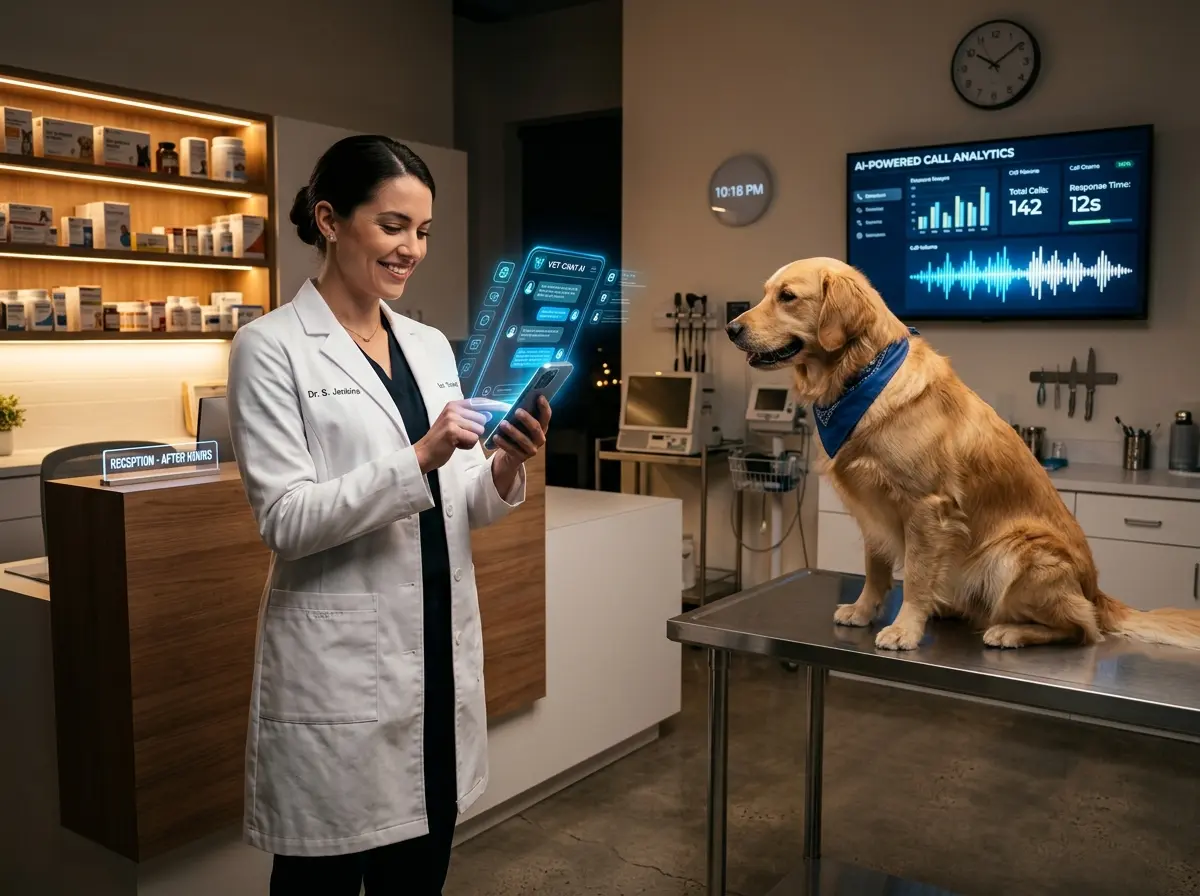
Picture this: It's 11:47 PM on a Tuesday. A panicked pet owner's golden retriever has just eaten an entire chocolate birthday cake — candles included — and they're frantically Googling emergency vet clinics. They find yours. They call. And they get... voicemail. So they hang up, call your competitor, and that's the last you hear of Biscuit and his questionable dietary choices.
After-hours emergency calls are one of the most persistent pain points for veterinary clinic owners. You can't staff a full receptionist team around the clock without hemorrhaging money, but you also can't afford to let panicked, loyal clients feel abandoned when their fur babies need help most. The good news? AI is stepping in to bridge that gap — and it's doing it remarkably well.
This post breaks down exactly how veterinary clinics are using AI phone tools to handle after-hours calls, what the real-world results look like, and how you can implement a similar system without hiring a single extra human being.
The After-Hours Problem Is Bigger Than You Think
The Revenue and Retention Cost of Missed Calls
Most veterinary clinic owners know missed calls are bad. What they don't always realize is how bad. Studies suggest that businesses miss up to 62% of incoming calls, and in healthcare-adjacent industries like veterinary medicine, a missed call rarely means a voicemail — it means a lost client. Pet owners in distress aren't patient. They need reassurance, information, and direction immediately, and if your clinic can't provide that at 11 PM, the emergency clinic across town will.
Beyond the emergency scenarios, there's a steady drip of after-hours inquiries that never quite reach crisis level but still matter enormously: questions about appointment availability, medication refill requests, post-surgery follow-up concerns, and vaccination record requests. These are calls that don't need a licensed veterinarian — they need a knowledgeable, calm voice that can answer basic questions, collect information, and route the truly urgent cases appropriately.
Why Traditional Solutions Fall Short
Clinics have tried the usual workarounds. Answering services staffed by humans sound promising until you realize those humans often have no knowledge of your specific clinic, your protocols, your pricing, or which situations genuinely warrant waking up your on-call vet. The result is generic, frustrating interactions that leave clients feeling like they've called a call center rather than their trusted veterinary practice.
Extended staffing hours are another option — an expensive one. Adding even part-time after-hours coverage for a small to mid-sized clinic can run several thousand dollars per month when you factor in wages, benefits, and the joyful process of finding someone who wants to work the 8 PM to midnight shift on a Friday.
How AI Phone Receptionists Are Changing the Game for Vet Clinics
Triage Without the Drama
Modern AI phone receptionists can be trained with your clinic's specific protocols for triaging after-hours calls. That means when a client calls at midnight describing symptoms, the AI can walk through a structured intake conversation — collecting the pet's name, species, breed, age, and a description of the issue — and then route the call appropriately based on urgency thresholds you define.
Truly emergent situations — suspected poisoning, difficulty breathing, trauma — can be escalated immediately to an on-call staff member or redirected to the nearest 24-hour emergency animal hospital with a warm, informative handoff. Non-urgent calls get logged with detailed AI-generated summaries so your morning team walks in already knowing who called, why, and what follow-up is needed. No more sticky notes. No more "someone called about a dog thing" messages.
Consistent, Knowledgeable Client Interactions
One of the underrated advantages of AI phone receptionists is consistency. Your human receptionist — wonderful as she is — has bad days, gets flustered when three lines ring at once, and occasionally forgets to mention that you now offer dental cleanings. An AI receptionist answers every call with the same calm, informed, professional demeanor whether it's the first call of the day or the forty-seventh.
Veterinary clinics using AI phone tools report that clients often don't realize they're speaking with an AI — which speaks to the quality of natural language processing available today. More importantly, those clients get answers. Hours, services, pricing ranges, what to do in a specific situation — all delivered accurately, every time.
Where Stella Fits Into Your Clinic's After-Hours Strategy
A Receptionist Who Never Clocks Out
Stella is an AI robot employee and phone receptionist built specifically for businesses that need reliable, intelligent customer communication — including veterinary clinics. She answers calls 24/7 using the same knowledge base she'd use in person, meaning she can discuss your services, explain your emergency protocols, collect client and patient information, and forward calls to your on-call staff based on the conditions you configure.
For clinics with a physical location, Stella also has a presence in-store as a human-sized kiosk — greeting clients in the waiting room, answering questions about services, and even promoting current offers like seasonal wellness packages. But her phone capabilities are where she really shines for the after-hours challenge. She collects intake information through conversational forms, generates AI summaries of every call, and pushes notifications to managers so nothing falls through the cracks. Her built-in CRM means all of that client and patient data is organized, tagged, and ready for your team each morning — no manual data entry required.
At $99/month with no upfront hardware costs, she's considerably cheaper than the midnight shift.
Implementing AI After-Hours Coverage: What to Actually Do
Step One: Map Your Call Scenarios Before You Set Anything Up
The clinics that get the best results from AI phone tools are the ones that do their homework first. Before you configure anything, sit down with your team and document every type of call you receive after hours. Categorize them: true emergencies, urgent-but-not-critical, routine inquiries, and misdials (yes, those count). For each category, define what the ideal response looks like. Should the AI escalate immediately? Collect information and promise a callback? Redirect to an emergency hospital? Knowing your call scenarios in advance means your AI receptionist is configured with purpose, not guesswork.
Step Two: Build a Knowledge Base Your AI Can Actually Use
Your AI is only as good as the information you give it. This means writing out your clinic's services, hours, pricing (or pricing ranges), emergency protocols, and frequently asked questions in a format the system can reference. Think of it as onboarding a new staff member — except this one retains everything perfectly and never misquotes your spay/neuter pricing to a client. Include specifics: which species you treat, whether you offer house calls, what your cancellation policy is, and how clients should handle genuine emergencies after hours.
Step Three: Test It Like a Panicked Pet Owner Would
Once you've set up your AI receptionist, don't just flip the switch and hope for the best. Call your own clinic after hours. Ask the hard questions. Try to confuse it. Describe a vague but worrying symptom and see how it responds. Have a staff member pretend to be an anxious first-time pet owner calling about something urgent. The goal is to identify any gaps in your knowledge base or configuration before a real client does — because real clients will find those gaps with impressive efficiency.
Refine based on what you learn, and revisit your setup periodically as your services or protocols change. AI tools aren't set-it-and-forget-it forever, but with a good initial setup, ongoing maintenance is minimal.
A Quick Note About Stella
Stella is an AI robot employee and phone receptionist that works around the clock — answering calls, greeting in-store visitors, collecting client information, and keeping your team informed with smart summaries and CRM-ready data. She's built for businesses that want professional, consistent customer communication without the overhead of additional staff. At $99/month, she's one of the more sensible business decisions you'll make this year.
Your Next Steps: Don't Let Biscuit's Owner Go to a Competitor
The after-hours call problem is solvable. It's not a matter of hiring more people, installing a better voicemail system, or hoping clients are patient enough to wait until 8 AM. AI phone receptionists have matured to the point where they can handle the nuanced, emotionally charged calls that veterinary clinics receive — professionally, accurately, and without ever needing a coffee break.
Here's where to start:
- Audit your current after-hours situation. How many calls are you missing? How many clients have you lost to competitors simply because nobody answered? Even rough estimates will sharpen your motivation considerably.
- Document your call scenarios and protocols. This work pays dividends regardless of which AI tool you choose.
- Explore AI receptionist platforms — including Stella — and evaluate them against your specific needs. Look for configurable call routing, intake form capabilities, CRM integration, and 24/7 availability.
- Pilot, test, and refine. Start with after-hours coverage, measure the impact, and expand from there.
The clinics winning client loyalty right now aren't necessarily the ones with the fanciest equipment or the most Instagram-worthy waiting rooms. They're the ones that answer the phone — at midnight, on weekends, and every time in between. With AI, that's no longer an unrealistic standard. It's just Tuesday.