You Didn't Open a Restaurant to Work 80 Hours a Week (And Yet, Here You Are)
There's a particular kind of tired that only independent restaurant owners know. It's the kind that sets in somewhere between your third double shift this week and the moment you realize you just answered the same phone call about your hours for the fourteenth time today. You opened this restaurant because you love food, hospitality, community — maybe all three. What you probably didn't sign up for was becoming simultaneously the chef, the cashier, the marketing department, the HR team, and the person who has to explain, again, that yes, you do have gluten-free options.
The hard truth? Working harder is not the same as working profitably. Many independent restaurant owners are generating real revenue while watching their margins quietly bleed out through inefficiency, understaffing, missed upsells, and the slow burn of doing everything themselves. The good news is that profitability isn't just about cutting costs or raising prices — it's about running smarter. This article breaks down the formula for doing exactly that, without requiring you to clone yourself.
The Real Costs That Are Eating Your Margins
Before you can fix a profitability problem, you have to see it clearly. Most restaurant owners have a decent handle on food costs, but the more insidious margin-killers tend to hide in plain sight.
Labor Inefficiency: Paying for Hours, Not Results
Labor typically accounts for 30–35% of restaurant revenue, and for many independents, it runs even higher. The problem isn't always that you're overstaffed — it's that your staff's time is frequently consumed by low-value tasks. Answering routine phone calls. Repeating the specials. Explaining the parking situation. Handling questions that have nothing to do with the actual service experience. Every minute a server spends on the phone explaining your hours is a minute they're not building rapport with a table or turning a $14 entrée into a $22 one with a well-timed dessert suggestion.
The fix starts with an honest audit: track what your team actually does for one full week. You'll likely find that a meaningful chunk of labor hours is going toward tasks that could be automated, systemized, or eliminated entirely.
Table Turnover and the Upsell Gap
Independent restaurants often leave significant money on the table — sometimes literally. Industry data suggests that increasing average check size by just 10–15% through consistent upselling can dramatically improve net margin, especially when fixed costs like rent and utilities stay constant. Yet upselling is one of the first things that falls apart when your team is stretched thin or undertrained.
A tired server running four tables during a rush isn't going to pause to recommend the wine pairing or mention that the seasonal appetizer is only available this week. Upselling requires mental bandwidth, and mental bandwidth is a finite resource on a Friday night. Building upsell prompts into your ordering process — whether through trained staff, table cards, or technology — ensures that the opportunity doesn't disappear just because the room is full.
No-Shows, Last-Minute Calls, and the Hidden Cost of Poor Communication
Phone management is one of the most underestimated operational costs in the restaurant industry. Missed calls mean missed reservations. Unanswered after-hours inquiries mean customers who simply call the next place on the list. And when your host or manager is stuck on a five-minute call explaining your catering policy during peak service, the ripple effect on the floor can be significant.
According to some estimates, restaurants miss up to 30% of incoming calls during busy periods. Each one of those is a potential reservation, a catering inquiry, or a loyal customer who just needed a quick answer. The revenue impact adds up faster than you'd think.
How Technology Can Do the Heavy Lifting (Without Replacing Your Hospitality)
This is the part where some restaurant owners mentally check out, assuming "technology solution" means a six-month implementation, a five-figure investment, and a vendor who stops returning calls after the contract is signed. Understandable skepticism. But the landscape has changed considerably, and the tools available to independent operators today are genuinely accessible.
Let Stella Handle the Interruptions So Your Team Can Focus on Hospitality
Stella is an AI robot employee and phone receptionist that can greet customers as a physical kiosk inside your restaurant and answer phone calls around the clock — including during the dinner rush, after close, and on holidays when your team is (rightfully) not picking up. She answers questions about your menu, hours, specials, and policies with the same knowledge and consistency every single time, and she never has an off night.
For restaurant owners specifically, Stella's ability to handle inbound calls and proactively engage walk-in customers means your front-of-house staff can stay focused on the guest experience rather than fielding the same five questions on loop. She can also upsell and cross-sell by highlighting current promotions — which means those margin-building conversations happen even when your team is slammed. At $99/month with no upfront hardware costs, she costs less than a few hours of labor per week and works considerably more of them.
Building a Profitability System, Not Just a Busier Restaurant
Revenue is vanity, profit is sanity — and for independent restaurant owners, the path to sustainable profit runs through systems, not just hustle. Here's what that actually looks like in practice.
Know Your Numbers (All of Them)
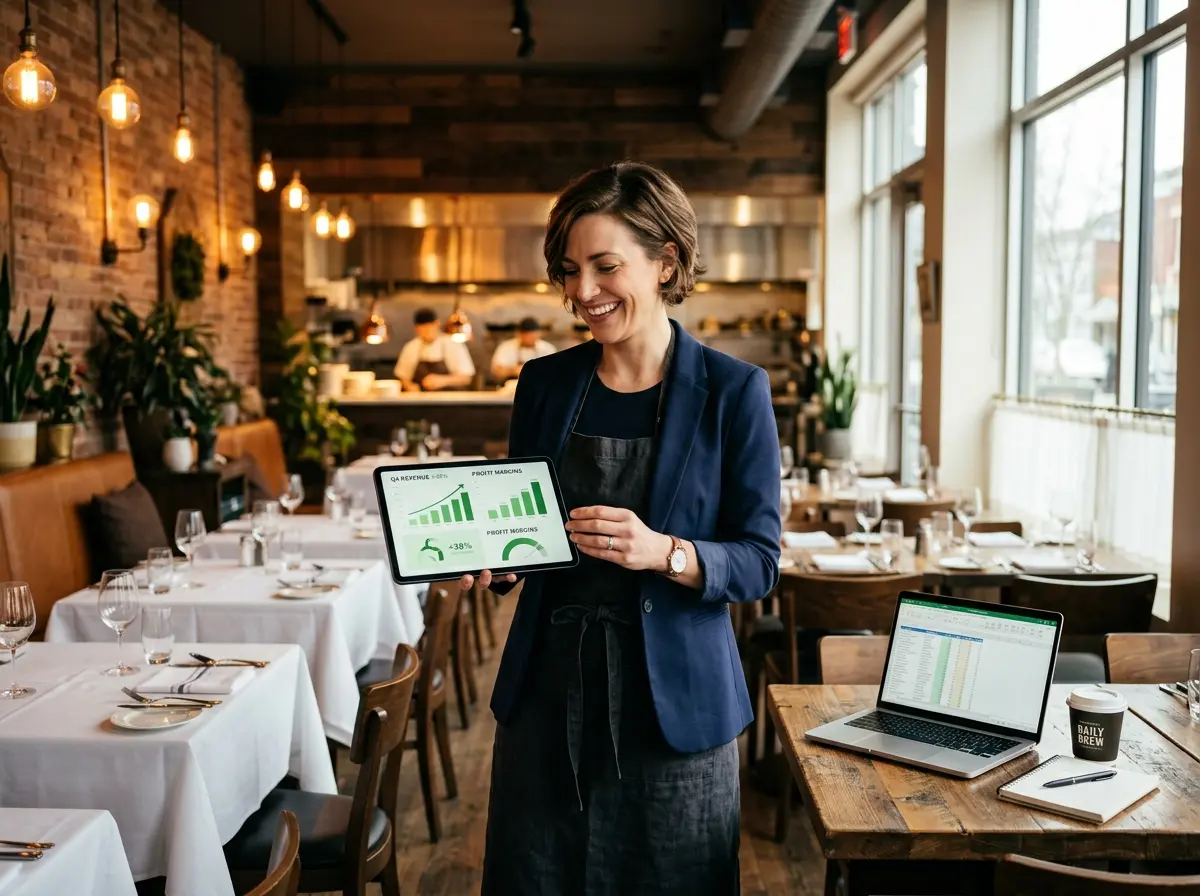
This sounds obvious, but a surprising number of independent operators are running their businesses on intuition and monthly P&Ls without a granular understanding of contribution margins by menu item. Your most popular dish and your most profitable dish are often not the same thing. Menu engineering — the practice of analyzing item popularity against actual margin contribution — is one of the highest-ROI exercises a restaurant owner can do, and it costs nothing but time.
Start by calculating the food cost percentage for each menu item, then cross-reference with your sales mix data. You'll almost certainly find items that are selling well but dragging down your margins, and items with great margins that simply need better placement or promotion. A few strategic menu adjustments can move your overall food cost by 2–3 percentage points without anyone at the table noticing a thing.
Systematize Your Slow Periods
Most restaurants have predictable slow periods, and most restaurant owners spend those periods either catching up on tasks or stressing about revenue. The more profitable approach is to treat slow periods as operational investment time. Use them to train staff on upselling techniques, review your top customer interactions, update your promotional offers, or analyze what's working in your marketing. The restaurants that consistently outperform their peers aren't necessarily busier — they're better organized during the hours when the pressure is off.
Consider implementing a simple weekly rhythm: one slow period per week is dedicated to one specific business improvement task. Over a year, that's 50 small improvements compounding on each other. That's not a minor thing.
Retention Is Cheaper Than Acquisition (Treat It That Way)
It costs roughly five times more to acquire a new customer than to retain an existing one, and yet most independent restaurants invest the majority of their marketing energy chasing new guests. A modest investment in loyalty, personalization, and follow-up communication with your existing customer base will almost always outperform the same dollars spent on new customer advertising.
Simple tactics work here: a birthday offer sent via email, a "we miss you" message to customers who haven't visited in 60 days, or a first-look invitation to regulars when you launch a new menu. None of this requires a sophisticated tech stack — just a customer list and a commitment to using it consistently.
A Quick Reminder About Stella
Stella is the AI robot employee and phone receptionist built for businesses exactly like yours — friendly, always available, and genuinely useful for handling the repetitive tasks that pull your team away from what matters. She works in-store as a physical kiosk and answers phone calls 24/7, making sure no customer inquiry goes unanswered and no promotional opportunity gets missed. At $99/month, she's one of the more straightforward ways to add operational capacity without adding payroll.
Stop Grinding Harder. Start Running Smarter.
The profitability formula for independent restaurant owners isn't a secret. It's margin awareness, labor efficiency, consistent upselling, and the discipline to build systems instead of just surviving service. None of it requires a massive budget or a business degree — it requires the willingness to step back from the day-to-day grind long enough to actually look at how the business is running.
Here's where to start this week:
- Pull your sales mix report and identify your three highest-margin menu items. Make sure your staff knows to recommend them and your menu gives them visual prominence.
- Track one week of incoming phone calls — how many are you missing, and what are they about? The answer will probably surprise you.
- Identify one recurring task that you or your staff handle manually that could be automated or delegated to technology.
- Email your last 90 days of customers with a simple, genuine message and a reason to come back. See what happens.
You built something real. The goal now is to make sure it's working for you — not the other way around. Because if you're still answering phones during the dinner rush, explaining your hours for the fifteenth time, and wondering where the margin went, the problem isn't your food. It's your system. And systems, unlike soufflés, are actually pretty fixable.