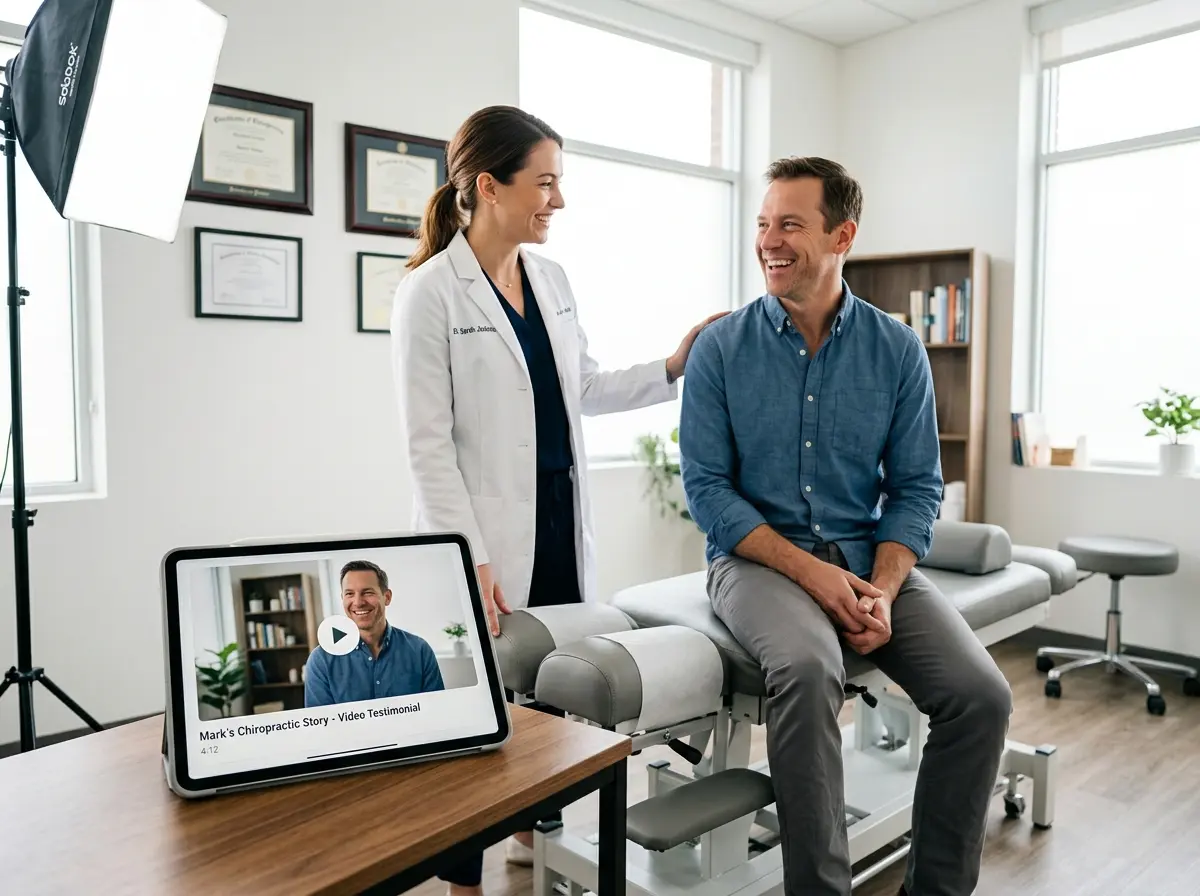
Why Most Chiropractic Offices Are Leaving New Patients on the Table
Let's be honest — when someone's back is screaming at them after a questionable attempt at moving a couch, they're not going to call the first chiropractor they find. They're going to research. They're going to scroll through reviews, poke around your website, and try to figure out whether you're the kind of office that actually fixes people or the kind that has them coming back every week forever (which, yes, some patients eventually figure out). What they're really looking for is proof — and nothing delivers proof quite like a real patient, on video, talking about how you changed their life.
Testimonial videos are one of the most powerful conversion tools in a chiropractic practice's marketing arsenal, yet most offices either don't use them at all or produce something so stiff and awkward it does more harm than good. According to Wyzowl's State of Video Marketing report, 89% of consumers say watching a video has convinced them to buy a product or service. For healthcare — where trust is everything — that number is even more meaningful. People don't just want to know you're good. They want to feel it.
In this post, we'll walk through how to actually get great testimonial videos from your patients, how to use them strategically to convert new patients, and how to make your entire front-end patient experience work harder for your practice.
Getting Testimonial Videos That Actually Convert
The biggest mistake chiropractic offices make with testimonial videos isn't the lighting or the camera angle — it's the content itself. A video of a patient saying "Dr. Johnson is really nice and my back feels better" is not going to convert anyone. You need stories, and you need them told the right way.
Ask the Right Questions
The secret to a compelling testimonial is the question you ask before the camera even starts rolling. Most patients, when asked to "say something nice," will freeze up and deliver the most generic statement imaginable. Instead, guide them with specific prompts that draw out the real story:
- "What was your life like before you came to see us?" — This sets up the problem. Pain, limitation, frustration.
- "What made you hesitant to try chiropractic care?" — This addresses objections your prospective patients probably share.
- "What changed after your treatment?" — This is the transformation. The money shot.
- "What would you tell someone who's on the fence about calling us?" — A direct call to action, delivered by someone who isn't you.
When you ask questions like these, patients stop performing and start talking. That's when you get the good stuff — the moment someone says "I hadn't slept a full night in three years, and after six visits I finally woke up without pain." That is what makes a prospective patient pick up the phone.
Make It Easy and Comfortable to Participate
You're not running a film studio. You don't need a production crew or a green screen. What you need is a quiet corner of your office, decent natural light or a simple ring light, and a patient who feels relaxed enough to speak naturally. Shoot vertically for social media or horizontally for your website — ideally both. Keep it short: two to three minutes is plenty. Most of the magic happens in the first 60 seconds anyway.
Pick your timing wisely. The best moment to ask a patient for a testimonial is right after a breakthrough session — when they're standing up straighter and their face says everything before their mouth even does. A simple "Would you be willing to share your experience on camera? It helps other people in your situation find us" is all you need. Most happy patients will say yes. The ones who've been coming for years and rave about you anyway? Ask them first.
Diversify Your Patient Stories
One testimonial is a data point. Ten testimonials covering different conditions, demographics, and life situations is a trust ecosystem. A 45-year-old athlete with a sports injury and a 60-year-old teacher with chronic neck pain are not the same prospective patient — but both could be your next one. Build a library of testimonials over time that speaks to your different patient personas: weekend warriors, desk workers, seniors, prenatal patients, parents bringing in kids. When a prospective patient sees someone who looks and sounds like them describing a problem they recognize, conversion becomes almost inevitable.
Where and How to Deploy Your Testimonial Videos
Strategic Placement Across Your Digital Presence
Creating great testimonial videos is only half the battle. Where you put them determines whether they actually drive new patient calls. Your website's homepage should feature at least one prominent testimonial video above the fold — ideally one that speaks to your most common patient concern. Your "About" and "Services" pages are also prime real estate. Don't just bury them in a "Testimonials" tab that no one clicks; weave them into the pages where prospective patients are already making decisions.
On social media, short clips (30–60 seconds) perform exceptionally well on Instagram Reels, Facebook, and even TikTok. Google Business Profile now supports video uploads, and a testimonial video there can dramatically improve your local search presence. Email nurture sequences for prospective patients who've expressed interest but haven't booked yet are another underutilized channel — a single well-placed testimonial video in a follow-up email can be the nudge that closes the gap.
How Stella Can Support Your New Patient Conversion Workflow
Here's where things get interesting. You can have the most compelling testimonial video library in your city, but if a prospective patient calls your office after watching one and hits a voicemail — or worse, gets put on hold for five minutes — you've lost them. That's where Stella, the AI robot employee and phone receptionist, comes in. Stella answers every call, 24/7, with the same warmth and knowledge a well-trained front desk staff member would bring — without the sick days or the "can you hold?" moments.
For chiropractic offices specifically, Stella can handle new patient intake through conversational forms over the phone, collect insurance and appointment preference information, and even answer common questions about your services and approach — all before a human staff member ever gets involved. She also greets walk-ins at the kiosk inside your office, which means someone who came in after watching a testimonial video is met with a professional, friendly experience from the very first second. Her built-in CRM captures patient contact information and interaction details, so nothing falls through the cracks when your team follows up.
Turning Testimonials Into a Systematic Growth Engine
One great video is a win. A repeatable process for consistently generating and deploying testimonials is a growth strategy. The practices that dominate their local market don't stumble into great patient stories — they build systems around collecting them.
Build a Testimonial Collection Process Into Your Practice Workflow
Assign someone on your team — or yourself — to be the designated testimonial champion. This person flags happy patients, keeps a simple release form on hand, and has a go-to setup for quick recordings. Set a realistic goal: two to four new testimonial videos per month. At that pace, you'll have a comprehensive library within six months and enough content to fuel your social media calendar, website updates, and email campaigns without ever scrambling for content.
Also consider using a simple patient feedback touchpoint — whether a follow-up text, an email, or even a kiosk prompt — to identify who's had a great experience recently. Patients who leave a five-star Google review are excellent candidates to approach for a video testimonial. They've already publicly declared they love you. Getting them on camera is just the natural next step.
Repurpose and Amplify Every Video You Capture
One testimonial video can generate a remarkable amount of content. The full version lives on your website. A 60-second cut goes on Instagram and Facebook. A 15-second highlight becomes a Story or a Reel. A transcript becomes a written testimonial for your Google Business Profile or a blog quote. An audio pull can even be used in a podcast ad or a local radio spot. You're not just capturing a video — you're capturing a story that can be told in a dozen different formats across a dozen different channels.
Track What's Working
Don't just post and pray. Use UTM parameters on video links to track which testimonials drive the most website traffic and form submissions. Ask new patients during intake how they heard about you — and specifically whether they saw a video. Over time, you'll start to see patterns: which stories resonate most, which platforms drive the most bookings, and which patient demographics are most influenced by which types of testimonials. This data turns a good content strategy into a great one.
Quick Reminder About Stella
Stella is an AI robot employee and phone receptionist built for businesses like yours — she stands inside your office greeting and engaging patients, while also answering every phone call around the clock with full knowledge of your services, policies, and promotions. At just $99/month with no upfront hardware costs, she's the kind of reliable front-desk presence that doesn't call in sick right before a full appointment schedule. For a chiropractic office focused on converting new patients, she's a practical way to make sure no lead ever slips through the cracks.
Your Next Steps Start Today
You've invested in your skills, your equipment, and your space. Testimonial videos are one of the highest-ROI marketing moves you can make — and unlike paid ads, they keep working long after you hit publish. The good news is that you probably already have patients who would happily go on camera for you. You just need to ask.
Start this week with one video. Identify a patient who's had a great outcome, grab a ring light and your phone, and walk them through the four questions outlined above. Post it on your Google Business Profile, add it to your homepage, and share it on social media. Then do it again next week. Build the habit before you build the system.
And while you're optimizing the experience that happens after a prospective patient watches your video — the call, the intake, the first impression at the front desk — make sure that experience is as polished as the content that brought them in. Because the best testimonial video in the world can't save a frustrating phone experience or a chaotic front office. Get the whole picture right, and watch your new patient numbers move.