Stop Leaving Money in the Mop Bucket
Here's a scenario that probably sounds familiar: a customer walks into your cleaning supply store (or lands on your website), grabs the one item they came for, and walks right back out. Transaction complete. Opportunity missed. You just sold someone a mop head and forgot to mention the bucket, the wringer, the floor cleaner, and the industrial-strength degreaser that would have made their life significantly easier — and your register significantly happier.
Product bundling is one of the oldest tricks in the retail playbook, and for good reason: it works. Studies consistently show that bundling can increase average order value by 20–30%, and in an industry like cleaning supplies — where products are inherently complementary — the opportunities are practically endless. The challenge isn't whether to bundle; it's knowing how to bundle smartly so customers feel like they're getting a deal instead of feeling upsold into something they don't need.
Let's break down exactly how to do that.
Building Bundles That Actually Sell
A good bundle isn't just "throw three things together and slap a discount on it." It needs to tell a story. Customers should look at your bundle and think, "Yes, obviously those go together — why didn't I think of that?" That's the sweet spot between obvious logic and pleasant surprise.
Start with Use-Case Bundles
The most effective bundles are organized around what the customer is trying to accomplish, not around what's convenient for your shelves. Think about the jobs your customers come in to do: deep-cleaning a commercial kitchen, sanitizing a medical office, maintaining a warehouse floor, or doing a weekly janitorial restocking run.
For example, a "Commercial Kitchen Deep Clean Kit" might include a heavy-duty degreaser, a stainless steel cleaner, color-coded microfiber cloths, and a pair of chemical-resistant gloves. A "Restroom Refresh Bundle" could bundle toilet bowl cleaner, disinfectant spray, disposable gloves, and paper towels. Each of these bundles answers a question the customer already has — "What do I need to get this done?" — before they even have to ask it.
Price It Like a Deal (Because It Should Be One)
Bundle pricing needs to feel like a genuine win for the customer. A common and effective approach is to offer a 10–15% discount compared to buying each item individually. This is enough to feel meaningful without gutting your margins — especially if you're strategically pairing high-margin items with lower-margin staples.
You can also experiment with tiered bundles: a "Starter" kit, a "Professional" kit, and a "Commercial" kit at different price points. This gives customers a natural upgrade path and makes upselling feel like a logical choice rather than a sales tactic. Nobody wants to feel upsold. Everyone wants to feel like they made a smart decision. Design your bundles accordingly.
Feature Your Bundles Prominently — Don't Hide Them
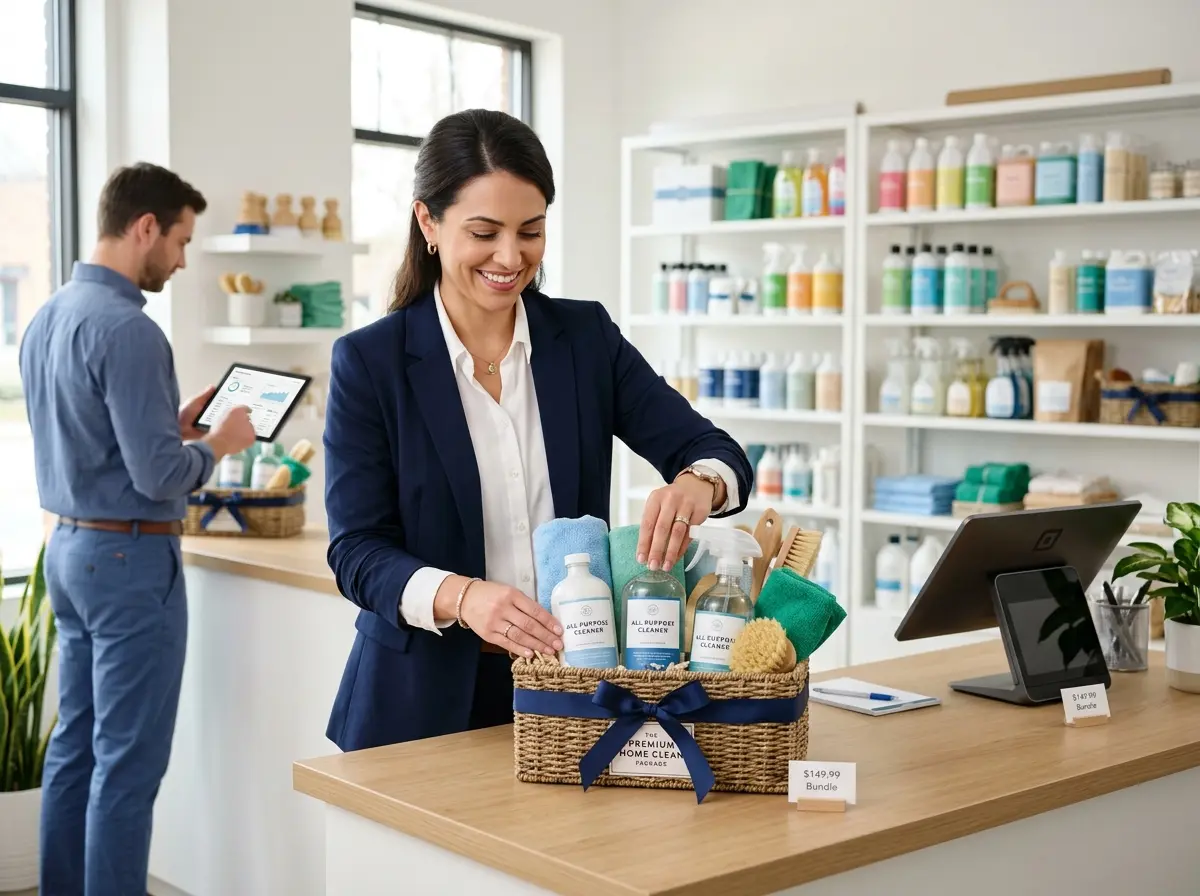
A bundle that nobody sees doesn't sell anything. Whether you're operating a physical storefront or an e-commerce shop, your bundles need to be front and center. In-store, create dedicated bundle displays near high-traffic areas or at checkout. Online, feature them on your homepage, in product category pages, and with "Frequently Bought Together" recommendations. If a customer has to go looking for your bundles, you've already lost most of them.
Let Technology Do the Talking (Seriously)
Even the most brilliant bundle strategy falls flat if no one's around to explain it. This is where Stella, the AI robot employee and phone receptionist, can quietly become one of your most effective salespeople. Standing right inside your storefront, Stella greets customers proactively — not in a pushy, "can I help you find something?" way that everyone ignores, but in a friendly, conversational way that naturally leads customers toward your current promotions and bundle offerings.
When a customer calls in to ask about floor cleaning products, Stella answers the phone 24/7, knows your inventory, and can mention your current Commercial Floor Care Bundle before the customer even thinks to ask. That's a cross-sell that happens automatically, without training a new hire or hoping your staff remembers to mention it during a busy afternoon rush. Whether it's an in-store interaction or a phone call, Stella keeps your bundle messaging consistent and your cart values moving in the right direction.
Strategies for Ongoing Bundle Optimization
Creating bundles once and forgetting about them is almost as bad as not creating them at all. The most successful cleaning supply businesses treat bundling as a living strategy — one that evolves with the seasons, customer feedback, and sales data.
Rotate Bundles Seasonally and by Industry
Cleaning needs change throughout the year and vary wildly by industry. Spring brings a surge in deep-cleaning demand. Back-to-school season means schools and daycare centers are stocking up on disinfectants. Cold and flu season drives demand for sanitizing products in medical offices and gyms. Holiday season means restaurants are preparing for maximum foot traffic and health inspections.
Build seasonal bundles that speak directly to these moments. A "Flu Season Sanitation Kit" targeted at gyms and fitness centers in the fall, or a "Spring Deep Clean Package" for janitorial services in March, shows customers that you understand their world — and that's worth paying a premium for. Consider building an industry-specific section on your website or in your store where healthcare clients, restaurant owners, and property managers can each find bundles tailored to them.
Use Sales Data to Refine What's Working
Pay attention to which products are most commonly purchased together — your point-of-sale data will tell you this. If you notice that 60% of customers who buy commercial mop heads also grab floor finish within the same visit, that's a bundle waiting to happen. Likewise, if a bundle isn't moving, don't just discount it further — investigate. Maybe the combination doesn't feel intuitive, or the price point is off, or it needs better placement.
Survey your best customers. Ask them what a "complete kit" for their specific job would look like. They'll often describe bundles you hadn't thought of, and they'll feel valued in the process — which is its own form of customer retention.
Train Staff to Reinforce the Bundle Message
Your bundles will only succeed if your team believes in them and knows how to talk about them. Make sure every staff member understands the current bundle offerings, the discount value, and the customer benefit. A simple training approach: for each bundle, practice a one-sentence explanation of why these products go together. "These three products are everything you need for a full kitchen sanitation — and you save $12 buying them together." Simple, honest, done.
A Quick Word About Stella
Stella is an AI robot employee and phone receptionist that works in-store as a friendly kiosk and answers phone calls around the clock — for just $99/month with no upfront hardware costs. She's always ready to greet customers, promote your bundles, and make sure nothing falls through the cracks, whether you're swamped at the register or closed for the night.
Time to Bundle Up
Product bundling in the cleaning supply industry isn't complicated — but it does require intention. The businesses that do it well aren't just throwing products together; they're thinking like their customers, pricing with transparency, and making sure every touchpoint (in-store, online, on the phone) reinforces the value of buying more than one thing at a time.
Here's your action plan to get started:
- Identify your top five most commonly paired products using your existing sales data.
- Create two or three use-case bundles around common customer jobs — kitchen cleaning, restroom maintenance, floor care, etc.
- Price them competitively with a clear per-item comparison so customers can see the savings instantly.
- Display them prominently — in your store, on your website, and in your marketing materials.
- Rotate seasonally and track performance so you're always optimizing.
The cleaning supply business is competitive, margins can be tight, and customer loyalty isn't guaranteed. But a smart bundling strategy is one of the simplest, most cost-effective ways to increase revenue without increasing your customer acquisition costs. Every transaction is an opportunity to add value — for your customer and for your bottom line. Don't leave that opportunity in the mop bucket.