Your Frames Are Gorgeous. Too Bad Nobody Can Ask About Them at 9 PM.
Picture this: A potential patient finishes dinner, remembers they need new glasses, and pulls up their phone to call your practice. It's 8:47 PM. Your office closed at 5. They get voicemail, hang up, and by tomorrow morning they've already booked an appointment with the competitor down the street who had a chatbot ready and waiting. You, meanwhile, are blissfully unaware this ever happened.
After-hours inquiries are the silent revenue leak that most optometry practices never think to plug. Frame selection — one of the most personal, detail-heavy, and emotionally driven purchases your patients make — doesn't always happen on a convenient Tuesday at 2 PM. People browse, wonder, compare, and decide on their own schedule. And if your practice isn't available to answer questions when curiosity strikes, you're essentially leaving money on the table with a polite little "we'll be open Monday" note attached to it.
The good news? AI has entered the chat. Literally. Let's talk about how your optometry practice can use AI to handle after-hours frame selection inquiries — and why doing so might be one of the smartest operational moves you make this year.
Why Frame Selection Inquiries Happen After Hours (And Why It Matters)
The Browsing Behavior of Modern Eyewear Shoppers
Modern consumers do their research outside of business hours. According to studies on retail consumer behavior, a significant portion of purchase-related research happens in the evenings and on weekends — times when your front desk staff is, quite reasonably, at home. For optometry practices, this is particularly relevant because frame selection isn't a quick, impulsive decision. Patients want to know what brands you carry, whether you have titanium frames, what your price range looks like, and whether that designer collection they saw on Instagram is actually available at your location.
These are not complex questions. They don't require a licensed optometrist. But they do require someone — or something — to answer them promptly. A delayed response isn't neutral; it's actively harmful to your conversion rate.
The Emotional Stakes of Choosing Frames
Frames are not just a medical device. They sit on someone's face every single day. Patients agonize over them. They want to know if you carry lightweight options for sensitive noses, whether you have styles that work for wide faces, and if your brand selection skews more classic or trendy. These questions are personal, and the moment someone feels engaged and helped — even by an AI — you've already begun building the kind of trust that turns a curious caller into a loyal patient.
An AI that can confidently say, "Yes, we carry Lindberg and Silhouette — both are excellent lightweight options — and our optical team would love to help you find the right fit during your visit," does more than answer a question. It starts a relationship.
The Competitive Reality
Optical retail is more competitive than ever. Independent practices are competing not just with each other, but with big-box chains and online eyewear retailers that are available 24/7 by design. If a patient can get a thoughtful, informative response from a competitor's website chatbot at 10 PM, your silent phone line is a competitive disadvantage. You don't need to out-spend national chains. You just need to out-respond them — and that's entirely achievable with the right tools.
Setting Up AI to Actually Know Your Frame Inventory
Training Your AI on What You Actually Carry
The biggest fear most practice owners have about AI is that it'll say something confidently wrong — like telling a patient you carry a brand you discontinued two years ago. That's a fair concern, and it's why the setup phase matters enormously. A well-implemented AI assistant for your practice should be trained on your actual inventory: the brands you carry, the price ranges you offer, any exclusive collections, your lens upgrade options, and your policies on adjustments and returns.
Think of it like onboarding a new front desk employee, except this one never forgets what you tell it, never calls in sick, and doesn't need a 401(k). You provide the information; the AI delivers it consistently and accurately, every time.
How Stella Fits Into Your Practice
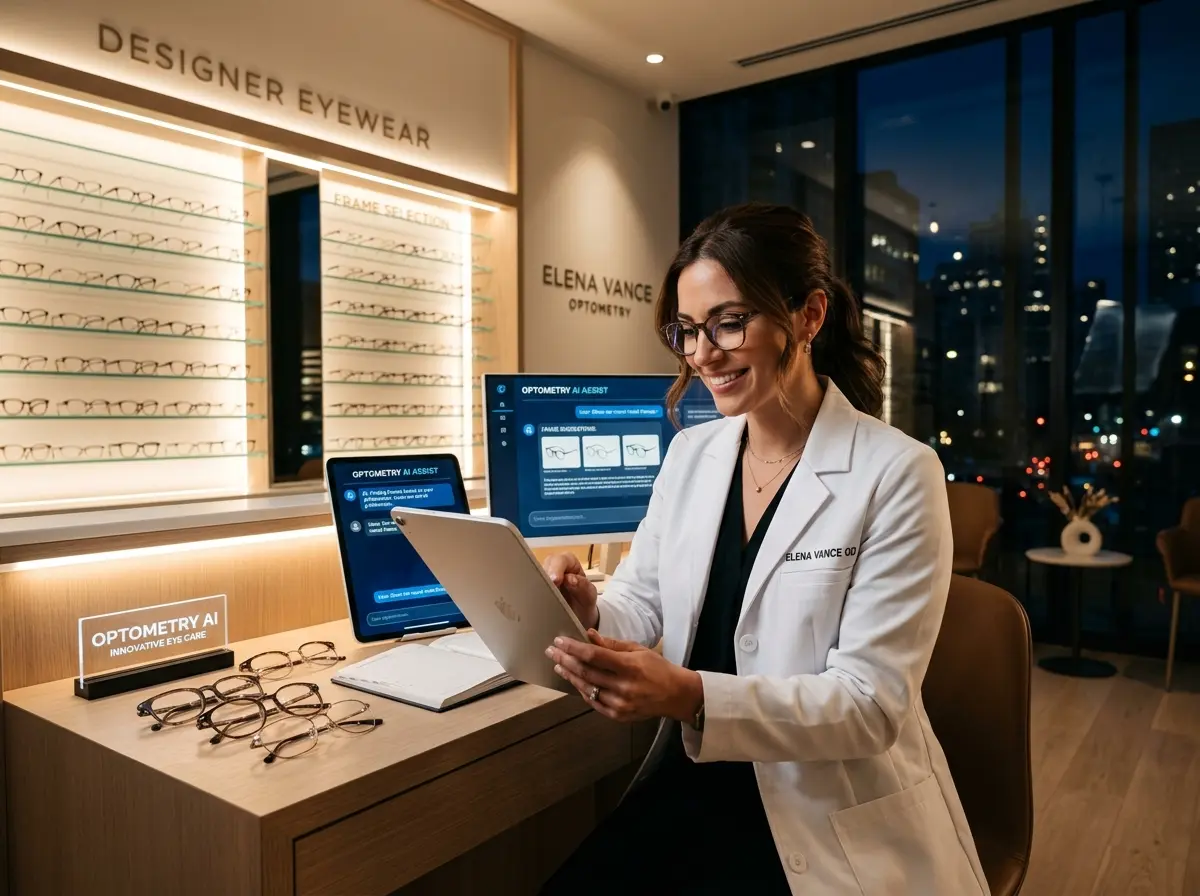
This is where an AI solution like Stella becomes genuinely useful for optometry practices. Stella works both as an in-store kiosk presence — greeting patients, answering questions about your frame collections, and promoting current eyewear promotions — and as a 24/7 AI phone receptionist that handles after-hours calls with the same knowledge base she uses in person. A patient calling at 9 PM to ask about your designer frame selection won't reach a generic voicemail. They'll reach Stella, who can walk them through what you carry, mention any current promotions, collect their contact information through a conversational intake form, and even schedule a callback or appointment for the next day. Her built-in CRM logs the interaction, tags the contact, and sends a push notification to your manager so nothing falls through the cracks by morning.
Practical Ways AI Improves the Frame Selection Experience
Answering Specific Product Questions Consistently
One of the underappreciated advantages of AI is consistency. Your human staff are excellent — but one associate might enthusiastically describe your Maui Jim collection while another forgets to mention it entirely. AI answers the same question the same way, every time, with every relevant detail included. For frame inquiries, this means patients always hear about your current promotions, your lens package bundles, your adjustment and repair services, and whatever else you've decided is important to communicate. Consistency at the front desk is hard to achieve with humans. With AI, it's the default setting.
Upselling Without the Awkwardness
Nobody likes feeling pressured by a salesperson. But patients do appreciate relevant suggestions. AI is remarkably good at weaving in upsell mentions naturally — mentioning that the frame a patient is asking about pairs well with your anti-reflective lens coating, or that your current buy-one-get-one promotion on frames ends at the end of the month. It doesn't feel pushy because it's informational, and because the patient asked a question and got a helpful, complete answer. Done right, AI upselling feels like good service — because it is.
Collecting Leads From Curious Callers
Not every after-hours caller is ready to book. Some are just browsing, doing early research, or comparing practices. That doesn't mean they're not valuable. AI can collect basic contact information — name, phone number, email, what they're looking for — through a natural conversation rather than a clunky web form. By morning, your team has a list of warm leads who expressed interest in your frames, complete with notes on what they asked about. That's not a missed call. That's a sales pipeline.
Quick Reminder About Stella
Stella is an AI robot employee and phone receptionist built for businesses like yours — available as a friendly in-store kiosk and as a 24/7 phone answering solution, all for $99/month with no upfront hardware costs. She's easy to set up, endlessly patient, and never asks for a lunch break. For optometry practices looking to capture after-hours inquiries without hiring additional staff, she's worth a serious look.
Turn After-Hours Curiosity Into Monday Morning Appointments
The path forward for your optometry practice isn't complicated. After-hours frame selection inquiries are happening whether you're prepared for them or not. The question is whether those inquiries result in booked appointments at your practice or someone else's.
Here are your actionable next steps:
- Audit your current after-hours experience. Call your own practice at 7 PM. What happens? If the answer is "voicemail," you've identified your gap.
- Document your frame inventory and key selling points. Brands, price ranges, specialty collections, current promotions — get it all written down in a format that can be used to train an AI assistant.
- Define what questions you want AI to handle. Frame availability, pricing, brand questions, appointment scheduling, and promotion details are all excellent candidates.
- Implement a solution and track the results. Monitor how many after-hours inquiries convert to appointments. The data will speak for itself.
Your frames deserve an audience beyond business hours. Your patients deserve answers when they're actually thinking about their eyes. And your practice deserves the revenue that comes from being available, informed, and engaging — even when you're sound asleep. AI makes all of that possible, and at this point, the only real question is how long you're willing to wait before putting it to work.