You Did the Work — Now Make Sure They Come Back
You unclogged the drain. You replaced the HVAC filter. You pressure-washed the driveway until it looked like it was installed yesterday. The job is done, the invoice is paid, and your crew is already on the way to the next one. Mission accomplished, right?
Well, mostly. There's one small step that most home services businesses skip — and it's quietly costing them repeat business, referrals, and five-star reviews. That step is the post-service check-in call.
It sounds almost too simple to matter. Call the customer a day or two after the job, ask how things are going, make sure they're happy. That's it. No upsell pressure, no awkward script, no gimmicks. And yet, businesses that do this consistently report higher customer retention, more online reviews, and significantly more word-of-mouth referrals than those that don't. Turns out, people remember the contractors who actually followed up — because almost none of them do.
So let's talk about why the post-service check-in call is one of the most underrated tools in your business, and how to actually make it work for you.
Why the Check-In Call Works (and Why You're Probably Skipping It)
The Psychology Behind the Follow-Up
Customers who hire home services businesses are, by definition, people who just had something fixed, cleaned, installed, or improved in their home. That's a personal space. They trusted you with their property, their schedule, and often their family's comfort. When the job is done and you disappear into the void, it feels transactional — because it was.
A follow-up call changes that dynamic entirely. Research consistently shows that customers who feel valued are significantly more likely to become repeat buyers. According to a Bain & Company study, increasing customer retention by just 5% can increase profits by 25% to 95%. A two-minute phone call is one of the cheapest and most effective ways to make someone feel like more than a line item on a work order.
The psychology is straightforward: you're signaling that you care about the outcome, not just the payment. That small gesture builds trust, and trust is what turns a one-time customer into a loyal one.
The Real Reason Most Businesses Don't Do It
Let's be honest. You already know follow-up calls are a good idea. You've probably nodded along to this advice at some point, maybe even added "follow up with customers" to a to-do list that has since been buried under seven other to-do lists. The reason it doesn't happen isn't lack of awareness — it's lack of bandwidth.
When you're running a home services operation, your day is already packed. You're scheduling jobs, managing crews, ordering supplies, handling complaints, and somehow also trying to find time to eat lunch before it's cold. Adding a systematic follow-up process feels like one more thing on a plate that's already overflowing. So it gets skipped. Every time. Indefinitely.
The good news is that this is a systems problem, not a motivation problem. And systems problems have solutions.
Making the Check-In Call Work Without Losing Your Mind
How Stella Can Help You Stay on Top of Customer Follow-Ups
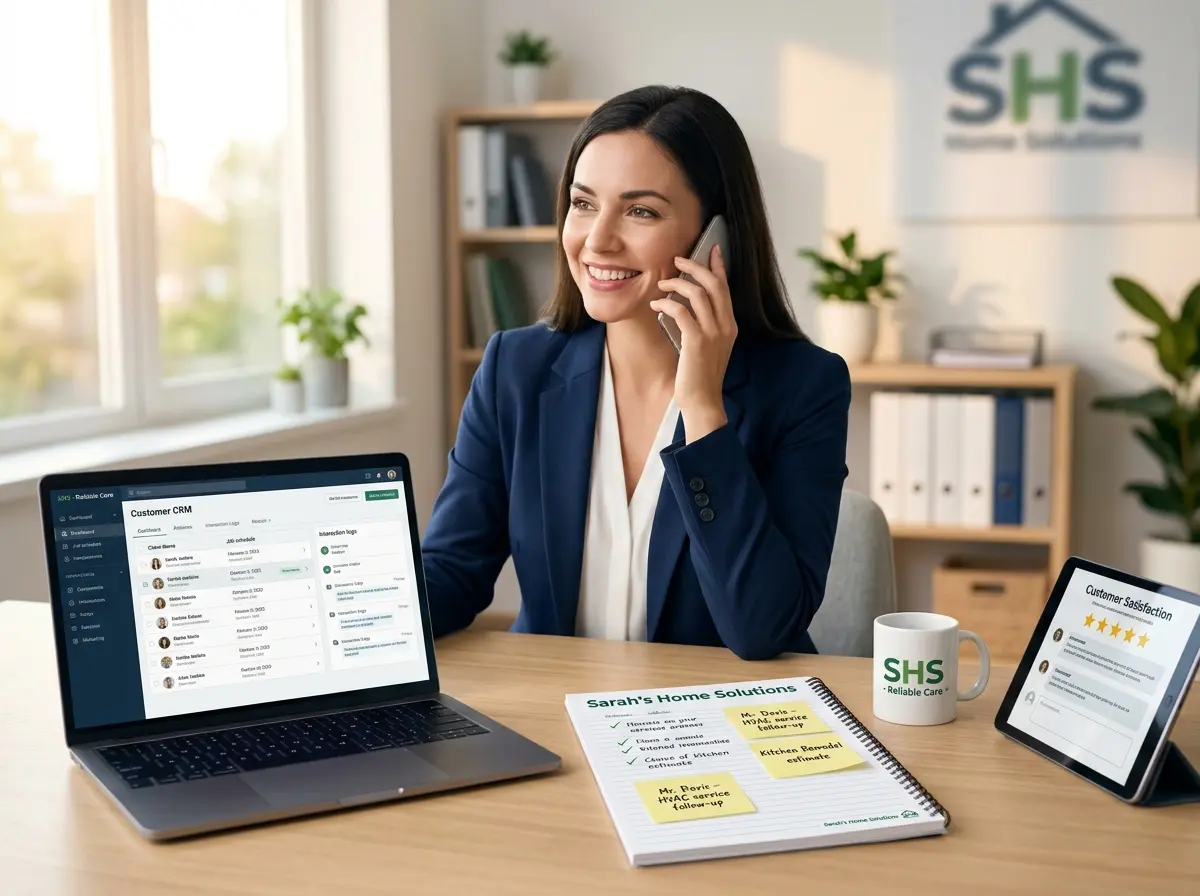
This is exactly the kind of operational gap that Stella, the AI robot employee and phone receptionist, is built to help with. While Stella doesn't personally place outbound calls on your behalf, she plays a critical supporting role in the follow-up process. When customers call back after receiving a check-in, Stella answers 24/7, captures their responses, and logs everything in her built-in CRM — complete with AI-generated customer profiles, custom fields, tags, and notes. If a customer calls to say the repair is holding up great and they need to schedule a gutter cleaning next month, Stella captures that information through conversational intake, updates the contact record, and makes sure nothing slips through the cracks.
For home services businesses with a physical presence or showroom, Stella's in-store kiosk greets walk-in customers and can surface relevant promotions based on the season or current specials — so when a customer comes in after a positive follow-up experience, they're already being engaged with the right offers. She handles the front-end customer experience so your team can focus on the actual work.
What to Say, When to Say It, and How to Say It
The Anatomy of a Great Check-In Call
A good post-service check-in call is short, genuine, and low-pressure. Here's a simple structure that works:
- Identify yourself and reference the job. "Hi, this is Marcus from ClearFlow Plumbing — we replaced your water heater on Tuesday." Don't assume they remember you. They've had a whole week since then.
- Ask the one important question. "I just wanted to check in and make sure everything is working well and you're happy with how things turned out." That's it. Simple, direct, human.
- Listen and respond genuinely. If there's a problem, take it seriously and offer to fix it. If everything's great, say you're glad to hear it. Resist the urge to immediately pivot to a sales pitch.
- Close naturally. If the conversation is going well, this is a perfectly appropriate moment to mention a seasonal service, ask for a review, or request a referral. But only after you've established that they're actually satisfied.
The whole call should take two to three minutes. It's not a big production. The value isn't in the length — it's in the fact that you called at all.
Timing Is Everything
The sweet spot for a post-service check-in is 24 to 72 hours after job completion. Call too soon and the customer hasn't had a chance to really experience the work. Call too late and the emotional momentum has faded — they've moved on, and your call feels random rather than attentive.
For larger jobs like full HVAC installations, roofing replacements, or major renovations, a two-stage follow-up works well: a quick check-in at 48 hours, and a more thorough satisfaction call at the 30-day mark. That second call is a particularly good opportunity to ask for a review, since the customer has now lived with the result and can speak to its quality with real confidence.
Turning Check-In Calls Into a Review and Referral Engine
Here's where the real ROI lives. A satisfied customer on the phone is already warm — they're happy, they're talking to you, and they're in a positive headspace about your business. That is the single best moment to ask for a Google review or a referral, and most business owners completely waste it by not asking.
Keep it casual. Something like: "Really glad to hear that. If you ever have a moment, a quick Google review would honestly mean the world to us — it helps other homeowners find us when they need help. And if you have any neighbors or friends who need [your service], we'd love to take care of them too."
According to BrightLocal, 76% of customers who are asked to leave a review actually do so. The bottleneck isn't willingness — it's that nobody asks. Your check-in call is the ask.
Quick Reminder About Stella
Stella is an AI robot employee and phone receptionist that answers calls 24/7, manages customer information through a built-in CRM, and greets customers in-store — all for $99/month with no upfront hardware costs. She's always on, always professional, and never calls in sick the day before a big job. For home services businesses looking to tighten up their customer experience, she's worth a look.
Start Small, Stay Consistent, and Watch the Numbers Move
The post-service check-in call doesn't require a big investment, a new software platform, or a dedicated staff member. What it requires is commitment and consistency. Here's how to get started without overcomplicating it:
Start with a simple process. After every completed job, add the customer's name and phone number to a follow-up list. Assign one person — even if that's you — to make those calls each morning for jobs completed 24 to 48 hours prior. Keep a script handy for the first few weeks until it feels natural.
Track what happens. Note whether customers were satisfied, whether any issues came up, whether they left a review, and whether they expressed interest in future services. Over time, this data will show you exactly how much value the check-in call is generating — and it will motivate you to keep doing it.
Automate the reminders, humanize the calls. Use your CRM or scheduling software to trigger a reminder when a follow-up call is due. The call itself should always be a real human voice — not a robocall, not a text, not an automated email. The personal touch is the entire point. Everything else can be systematized; the conversation should not be.
The businesses that win long-term in home services aren't always the ones with the fanciest equipment or the lowest prices. They're the ones that make customers feel like they genuinely matter. A two-minute phone call, made consistently and sincerely, is one of the simplest ways to be that business. So pick up the phone. Your competitors almost certainly won't.