Why Most Restaurants Are Sitting on a Goldmine of Feedback They Never Use
Let's be honest — most restaurant owners collect customer feedback the same way people collect gym memberships: with great intentions and almost zero follow-through. A comment card here, a Yelp notification there, maybe a Google review that someone stumbles across three weeks after the fact. Meanwhile, the same three problems keep happening every Tuesday, and nobody connects the dots.
Here's the uncomfortable truth: your customers are telling you what's wrong (and what's right) with your restaurant. The question is whether you've built a system that actually listens, captures that information, and turns it into weekly improvements — or whether you're just hoping for the best and blaming the line cook when things go sideways.
A genuine customer feedback loop isn't just a suggestion box with ambitions. It's a structured, repeatable process that helps you make smarter decisions, retain more customers, and quietly outmaneuver competitors who are still guessing. And the good news? You don't need a corporate budget or a data science team to pull it off. You just need the right habits and the right tools.
Building the Foundation of a Real Feedback Loop
Step One: Collect Feedback From More Than One Source
If your only feedback channel is Google Reviews, you're getting a very dramatic sample of your customer base — mostly people who either loved you unconditionally or had their order botched and want the world to know. The silent majority, the regulars who come in every Thursday and quietly wish you'd bring back the butternut squash soup, never say a word.
A solid feedback collection strategy casts a wider net. Think about layering multiple touchpoints:
- Post-visit email or SMS surveys — short, two to three questions, sent within an hour of the visit while the experience is fresh
- In-store feedback prompts — a QR code on the receipt, a tablet near the exit, or a friendly in-person ask from staff
- Phone interactions — tracking what questions and complaints come in over the phone, which reveals patterns you won't see in reviews
- Review platform monitoring — Google, Yelp, TripAdvisor, and any platform relevant to your niche
The goal isn't to drown in data. It's to make sure you're hearing from enough different types of customers to get a realistic picture of what's actually happening in your restaurant.
Step Two: Make It Embarrassingly Easy to Leave Feedback
Customers will not jump through hoops to tell you their pasta was undersalted. If your feedback process requires logging into an account, filling out a seven-question form, or — heaven forbid — downloading an app, you've already lost them. According to research from McKinsey, companies that make feedback collection frictionless see significantly higher response rates, which means better data and fewer blind spots.
Keep your surveys to three questions maximum for casual customers. Use a simple rating scale plus one open-ended question like, "What's one thing we could do better?" That question alone will tell you more than a twelve-question survey that nobody finishes. And always, always send a thank-you response when someone takes the time to share feedback — even if it's automated. It signals that someone is actually listening, which encourages future participation.
Step Three: Centralize Everything So You Can Actually See the Patterns
Scattered feedback is useless feedback. If your Google reviews live in one tab, your comment cards are in a shoebox, and your phone complaints exist only in your staff's collective memory, you have noise — not insight. You need a single place where all feedback flows, gets tagged, and can be reviewed at a glance.
Even a simple spreadsheet with consistent categories (food quality, service speed, staff friendliness, atmosphere, value) can reveal patterns that would otherwise stay invisible. Restaurants that centralize feedback consistently find recurring themes within just two to three weeks — and those themes point directly to the operational changes that will have the biggest impact on customer retention.
How Technology Can Do the Heavy Lifting
Let Your Front-of-House Technology Capture Feedback Automatically
One of the most underutilized opportunities in the restaurant industry is the phone call. Every time a customer calls to ask about your hours, inquire about a reservation, or complain that their takeout order was missing the garlic bread — that interaction is a data point. And in most restaurants, that data evaporates the moment the call ends.
Stella, the AI robot employee and phone receptionist, changes that dynamic entirely. She answers calls 24/7, handles common questions about your menu, hours, and specials, and captures interaction data that flows into a built-in CRM with AI-generated customer profiles, custom fields, and notes. If a customer calls after hours to ask whether you offer gluten-free options, Stella logs it — and now you know that's a question worth addressing proactively, maybe on your menu or website.
For restaurants with a physical location, Stella also operates as a friendly in-store kiosk, greeting customers, promoting specials, and serving as a natural touchpoint for gathering information through conversational intake — all without pulling your staff away from more pressing tasks. It's feedback infrastructure that runs itself.
Turning Raw Feedback Into Weekly Action
Schedule a Weekly Feedback Review — and Actually Do It
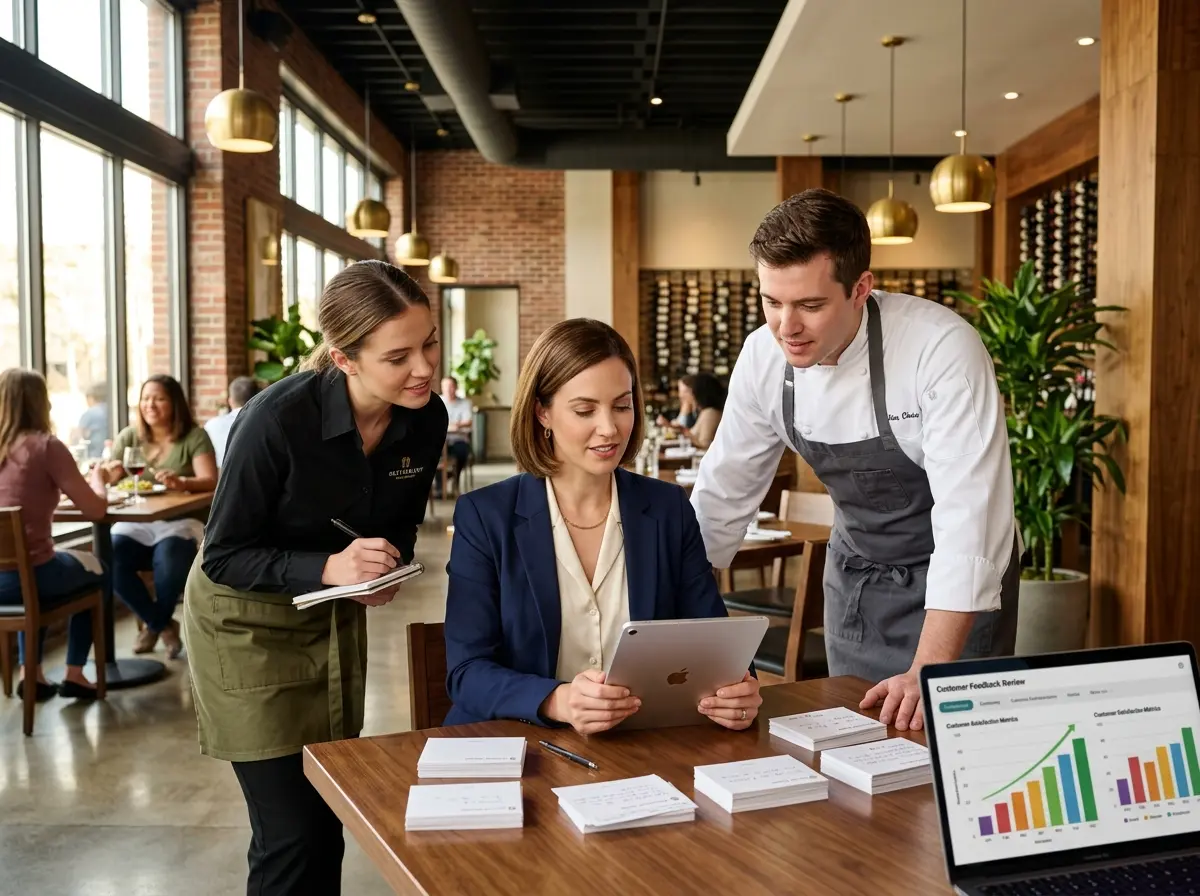
The difference between restaurants that improve steadily and restaurants that spin their wheels is almost always a weekly review habit. Block thirty minutes every Monday morning — or Sunday night if you're ambitious — and treat it like a meeting with your most honest investor. Because in a way, that's exactly what it is.
During this review, look for three things: what customers praised most (double down on it), what they complained about most (fix it this week, not next quarter), and what questions came up repeatedly (address them proactively in your signage, menu, or staff training). If the same complaint about slow weekend service appears in feedback for the third week in a row, that's not a fluke — that's a process problem wearing a disguise.
Close the Loop With Your Team
Your feedback review is only as valuable as the conversations it generates with your staff. Share insights — anonymized and constructively framed — in your pre-shift meetings. If customers consistently mention that a particular server made their night, call it out publicly. If the feedback reveals that the fish tacos have been underwhelming lately, loop in the kitchen team without turning it into a blame session.
Restaurants with strong feedback cultures tend to have lower staff turnover too, because employees feel like they're part of an improving operation rather than just showing up and hoping nothing catches fire. When your team understands that feedback leads to real changes, they become active participants in collecting it — and that multiplies your data quality without any additional cost.
Track Your Improvements Over Time
Here's where most feedback loops stall: the review happens, the insight is noted, the change is made — and then nobody checks whether it worked. Build a simple baseline metric, even something as informal as your average rating on Google or your repeat visit rate, and track it month over month. When you reduce complaints about wait times in February and your March ratings tick upward, you've just closed the loop completely. That's the feedback loop actually working.
Over time, this creates a compounding advantage. Small improvements stack on each other, your regulars notice that things keep getting better, and word of mouth does work that no marketing budget can fully replicate. According to Harvard Business School, increasing customer retention by just 5% can boost profits by 25% to 95% — and a functioning feedback loop is one of the most reliable paths to that retention.
Quick Reminder About Stella
Stella is an AI robot employee and phone receptionist designed for businesses like yours — she greets customers in-store, answers phone calls around the clock, captures interaction data, and keeps your operation running smoothly without breaks, bad days, or turnover. At $99 per month with no upfront hardware costs, she's the kind of team member who pays for herself remarkably fast. If you haven't explored what she can do for your restaurant, it's worth five minutes of your time.
Your Restaurant Gets Better When You Make Listening a System, Not an Afterthought
The restaurants that will thrive over the next five years aren't necessarily the ones with the best chefs or the trendiest concepts — though those things certainly help. They're the ones that have built genuine feedback loops that turn customer voices into operational improvements, week after week, without waiting for a crisis to force their hand.
Here's your action plan to get started this week:
- Audit your current feedback channels. List every place customers can currently give you feedback and identify the obvious gaps.
- Add one new frictionless touchpoint. A QR code on receipts linking to a three-question survey is a fifteen-minute project with long-term payoff.
- Create a simple centralized log. A shared spreadsheet with consistent categories is enough to start seeing patterns within a month.
- Schedule your first weekly review. Put it on the calendar right now, before you close this tab, or it won't happen.
- Share one insight with your team this week. Build the culture of feedback from the top down.
Your customers are already talking. The only question is whether your restaurant is set up to hear them — and do something about it before the competition does.