Introduction: The Power Opportunity Already Sitting in Your Customer Database
Here's a scenario that plays out thousands of times a year: a homeowner sits in the dark for three days after a storm, eating warm soup by candlelight and seriously reconsidering every life decision that led to this moment. Meanwhile, their neighbor — the one who had a whole-home generator installed six months ago — is watching Netflix and running the dishwasher without a care in the world.
Now here's the part that should interest you as an electrician: that storm-weary homeowner is about to call someone for a generator quote. The question is whether they're going to call you — the electrician who already wired their kitchen remodel and knows exactly where their panel is — or some competitor they found on Google at 2 a.m. in a moment of frustrated desperation.
Whole-home standby generators are one of the most lucrative upsell opportunities in the residential electrical market right now. The global standby generator market is projected to exceed $5 billion by 2027, and homeowners are increasingly treating backup power not as a luxury, but as a necessity. If you're not proactively promoting generator installations to your existing customer base, you're leaving serious money on the table — and handing warm leads to your competitors on a silver platter.
Let's fix that.
Understanding the Generator Upsell Opportunity
Why Existing Customers Are Your Best Prospects
The math here is not subtle. Acquiring a new customer costs anywhere from 5 to 25 times more than selling to an existing one, and existing customers are 60–70% more likely to convert on a new offer. Your existing customer database isn't just a list of past jobs — it's a warm pipeline of homeowners who already trust your work, already know your name, and have already invited you into their home. That's extraordinarily valuable in a trade where trust is the entire product.
When you've already installed a panel upgrade, wired an addition, or handled a service call for a customer, you have something no Google ad can buy: credibility. You know their home's electrical setup, you understand their panel capacity, and you can have an intelligent conversation about what a transfer switch installation would actually involve for their specific situation. That personalized knowledge is your competitive advantage, and it should be the foundation of your upsell approach.
Identifying the Right Customers to Target
Not every past customer is the right fit for a generator pitch, and a scattershot approach wastes your time and theirs. The best candidates share a few common characteristics: they own their home, live in an area with frequent outages, have medical equipment or home offices that depend on reliable power, or have recently added high-draw appliances that make outages more painful. Homeowners who recently finished major electrical work — a panel upgrade, a new addition, EV charger installation — are also prime targets, since they've already demonstrated willingness to invest in their home's infrastructure.
Pull your job history and tag customers by job type, location, and home age. Older homes in suburban or rural areas with overhead power lines are statistically more vulnerable to outage-causing weather events. A little segmentation goes a long way toward making your outreach feel targeted and relevant rather than like a mass mailer.
Automating Your Outreach Without Losing the Personal Touch
Letting Technology Do the Heavy Lifting
Proactive outreach sounds great until you remember that you're also trying to run a business, manage a crew, and occasionally sleep. This is where smart tools earn their keep. Stella, the AI robot employee and phone receptionist, can handle inbound calls around the clock — meaning that when your generator campaign prompts homeowners to call in with questions, no lead falls through the cracks because you were on a job site or it was 8 p.m. on a Sunday. Stella answers the phone with the same knowledge and professionalism every time, can discuss your generator services, and can collect customer information through conversational intake forms so your team has everything they need before the follow-up call.
For electricians with a physical office or showroom, Stella's in-store kiosk presence means walk-in customers are greeted proactively and can get immediate answers about generator options, pricing ranges, or scheduling — without monopolizing your front desk staff. Her built-in CRM also lets you tag, segment, and track generator leads so your follow-up process stays organized as your campaign gains momentum.
Crafting a Generator Campaign That Actually Converts
The Messaging Framework That Works
The most effective generator upsell campaigns don't lead with the product — they lead with the pain. Nobody wakes up excited about a transfer switch. They do wake up frustrated after a 36-hour outage that spoiled their refrigerator contents and killed their work-from-home productivity. Your messaging should acknowledge that frustration, quantify it where possible, and position a whole-home generator as the sensible, one-time solution that eliminates the problem permanently.
A strong outreach message to existing customers might look something like this: "Hi [Name], this is [Your Company]. We handled your panel upgrade last spring and wanted to reach out — with storm season coming up, a lot of our customers in [neighborhood] have been asking about whole-home generators. Since we already know your home's setup, we can give you an accurate quote faster than starting from scratch. Want to schedule a quick consultation?" That message is personal, relevant, timely, and removes friction. It doesn't ask them to do research. It reminds them that you already know their home, which is reassuring.
Timing Your Outreach Strategically
Generator interest spikes predictably — right before hurricane season, after a major regional outage, and during late fall when homeowners start thinking about winter storms. Smart electricians run generator campaigns before these windows, not during them, because during the peak everyone is scrambling and lead times get stretched. Reach out in early spring and early fall, position your consultations as proactive planning rather than reactive panic, and you'll book jobs at a steadier pace with less competition from every other electrician suddenly running generator specials after the first big storm.
Consider setting up automated follow-up sequences for customers who expressed interest but didn't commit. A two-touch sequence — an initial outreach, followed by a check-in four to six weeks later — is often enough to convert fence-sitters who just needed a little more time. The key is consistency without being annoying, which is a genuinely difficult balance to strike manually but much easier with the right systems in place.
Structuring the Consultation for Maximum Close Rate
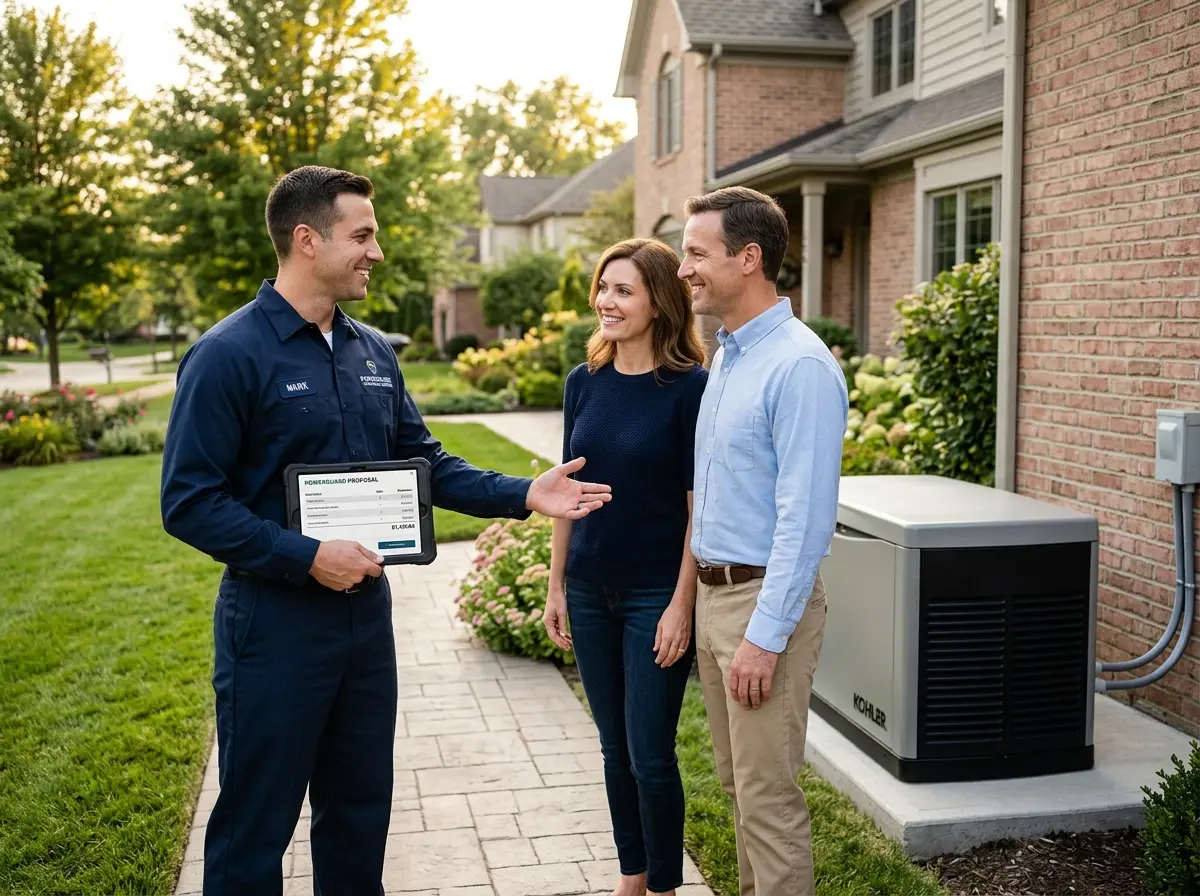
The in-home generator consultation is where the deal is made or lost, and it follows a logic that experienced electricians already understand intuitively. Start by asking questions rather than pitching. What appliances are most critical to them during an outage? Do they work from home? Any medical equipment? How long do they typically lose power when outages happen? Let them articulate the problem in their own words — that's far more persuasive than any brochure you could hand them.
From there, walk through the practical realities: what size unit their home needs, where the generator and transfer switch would be installed, how long the job typically takes, and what the maintenance schedule looks like. Homeowners are more confident buyers when they feel informed rather than sold to. Close with financing options front and center — generator installations typically run $10,000 to $20,000 fully installed, and monthly payment framing makes that number dramatically more approachable for most households.
Quick Reminder About Stella
Stella is an AI robot employee and phone receptionist who works 24/7 for just $99/month — no hardware costs, no sick days, and no moment where a generator lead goes to voicemail because your office was closed. She answers calls, promotes your services, collects customer information, and keeps your CRM organized so your team can focus on the work that actually requires a licensed electrician.
Conclusion: Your Next Generator Customer Already Knows You
The most frustrating version of this story is the one where a homeowner you wired for three years ago ends up going with a competitor for their generator installation — simply because the competitor called first, or showed up in a Google search at the right moment. That's not a lead generation problem. That's a follow-up and outreach problem, and it's entirely solvable.
Here's what actionable looks like in the next 30 days:
- Pull your customer list and segment it by job type, home age, and geography. Identify your top generator prospects.
- Draft a personalized outreach sequence — a phone call or email that leads with their situation, not your product catalog.
- Time your campaign ahead of storm season or the next regional outage event, not during the chaos.
- Systematize your inbound response so that when your campaign generates calls, every single one gets answered professionally and promptly.
- Structure your consultations around discovery questions first, and make financing options a standard part of your close.
Whole-home generators are not a hard sell when they're presented to the right person at the right time by someone they already trust. You've already done the hard work of earning that trust. Now it's just a matter of showing up and making the ask — consistently, professionally, and before the next storm does it for you.