So, You've Got a New Patient — Now What?
Let's be honest: the first time a patient walks through your medical practice's doors, they're already a little nervous. Maybe they've been putting off this appointment for six months (or, let's be real, two years). They finally called, they finally showed up, and now they're standing in your waiting room wondering if they filled out the right forms, if they brought the right insurance card, and whether that weird mole is actually something to worry about.
The new patient journey is a critical sequence of touchpoints — and how your practice manages each one determines whether that patient becomes a loyal, long-term client or disappears into the healthcare abyss, never to be seen again. According to a study by Accenture, 80% of patients say the experience a provider delivers is as important as its medical services. That's a staggering number. It means your bedside manner extends well beyond the exam room — it starts the moment someone picks up the phone or stumbles across your website at 11pm wondering if their symptoms are "normal."
This post walks through the full customer journey map for a new patient at a medical practice — from that very first moment of awareness all the way to the follow-up that keeps them coming back. Let's map it out.
Before They Ever Walk In: The Awareness and Decision Phase
The patient journey doesn't start at your front desk. It starts on Google, in a Facebook group, or in a text message to a friend that says "hey, do you have a good doctor?" Every touchpoint before the appointment is an audition — and you don't even know you're performing.
Discovery: How New Patients Find You
Most new patients will find your practice through one of three channels: a referral from another provider or friend, a search engine query ("urgent care near me" or "family doctor accepting new patients"), or an insurance directory. Your job is to make sure that when they find you, what they see inspires confidence.
This means your Google Business Profile should be up to date with accurate hours, a real phone number, and recent reviews. Your website should load fast, be mobile-friendly, and make it absurdly easy to understand what you offer and how to book. If a potential patient has to click more than twice to find your phone number, you've already lost a few of them.
The Decision: Can I Trust This Place?
Once a patient finds you, they evaluate you — sometimes in less than 30 seconds. Online reviews are enormous here. Nearly 75% of patients use online reviews as the first step in finding a new doctor, according to Software Advice. Peer trust outweighs almost everything else at this stage.
This is also where your responsiveness matters. If a potential patient calls your practice during lunch, after hours, or on a Saturday morning and nobody picks up — or they get a generic voicemail — many of them will simply call the next practice on the list. First impressions in healthcare are often made by whoever answers the phone, and how quickly they answer it.
First Contact: Modernizing the Intake Experience
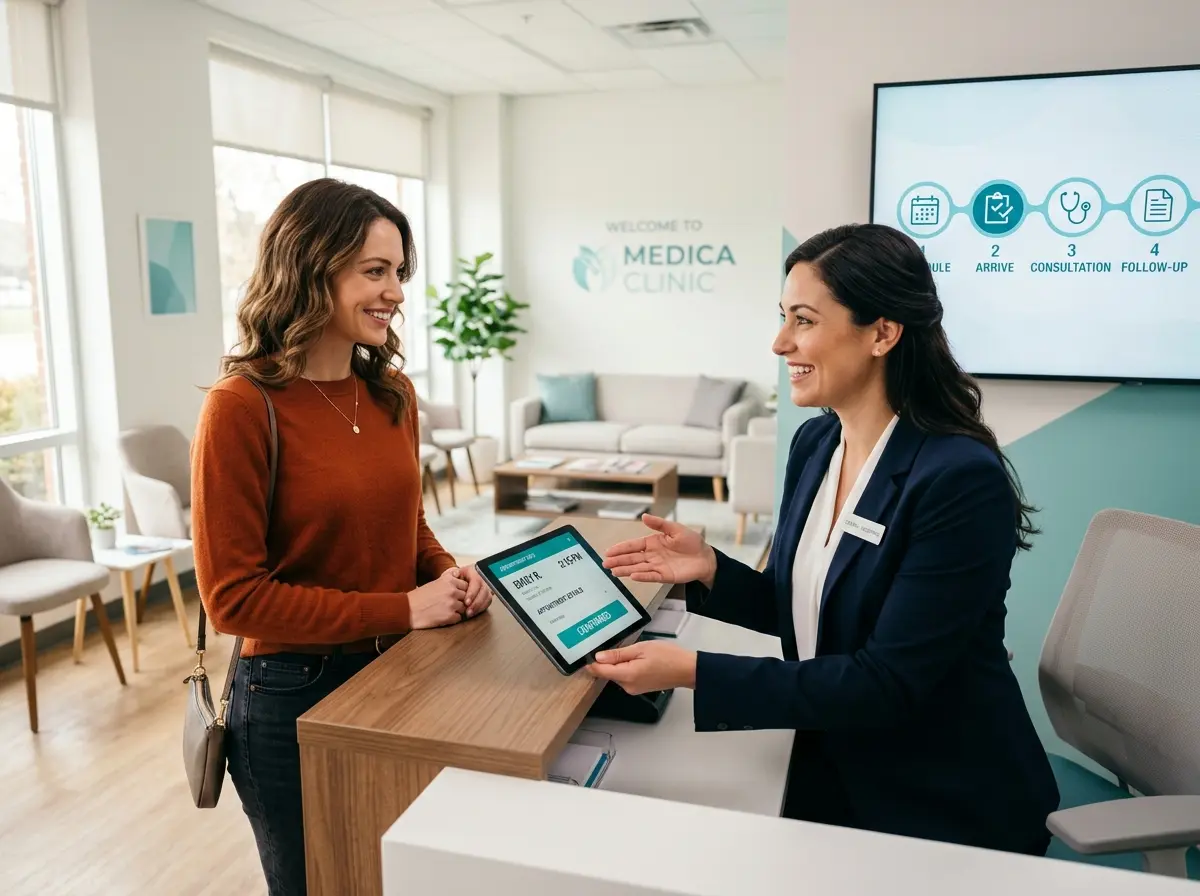
This is where many medical practices quietly lose patients they never knew they lost. The first real interaction — usually a phone call or an online booking attempt — sets the emotional tone for everything that follows. If it's clunky, cold, or slow, the patient mentally files you under "this is going to be annoying."
How Technology Can Transform the First Call
This is exactly where Stella — an AI robot employee and phone receptionist — can make a real difference for a medical practice. Stella answers every phone call, 24 hours a day, 7 days a week, with the same warmth and knowledge as your best front desk staff (minus the coffee dependency). She can collect new patient intake information conversationally over the phone, capture insurance details, explain what to bring to the first appointment, and answer common questions about the practice — all without putting anyone on hold for 11 minutes.
For practices with a physical lobby, Stella also operates as a human-sized in-person kiosk, greeting patients as they arrive and helping them navigate the check-in process. Her built-in CRM automatically organizes new patient contact information, generates AI-powered profiles, and flags important details so your staff walks into every interaction prepared. She also captures voicemails with AI-generated summaries and sends push notifications to managers — so nothing falls through the cracks at 2pm on a Tuesday when the waiting room is at capacity.
The Appointment Itself: Where Expectations Meet Reality
By the time the new patient actually sits in your exam room, they've already formed an opinion. The goal of the appointment experience is to confirm and exceed whatever positive expectation you've worked so hard to create — and to make the clinical visit feel as human and frictionless as possible.
Reducing Wait-Time Anxiety
Patients genuinely don't mind waiting as much as they mind waiting without information. A 15-minute delay that's acknowledged and explained lands very differently than a silent 15-minute delay where no one makes eye contact. Train your front desk team (or use technology) to proactively update patients when delays occur. Something as simple as a quick check-in message goes a long way toward maintaining trust during the wait.
Consider also the physical environment. Comfortable seating, clear signage, and easy access to water or reading material all send unconscious signals that your practice is organized and cares about the patient experience. These are small investments with outsized psychological returns.
The Clinical Experience: Human Skills, Always
Let's be clear: no amount of technology replaces a provider who listens. New patients are evaluating whether they feel heard. According to a report by the Beryl Institute, 95% of patients said that communication from staff was the most important factor in their overall experience. Take notes. Use the patient's name. Explain what you're doing and why. Avoid jargon, or define it when you use it. Ask if they have questions before you leave the room.
The goal at the end of the appointment is simple: the patient should leave feeling like they made the right choice by coming to your practice. If they do, you've earned a second visit. If they don't, no loyalty program or reminder email will save you.
Post-Appointment Clarity: Instructions, Follow-Ups, and Next Steps
One of the most common failure points in the patient journey is what happens in the 60 seconds after the appointment ends. Patients are handed a printout they'll lose, given verbal instructions they'll half-remember, and sent out the door with a vague "we'll call you." Be more specific. Confirm what happens next — whether it's a lab result, a referral, a prescription, or a scheduled follow-up. Clarity here reduces anxiety and unnecessary follow-up calls to your front desk.
Quick Reminder About Stella
Stella is an AI robot employee and phone receptionist built to help businesses — including medical practices — deliver a consistent, professional experience around the clock. She greets patients in your lobby, answers calls at any hour, collects intake information, and keeps your team informed through a built-in CRM and AI-generated summaries. At just $99/month with no upfront hardware costs, she's one of the more practical upgrades a growing practice can make.
Turning a New Patient Into a Loyal One
The patient journey doesn't end when they leave the building — it continues through every follow-up, reminder, and touchpoint that follows. This phase is where loyalty is actually built, and where most practices underinvest.
Send a follow-up message within 24–48 hours of the first appointment. It doesn't need to be elaborate — a simple check-in, a summary of next steps, or a reminder about an upcoming lab result demonstrates that your practice is attentive and organized. Patients notice. And in a world where many providers feel rushed and impersonal, attentiveness is genuinely differentiating.
Beyond the immediate follow-up, think about how you communicate between visits. Email newsletters with practical health tips, appointment reminders that go out far enough in advance to be useful, and a clear process for patients to reach you with questions all contribute to the sense that your practice is a partner in their health — not just a place they visit when something goes wrong.
And finally: ask for feedback. A short, low-friction survey after the first appointment tells you where your journey map has gaps. Most patients won't complain out loud — they'll just quietly switch providers. Give them an easy, private channel to share their experience, and then actually act on what you hear. That feedback loop, over time, is how good practices become great ones.
The new patient journey is a system. Map it, measure it, and improve it — and your practice will be the one people recommend to their friends.