So You're Still Relying on Hope as a Lead Generation Strategy?
Let's paint a familiar picture: a homeowner's pipe bursts at 9 PM on a Friday. They grab their phone, search "emergency plumber near me," and call the first three results. You're number two on that list. Your phone rings. And rings. And rings. Then they move on to number three — who answers — and you've just lost a $600 job while your phone sat there like a decorative object.
Home services businesses — plumbers, HVAC technicians, electricians, landscapers, roofers, cleaners — live and die by their ability to capture leads at the right moment. The problem is that "the right moment" almost never falls between 9 AM and 5 PM on a Tuesday. Customers need you when their toilet is overflowing, their AC dies in July, or they've finally committed to repainting their living room at 11 PM on a Sunday after watching three hours of home renovation content.
The good news? Building a lead capture funnel that actually works isn't rocket science. It just requires being present, responsive, and intentional at every stage of the customer journey. Here's exactly how to do it.
Building the Foundation: Where Leads Come From (and Where They Disappear)
Understanding the Home Services Customer Journey
Before you can capture leads, you need to understand how home services customers actually find and choose a business. According to BrightLocal, 87% of consumers used Google to evaluate local businesses in 2023, and the majority of them contact only the first business that responds to their inquiry. That's not a typo — the first one that responds. Not the best one. Not the cheapest one. The first one.
Home services customers typically move through a fast, intent-driven journey: something breaks or a project is finally prioritized, they search for local providers, they scan reviews and websites for about 90 seconds, and then they call or fill out a form. The entire decision cycle can happen in under five minutes. If your funnel isn't set up to catch them in that window, they're gone — and they probably just called your competitor.
The Three Places Leads Leak Out of Your Funnel
Most home services businesses lose leads in one of three ways. First, unanswered phone calls — the most expensive leak in the bucket. Studies suggest that up to 62% of calls to small businesses go unanswered. For a home services company, each missed call can represent hundreds or even thousands of dollars in lost revenue. Second, slow or no follow-up on web form submissions. If someone fills out your "Request a Quote" form and doesn't hear back for 24 hours, they've already hired someone else. Third, no after-hours coverage. Home emergencies don't schedule themselves around your office hours, and a business that can't respond at 8 PM is a business that loses emergency jobs — often the most lucrative ones — consistently.
What a Proper Lead Capture Funnel Actually Looks Like
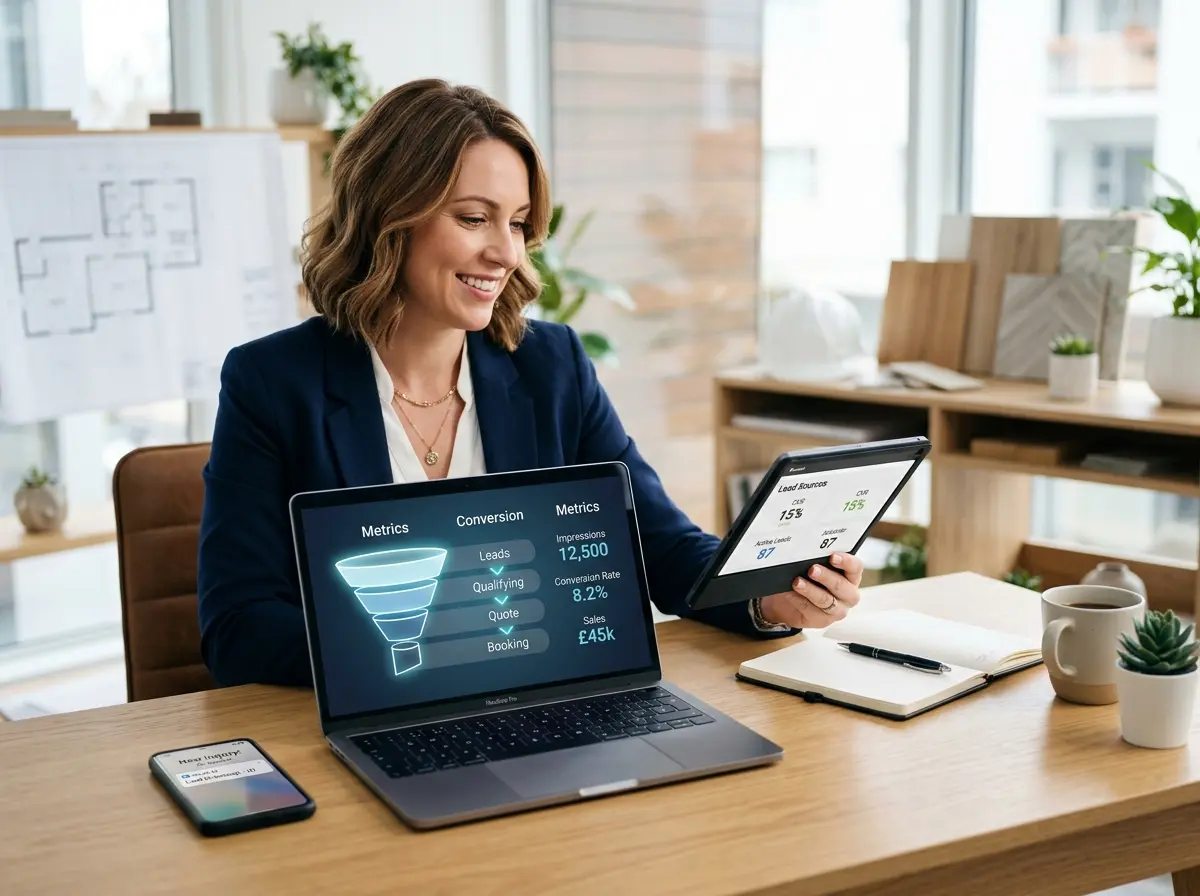
A solid lead capture funnel for a home services business has three stages: attract, capture, and convert. Attract means being visible where customers are searching — Google Business Profile, local SEO, paid ads, and social media. Capture means having systems in place to collect contact information and intent the moment someone shows interest — whether that's a phone call, a web form, or a chat interaction. Convert means following up fast, following up consistently, and making it easy for the customer to say yes. Most businesses invest in the attract phase and completely ignore the capture and convert stages. That's where the money actually is.
Plugging the Biggest Leak: Your Phone System
Why the Phone Is Still Your Most Important Lead Channel
Despite the rise of online booking and web forms, phone calls still dominate in home services. Customers dealing with urgent or complex issues want to talk to someone — they want reassurance, speed, and a human (or human-feeling) interaction. That means your phone system isn't just a communication tool; it's your primary sales channel. If it's not performing, your funnel has a hole the size of a burst water main.
This is exactly where Stella, the AI robot employee and phone receptionist, becomes a serious asset for home services businesses. Stella answers every call, 24/7, with full knowledge of your services, pricing ranges, service areas, and current promotions. She collects customer information through conversational intake forms during the call — name, address, type of issue, preferred appointment time — and routes urgent calls to on-call staff when needed. For businesses with a physical location or showroom, she also operates as an in-store kiosk, greeting walk-in customers and answering their questions proactively. Her built-in CRM automatically organizes every lead captured from calls, web interactions, and in-store conversations, giving you a clean pipeline without the manual data entry. At $99/month with no upfront hardware costs, she costs less than one missed emergency call.
Converting Captured Leads into Booked Jobs
Speed Is Your Competitive Advantage
Harvard Business Review found that businesses that respond to leads within an hour are seven times more likely to have a meaningful conversation with a decision-maker than those that wait even 60 minutes. In home services, where urgency is often the primary motivator, that number is likely even more dramatic. Speed isn't just a nice-to-have — it's the single biggest differentiator between a booked job and a lost one.
The practical implication is simple: every lead capture mechanism you have needs a real-time or near-real-time response system attached to it. Phone calls need to be answered immediately or called back within minutes. Web form submissions need an automatic confirmation email and a human follow-up within the hour during business hours. After-hours inquiries need an intelligent system that either handles them autonomously or alerts an on-call staff member immediately. If any of those response windows are longer than an hour, you're losing jobs you don't even know you're losing.
Building a Follow-Up Sequence That Actually Converts
Once you've captured a lead, the work isn't done — it's just starting. Most home services businesses either follow up once and give up, or they forget to follow up at all. A proper follow-up sequence looks something like this:
- Immediate (0–5 minutes): Automated confirmation of inquiry receipt, with expected response time.
- Same day: Personal phone call or text from a team member to confirm details and schedule an appointment or estimate.
- 24–48 hours (if no booking): A second touchpoint — either a text message or email — that reminds the customer you're available and makes booking easy.
- One week (if still no booking): A final outreach with a soft offer — perhaps a seasonal promotion or a discount on the first service visit.
This kind of structured follow-up sequence can recover 20–30% of leads that would otherwise go cold. Most businesses never implement it because it feels like a lot of work — but with basic CRM automation and templated messages, it can run almost entirely on autopilot.
Turning One-Time Customers into Repeat Revenue
The most underutilized part of any home services lead funnel is the back end — the stage after a job is completed. Home services customers have recurring needs: HVAC maintenance twice a year, gutter cleaning every fall, lawn care all season. A customer who booked you once is far easier to re-book than a brand-new lead, yet most businesses make zero attempt to stay in touch after the invoice is paid.
A simple post-service email sequence — a thank-you note, a request for a Google review, and a seasonal reminder three to six months later — can dramatically increase customer lifetime value. Pair that with a loyalty incentive (a small discount for repeat bookings or a referral bonus) and you've turned a one-time transaction into a long-term relationship. This is where your CRM earns its keep: if you're not tracking past customers and their service history, you have no foundation for proactive outreach.
A Quick Reminder About Stella
Stella is an AI robot employee and phone receptionist built for businesses that can't afford to miss a customer — which, honestly, is every business. She handles inbound calls around the clock, captures lead information through natural conversation, manages customer contacts in a built-in CRM, and greets walk-in customers at the kiosk. She's available 24/7, never calls in sick, and doesn't need a coffee break. At $99/month, she's one of the more straightforward investments a home services business can make.
Your Next Steps: Start Capturing What You're Already Earning
Here's the honest truth: the leads are already there. Homeowners in your service area are already searching for what you offer. The gap isn't in demand — it's in capture and conversion. Every unanswered call, every ignored web form, every customer who never heard from you after a job is completed represents revenue that was already within reach and simply wasn't claimed.
Start by auditing your current funnel. Answer these questions honestly:
- What percentage of your inbound calls are answered on the first try?
- How long does it take your team to respond to web form submissions?
- Do you have any after-hours coverage for calls or messages?
- Do you have a structured follow-up process for unconverted leads?
- Are you proactively reaching out to past customers for repeat business?
If any of those answers made you uncomfortable, you've just identified your highest-leverage opportunities. Fix the phone coverage first — it's the fastest and most impactful change you can make. Then build out your follow-up sequence, automate what you can, and start tracking everything in a CRM so you're making decisions based on data instead of gut feelings.
The home services market is competitive, but most of your competitors are losing leads the same way you are. The business that plugs those leaks first wins the neighborhood. That business might as well be yours.