When Every Branch Does Its Own Thing, Your Brand Pays the Price
Picture this: a loyal client visits your flagship salon location and has a flawless experience. The phone is answered promptly, the receptionist knows about the current promotions, and every question is handled with grace and professionalism. Then she visits your second location across town. The phone rings seven times before someone picks up mid-sentence, nobody knows what the "buy two, get one" color treatment deal is, and she's put on hold long enough to reconsider her entire loyalty to your brand.
Sound familiar? If you're running a multi-location salon chain, you already know that consistency is the silent killer — or the silent champion — of your customer experience. The problem isn't that your staff are bad people. It's that managing a standardized phone and front-desk experience across multiple locations is genuinely, maddeningly hard. Staff turnover in the salon industry hovers around 35% annually, meaning the "trained" receptionist at your third location might be a brand-new hire who's still figuring out where the bathroom is, let alone your current promotional calendar.
The good news? There's a smarter way to approach this — and it doesn't involve hiring a brand standards enforcer to shadow every receptionist you've ever employed.
The Real Cost of an Inconsistent Phone Experience
First Impressions Are Made on the Phone — Not in the Chair
Most salon owners obsess over the in-chair experience: the quality of the cut, the precision of the color, the warm towel on the shoulders. And rightly so — that's your craft. But here's the uncomfortable truth: the phone call is often the very first touchpoint a potential client has with your brand, and a fumbled call means they never make it to the chair in the first place.
Studies consistently show that businesses lose between 60% and 80% of potential customers simply by failing to answer the phone promptly or professionally. For a multi-location salon, multiply that across every branch, every missed call, every "can you hold?" that turns into a three-minute silence, and you start to see a significant revenue leak hiding in plain sight. A client who calls during a busy Saturday afternoon rush and gets a harried, distracted greeting isn't just mildly annoyed — she's mentally already Googling your competitor.
The "Every Location Has Its Own Personality" Problem
There's charming individuality, and then there's operational chaos dressed up in a scarf. When each of your locations develops its own ad-hoc way of answering calls, handling questions, and communicating promotions, you don't have a salon chain — you have a collection of loosely affiliated small businesses that happen to share a logo.
This inconsistency creates real problems beyond branding. Clients who visit multiple locations get confused when they receive contradictory information about services, pricing, or policies. Staff waste time fielding the same basic questions repeatedly because there's no standardized system. And managers spend more time putting out small fires than actually growing the business. Standardizing the phone experience isn't about stripping away personality — it's about building a reliable foundation that every location can stand on.
What "Standardized" Actually Means in Practice
Standardizing your phone experience doesn't mean robotic, cookie-cutter interactions that make callers feel like they've reached a call center in a distant timezone. It means ensuring that every caller, regardless of which location they reach, gets accurate information, a warm greeting, and a consistent representation of your brand values. It means promotions are communicated the same way across the board. It means no caller is left wondering whether the deal they heard about is "at this location or the other one." It means calls are answered — full stop.
How Technology Can Do the Heavy Lifting
Let AI Handle What Humans Consistently Drop
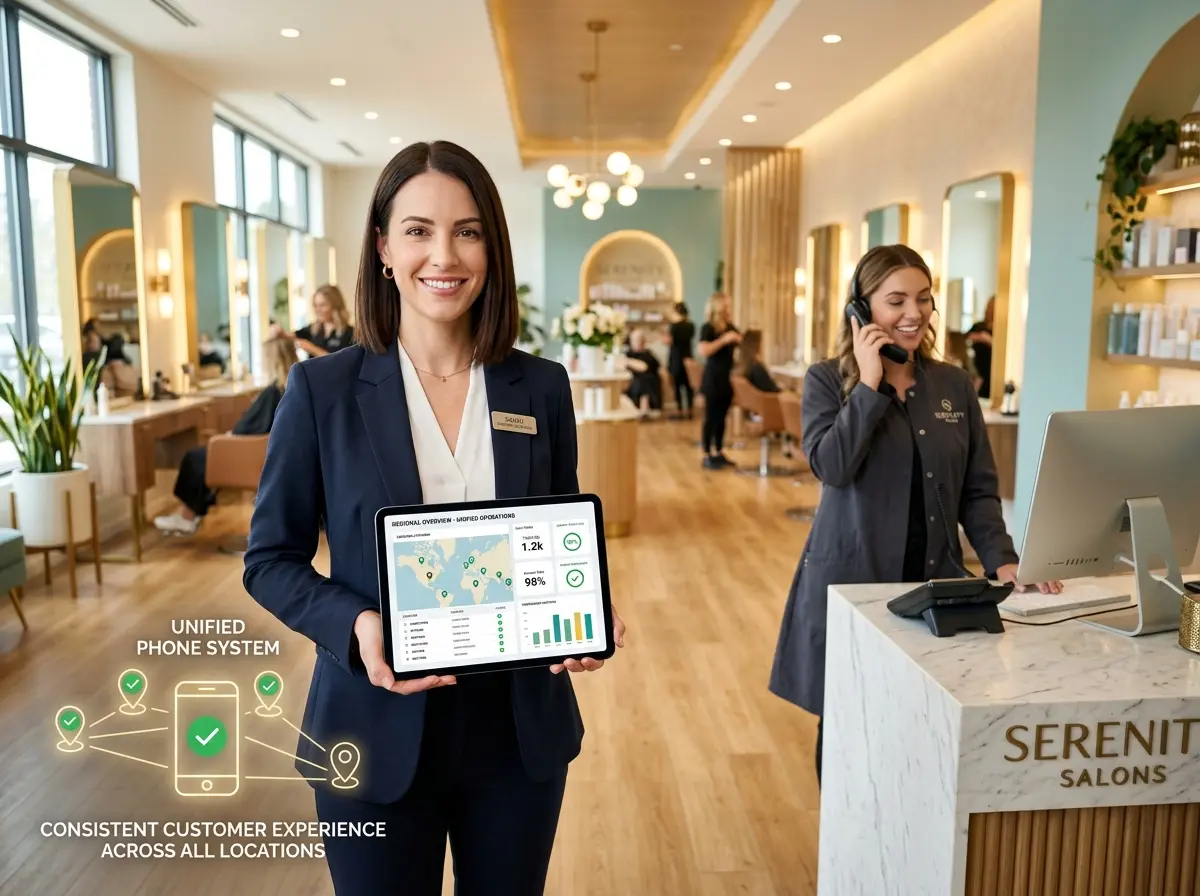
Here's where the conversation gets interesting — and where smart salon owners are quietly gaining a competitive edge. Stella, an AI robot employee and phone receptionist, is purpose-built for exactly this kind of multi-location standardization challenge. Rather than relying on the varying moods, training levels, and availability of human receptionists across every branch, Stella answers every call with the same knowledge base, the same brand voice, and the same reliable professionalism — whether it's 10 AM on a Tuesday or 8 PM on a Friday when your staff is elbow-deep in balayage appointments.
Stella can be configured with your specific service menu, pricing, current promotions, policies, and hours — and that information stays consistent across every location. No more crossed wires about whether the keratin treatment is on special this month. No more "I'm not sure, let me ask someone" spiraling into a three-minute hold. And because Stella also collects customer information through conversational intake forms and manages contacts through a built-in CRM with AI-generated profiles and custom tags, every interaction becomes a data point that actually helps you understand your clients better — across all your locations, in one place.
At $99/month per location with no upfront hardware costs, the math is considerably friendlier than hiring, training, and re-training a front-desk team that may or may not stick around past the holidays.
Building Your Standardization Framework
Start With a Phone Script Audit Across All Locations
Before you can standardize anything, you need to know what's actually happening. Call each of your locations as a mystery shopper — or have someone do it for you — and document what you find. How quickly is the call answered? Is the greeting consistent? Are staff accurately representing current promotions? Are they upselling add-on services, or simply answering the bare minimum and hanging up? The answers will probably be illuminating, and not always in a flattering way.
Use this audit to identify your biggest gaps. Are certain locations consistently underperforming on response time? Are others misstating your cancellation policy? This baseline gives you something concrete to work against, and it makes the case internally for why change is necessary — because "we should be more consistent" is easy to ignore, but "Location 3 is telling clients that balayage consultations are free when they're not" is a little harder to wave away.
Create a Centralized Knowledge Base That Every Location Uses
One of the most effective things you can do as a multi-location salon owner is build a single, authoritative source of truth for your business information — services, pricing, promotions, policies, hours, staff specializations — and ensure every location is working from the same document. This sounds obvious, and yet it's astounding how many growing salon chains are still running on a patchwork of outdated PDFs, group texts, and institutional memory held exclusively by one manager who took two weeks off in August.
Your centralized knowledge base should be living and updated in real time. When you launch a new promotion, every location should know within the hour — not next Tuesday when the manager happens to check their email. When your hours change for a holiday, that change should be reflected everywhere simultaneously. The more you can remove human error from the chain of information, the more consistent your client experience becomes.
Train for Experience, Not Just Information
Even with the best scripts and knowledge bases in place, your human staff still play a crucial role in the in-person experience. The difference is that when technology handles the repetitive, information-heavy phone interactions reliably, your team can focus their energy on being genuinely warm, attentive, and skilled when clients are physically present. Train your staff on how to make clients feel, not just on what to say. Consistency in warmth is harder to script than consistency in pricing — but it's equally valuable to your brand.
Consider quarterly cross-location training sessions where managers share what's working well in their branches. One location might have a fantastic approach to upselling conditioning treatments at checkout. Another might have perfected the art of handling last-minute cancellations gracefully. Share those wins systematically instead of letting good practices stay siloed at the location where they were invented.
Quick Reminder About Stella
Stella is an AI robot employee and phone receptionist designed to give businesses of all sizes a consistent, professional, always-on presence — both as a physical in-store kiosk and as a 24/7 phone receptionist. For multi-location salon chains specifically, she's an unusually elegant solution to the "every branch does its own thing" problem, running on a straightforward $99/month subscription with no complicated setup or hardware investment required.
Bringing It All Together: Your Next Steps
Standardizing the phone experience across a multi-location salon chain isn't a one-afternoon project, but it's also not the Sisyphean nightmare it might seem. It's a series of deliberate, manageable steps that compound into a dramatically better client experience — and a meaningfully stronger brand.
Here's where to start:
- Conduct a phone audit across all your locations this week. Call them yourself. Be honest about what you find.
- Build or update your centralized knowledge base — services, pricing, promotions, policies — and establish a process for keeping it current in real time.
- Evaluate your current phone coverage gaps: Which locations miss the most calls? Which hours are most under-served? Where is information being communicated inconsistently?
- Explore AI phone receptionist solutions that can give you standardized, always-on coverage without the overhead of additional staff at every branch.
- Invest in cross-location training that focuses on the client experience, not just operational procedures.
Your clients don't experience your brand the way you see it from the inside — as a well-intentioned work in progress. They experience it as a series of interactions, and every phone call is one of them. Make sure every single one reflects the business you've actually built, regardless of which location happens to answer.
Because at the end of the day, inconsistency is just another word for untapped potential — and you've worked too hard to leave that on the table.