Still Sending Patients Home to "Think About It"? There's a Better Way.
Picture this: A patient comes in with a cracked molar. You diagnose them, walk them through the treatment plan, and then — because your office doesn't have same-day crown capability — you send them home with a temporary crown and schedule them for a second appointment two weeks out. By the time that appointment rolls around, one of three things has happened: they've canceled, they've forgotten, or they've called the practice down the street that does offer same-day crowns and never looked back.
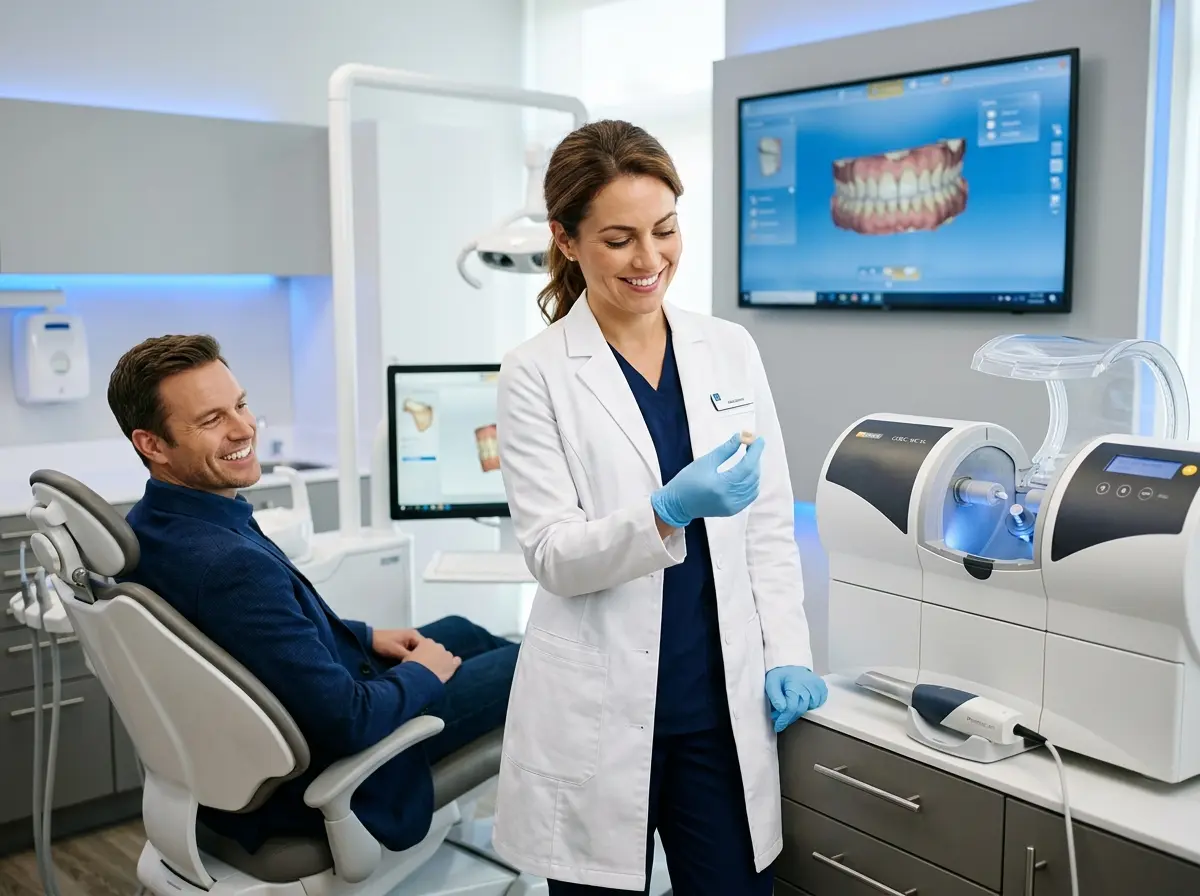
If that scenario sounds uncomfortably familiar, you're not alone. But here's the hard truth: in today's competitive dental landscape, patients have options, and they know it. Same-day crown technology — most commonly delivered through CAD/CAM systems like CEREC — has shifted from a luxury differentiator to a practical necessity for practices that want to retain cases, boost revenue, and actually keep patients happy. Let's talk about why the investment makes sense and how to position it effectively.
The Real Cost of Not Having Same-Day Crowns
You're Losing Cases and You Might Not Even Know It
It's easy to track the patients who cancel a second appointment. It's nearly impossible to track the patients who called your front desk, heard "you'll need to come in twice," and quietly hung up to call your competitor. That silent attrition is one of the most expensive problems in dentistry — and it's almost entirely invisible on your books.
According to industry research, anywhere from 10% to 40% of patients who require a second appointment for crown placement never complete treatment. That's not a rounding error. That's a substantial chunk of potential revenue walking out your door, often without a word. Multiply that by your average crown fee — typically $1,000 to $1,500 — and the math gets uncomfortable quickly.
Two Appointments Is Two Chances to Lose the Patient
Every additional appointment you require is another opportunity for life to get in the way. A patient's schedule changes. Their dental anxiety spikes between visits. They Google their symptoms and convince themselves the crown isn't urgent. They find a dentist who advertises "one-visit crowns" while they're mindlessly scrolling during lunch. Each of these scenarios represents a completed case that evaporated for entirely preventable reasons.
Same-day crowns eliminate the second appointment entirely — meaning there's no gap for doubt, distraction, or defection. The patient comes in, the work gets done, and they leave with a permanent restoration and a much better story to tell their friends and family.
The Competitive Landscape Has Already Shifted
Same-day crown technology has been commercially available for decades, and adoption rates among dental practices have grown steadily. If your primary competitors in your market already offer in-office milling, your two-appointment workflow isn't just inconvenient — it's a comparative weakness that savvy patients will notice. A quick Google search for dentists in most mid-sized cities will surface multiple practices advertising same-day crowns prominently. If your website doesn't include that phrase, you're invisible in that search category.
Making the Business Case for the Investment
The ROI Is More Attainable Than You Think
The upfront cost of a CAD/CAM system like CEREC can range from $80,000 to $150,000 depending on configuration — a number that understandably gives many practice owners pause. But consider the math: if your practice places an average of just two additional crowns per week as a direct result of the capability (whether from retained cases or new patients actively seeking same-day service), you're looking at roughly $100,000 to $150,000 in additional annual revenue. The equipment often pays for itself within the first year or two, and it continues generating returns for a decade or more with proper maintenance.
Beyond the direct revenue, consider the operational savings: fewer temporary crown placements, fewer lab fees, fewer scheduling headaches, and less chair time spent managing complications from temporaries. Labs charge anywhere from $100 to $300 per crown on average — fees you internalize with in-office milling, often at a fraction of that cost per unit in materials.
Financing and Leasing Options Make the Entry Point Manageable
Most equipment vendors and third-party financing companies offer leasing arrangements specifically designed for dental practices. Monthly payments on a CAD/CAM system can often be structured in the $2,000 to $3,500 range — a figure that one or two same-day crowns per month more than covers. Talk to your equipment rep, your dental CPA, or your practice management consultant about Section 179 deductions and first-year expensing, which can substantially reduce your effective out-of-pocket cost in the year of purchase.
How to Support Your Same-Day Crown Rollout With Better Patient Communication
Investing in the technology is step one. Communicating it effectively to existing and prospective patients is equally important — and this is where many practices underperform.
Let Stella Handle the Front-End Conversations
Stella — the AI robot employee and phone receptionist — is a practical tool for dental practices looking to promote new capabilities like same-day crowns without overwhelming their front desk staff. When a potential patient calls to ask about your crown process, Stella answers 24/7 and can immediately communicate that your practice offers one-visit, same-day permanent crowns — no lab wait, no temporary, no second appointment. That's a compelling answer to a question that patients are actively asking.
In your physical office, Stella's kiosk presence can proactively engage patients in the waiting room, highlight your same-day crown offering, and answer questions naturally — all without pulling a team member away from scheduling or billing. For practices with a busy front desk, that kind of autonomous patient engagement is genuinely valuable.
Positioning Same-Day Crowns as a Patient Experience Win
It's Not Just Convenient — It's Clinically Superior in Many Ways
Beyond the business angle, same-day crowns offer real clinical advantages worth communicating to your patients. Monolithic zirconia and lithium disilicate restorations milled in-office can match or exceed the fit and longevity of lab-fabricated crowns in many clinical situations. Patients avoid the discomfort and aesthetic awkwardness of wearing a temporary for two weeks. There's no risk of a temporary coming loose over a weekend and requiring an emergency visit. And the fit of a digitally milled crown is often excellent, with fewer adjustments needed at seating.
When you frame same-day crowns not just as convenient but as a better clinical experience, you give patients a reason to choose your practice that goes beyond mere scheduling preference.
Make It Visible — On Your Website, In Your Office, and On the Phones
Your same-day crown capability should be featured prominently on your website's services page, in your Google Business Profile description, and in any local advertising you run. Train your front desk team to mention it proactively when patients call about crown consultations. Consider a brief explainer video in your waiting room or on your website that walks patients through the one-visit process — demystifying the technology goes a long way toward building trust and excitement rather than uncertainty.
A Quick Reminder About Stella
Stella is an AI robot employee and phone receptionist that works for businesses across industries — including dental offices. She greets patients at the kiosk, answers calls around the clock, promotes services like same-day crowns, and collects intake information — all for just $99/month with no upfront hardware costs. For a busy dental front desk, she's the kind of tireless, knowledgeable team member who never calls in sick and never puts a patient on hold to go find the schedule.
It's Time to Stop Losing Cases You've Already Earned
If your practice is still relying on a two-appointment crown workflow, the opportunity cost is real and it's ongoing. Same-day crown capability isn't a gimmick or a gadget — it's a proven revenue driver, a patient retention tool, and increasingly, a baseline expectation in competitive dental markets.
Here's what to do next:
- Audit your numbers. Pull your crown case data from the last 12 months and calculate how many second appointments were canceled or never rescheduled. That figure is your baseline opportunity cost.
- Request a demo. Contact a CAD/CAM vendor — CEREC by Dentsply Sirona, Planmeca, and 3Shape are common options — and schedule an in-office demonstration so you can see the workflow firsthand.
- Run the financing math. Work with your dental CPA to model the ROI based on your current crown volume, average fee, and realistic case retention improvement.
- Update your marketing. The moment you have the capability, make sure your website, Google Business Profile, and phone scripts reflect it prominently.
- Strengthen your patient communication infrastructure. Tools like Stella ensure that every patient who calls or walks in gets a clear, compelling answer about what makes your practice different — including your same-day crown capability.
The practices winning new patients right now aren't necessarily the ones with the fanciest lobby or the longest hours. They're the ones that make it easy to say yes — and same-day crowns are one of the clearest ways to do exactly that.