When "Sorry, We Double-Booked You" Becomes Your Salon's Catchphrase
Picture this: It's a busy Saturday morning at your hair salon. Two clients walk in at the same time, both with 10 AM appointments, both wanting full color treatments, and both staring at you with that particular expression — somewhere between confused and absolutely furious. One of them drove 45 minutes to get here. Congratulations, you've just achieved what no salon owner aspires to: the legendary double-booking disaster.
If you run a high-volume hair salon, you already know that scheduling is the backbone of your entire operation. Get it right, and your day flows like a perfectly executed balayage. Get it wrong, and you're spending more time apologizing than actually cutting hair. The good news? Double-bookings aren't a fact of life — they're a systems problem, and systems problems have solutions. Let's talk about how to build a scheduling infrastructure that actually works, so you can get back to doing what you love without the chaos.
The Root Causes of Double-Bookings (And Why They Keep Happening)
Before you can fix the problem, you need to understand why it keeps happening in the first place. Spoiler: it's rarely one single thing. It's usually a perfect storm of outdated tools, miscommunication, and a front desk that's stretched too thin.
The Multi-Channel Booking Trap
Most high-volume salons accept appointments through multiple channels — phone calls, walk-ins, online booking platforms, social media DMs, and sometimes even text messages. When each of these channels operates in its own little silo, without syncing to a single source of truth, overlaps are practically inevitable. A client books online at 11 PM on a Thursday. Another calls Friday morning and gets the same slot from a staff member who hasn't refreshed the calendar yet. And just like that, you've got a problem before the day even starts.
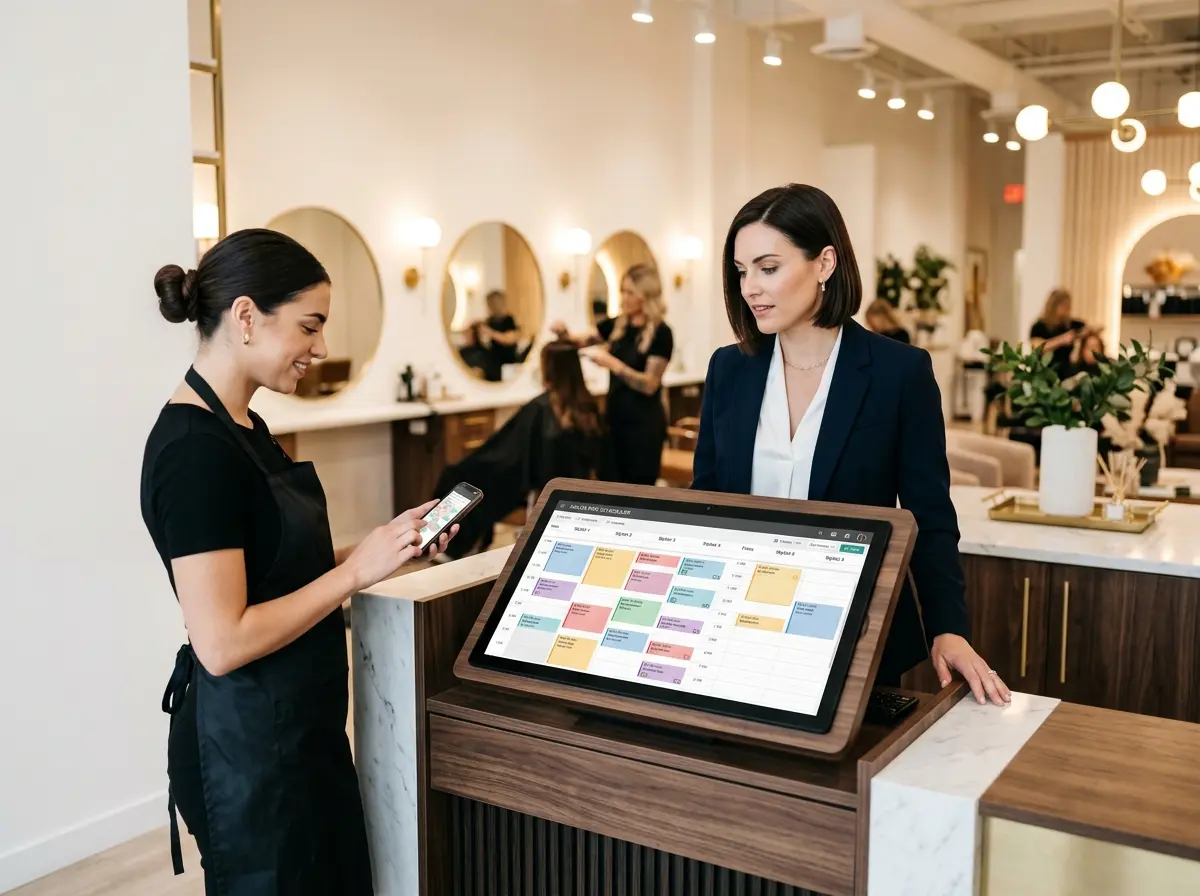
The fix here is non-negotiable: every booking channel must feed into one centralized calendar system in real time. No exceptions, no workarounds, no "we'll update it later." If your current setup doesn't support live synchronization across all channels, it's time to upgrade.
Human Error at the Front Desk
Your front desk team is talented, hardworking, and — crucially — human. They answer phones while checking in walk-ins, manage retail sales, answer questions about products, and somehow try to maintain a coherent schedule all at once. Under that kind of pressure, mistakes happen. A slot gets entered on the wrong stylist's column. An appointment gets confirmed verbally but never logged. Someone writes it on a sticky note "just for now" and then the sticky note disappears into the void.
Reducing reliance on manual entry is key. The more your booking system can automate confirmations, slot locking, and real-time updates, the less room there is for human error to sneak in and cause havoc.
Overbooking "Just in Case" — A Strategy That Backfires
Some salons intentionally overbook certain time slots to account for no-shows, operating on the assumption that not everyone will actually show up. This strategy has a catastrophic failure mode: everyone shows up. And when they do, you're not just dealing with a scheduling conflict — you're dealing with a trust problem. Clients who experience this rarely forget it, and in the age of Google reviews, they have a very public platform to share their disappointment.
A smarter approach to no-shows is a robust confirmation and reminder system — automated texts and emails sent 48 hours and 24 hours before an appointment — combined with a clearly communicated cancellation policy. Reduce the no-shows rather than gambling on them.
Technology Tools That Actually Solve the Problem
Choosing the Right Salon Scheduling Software
Not all scheduling software is created equal, and for a high-volume salon, you need a platform built for the demands of a busy service business. Look for software that offers real-time calendar syncing across all devices, individual stylist calendars with availability management, automated client reminders, and integration with your payment processing system. Popular options in the salon industry include Vagaro, Booksy, Square Appointments, and Mindbody — each with its own strengths depending on your salon's size and workflow.
When evaluating options, pay close attention to how the software handles simultaneous booking attempts. The best platforms will lock a time slot the moment a client begins the booking process, preventing another booking from claiming the same slot in the seconds it takes to complete a form. That small technical detail makes an enormous practical difference.
How Stella Can Support Your Front Desk
One underappreciated source of scheduling chaos is the phone — specifically, what happens when calls come in faster than your front desk can handle them. Missed calls lead to clients booking elsewhere, calling back multiple times, or worse, showing up without an appointment and expecting to be squeezed in. Stella, the AI robot employee and phone receptionist, addresses this directly by answering every call, 24/7, with accurate knowledge of your services, availability, and policies. For salons with a physical location, she also greets clients at the door as a friendly kiosk presence, handling check-ins and answering questions so your front desk can stay focused on the schedule.
Stella's built-in CRM and conversational intake forms also mean that client information is captured consistently every time — no more illegible intake sheets or missing contact details. When client data is clean and organized, managing appointments becomes significantly less stressful for everyone involved.
Building a Scheduling Culture That Sticks
Technology alone won't save you if your team isn't on board. The most sophisticated scheduling system in the world is useless if staff members are still texting appointments to each other or keeping personal "backup" calendars. Building a culture around your scheduling system is just as important as the system itself.
Train Your Team — Then Train Them Again
Onboarding staff to a new scheduling system is step one. But ongoing reinforcement matters just as much. Hold brief monthly check-ins to review any scheduling issues from the previous weeks and identify patterns. Were double-bookings happening at the same time of day? With the same stylist? Via the same booking channel? Patterns reveal process gaps, and process gaps are fixable.
Make it clear that the centralized calendar is the only calendar. No exceptions. If it's not in the system, it doesn't exist. This sounds obvious, but in a busy salon environment, it needs to be stated explicitly and reinforced consistently.
Create a Cancellation and Waitlist Protocol
A well-managed waitlist is one of the most underutilized tools in salon scheduling. When cancellations happen — and they will — having an active waitlist means that slot gets filled quickly rather than sitting empty. Some scheduling platforms automate this entirely, notifying waitlisted clients the moment a slot opens up. This not only recovers lost revenue but also gives clients who want to get in sooner a positive experience rather than a frustrated one.
Pair your waitlist with a firm but fair cancellation policy. A 24-hour notice requirement with a small fee for late cancellations reduces last-minute gaps while setting professional expectations with clients. Post it clearly on your booking page, in your confirmation emails, and at your front desk — no surprises, no arguments.
Review, Adjust, and Optimize Regularly
Your scheduling system should never be "set it and forget it." Review your booking data monthly. Look at your busiest time slots, your most in-demand stylists, and the times when double-bookings or conflicts most commonly occur. Use that data to adjust buffer times between appointments, redistribute availability, and make informed decisions about staffing. A high-volume salon that treats its schedule like a living document — rather than a static list — runs dramatically more smoothly over time.
A Quick Reminder About Stella
Stella is an AI robot employee and phone receptionist designed for businesses like yours — she stands inside your salon as a friendly, human-sized kiosk and answers phone calls around the clock. At just $99/month with no upfront hardware costs, she's the kind of reliable front desk presence that doesn't call in sick, never puts a client on hold indefinitely, and always knows your current services and promotions. For a high-volume salon juggling appointments, walk-ins, and phone calls simultaneously, that kind of consistency is genuinely valuable.
Your Next Steps to a Double-Booking-Free Salon
Double-bookings aren't inevitable — they're a symptom of a system that needs attention. The path forward is clear: consolidate all your booking channels into one real-time platform, reduce manual entry wherever possible, train your team to treat the system as the single source of truth, and build smart protocols around cancellations and waitlists. None of this requires a complete overhaul overnight. Start with your biggest pain point — whether that's the phone line, online bookings, or front desk communication — and build from there.
The salons that run like clockwork aren't the ones with the most talented staff or the best location. They're the ones that invested in solid systems and stuck to them. Your clients booked an appointment because they trust you with their hair — the least you can do is make sure their appointment actually exists when they show up. Start auditing your current scheduling setup this week, identify the gaps, and make one concrete improvement. Your future self — and your clients — will thank you.