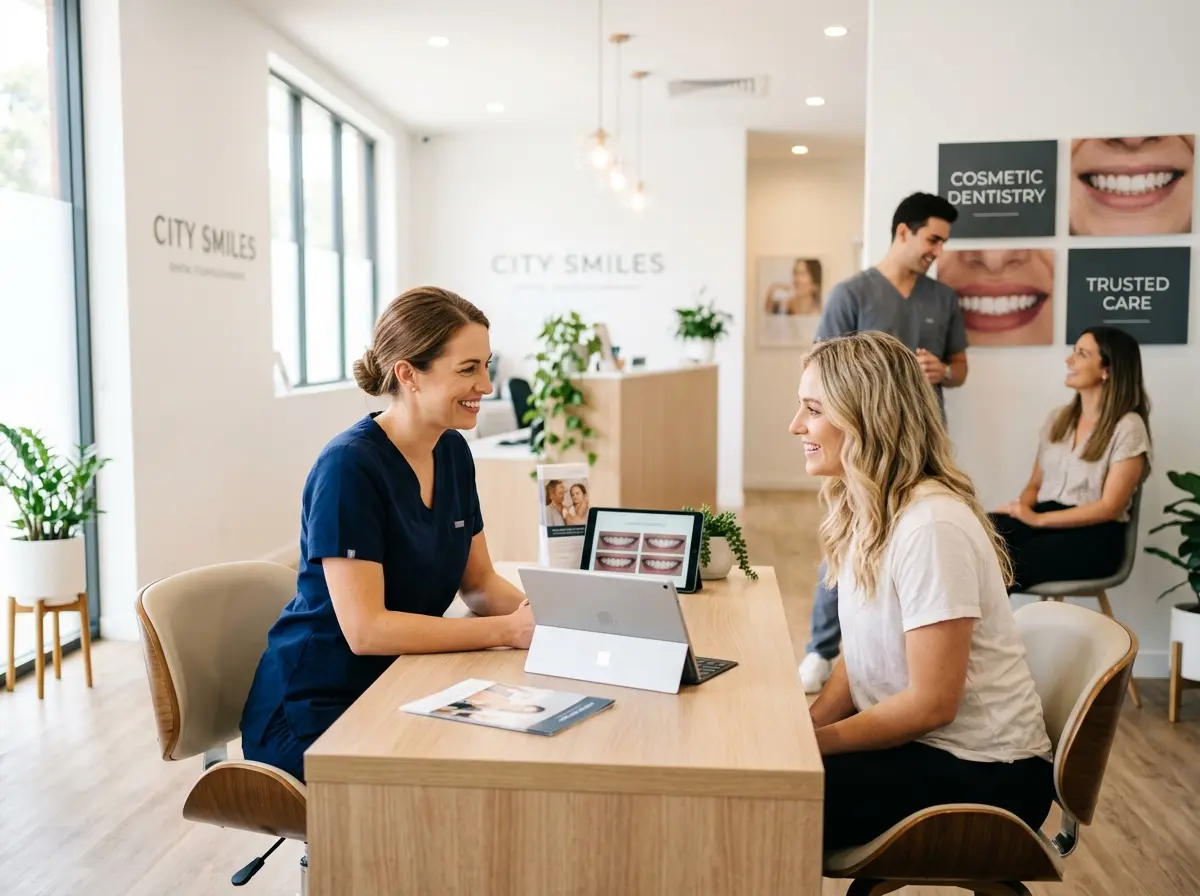
Introduction: The Fine Line Between Helpful and Pushy
Let's set the scene: a patient comes in for a routine cleaning, and somewhere between the fluoride treatment and the "you really should floss more" lecture, your front desk team mentions teeth whitening. The patient smiles politely, says "maybe someday," and leaves. Was that a missed opportunity? Absolutely. Was it handled with the grace of a bull in a china shop? Also possibly yes.
Cosmetic dentistry is a $16 billion industry in the United States, and patients are more interested in elective procedures than ever before. The problem isn't demand — it's delivery. When team members feel awkward discussing cosmetic services, they either avoid the conversation entirely or overcorrect into full-on sales mode, which sends patients running for the hills (and into the arms of the practice down the street).
The good news? There's a middle ground, and it's called informed, patient-centered conversation. With the right training, your team can discuss veneers, whitening, and Invisalign the way they talk about everything else — naturally, helpfully, and without making anyone feel like they're being sold a timeshare. This post will show you exactly how to get there.
Building the Foundation: Mindset, Language, and Timing
Shift the Mindset from "Selling" to "Serving"
The biggest reason dental teams clam up around cosmetic conversations is simple: they don't want to feel like salespeople. And honestly? That's a reasonable instinct. Nobody went to dental school — or took a job at the front desk — to pitch products. But here's the reframe your team needs to hear: informing a patient about a service that could genuinely improve their life is not selling. It's serving.
If a patient has mentioned feeling self-conscious about their smile at three different appointments and no one has ever brought up cosmetic options, that's not being respectful of their autonomy — that's a failure to provide complete care. Train your team to think of cosmetic conversations as an extension of patient education, not a departure from it. The moment "offering cosmetic services" gets filed under "patient advocacy" instead of "sales tactics," the whole dynamic shifts.
Choose Words That Open Doors, Not Close Them
Language matters enormously in a clinical setting. There's a significant difference between "We're running a special on whitening" (transactional, pressure-y) and "A lot of our patients have been really happy with the whitening results — have you ever thought about it?" (conversational, curious, zero-pressure). Train your team to use open-ended, curiosity-based language that invites the patient into a dialogue rather than pushing them toward a decision.
Some go-to phrases worth practicing:
- "Have you ever thought about..."
- "A lot of patients ask us about..."
- "We have some options that might be worth discussing if you're ever curious..."
- "Dr. [Name] noticed something during your exam — would you be open to hearing more?"
Notice what's missing from all of these: urgency, dollar signs, and any implication that the patient is somehow lacking. These phrases plant seeds without applying pressure — and seeds, as any good gardener (or dental marketer) will tell you, often grow into appointments.
Timing Is Everything — Literally
Bringing up cosmetic services while a patient has both hands in their mouth and a suction tool fighting for real estate is not ideal timing. Neither is ambushing someone as they're reaching for their coat at checkout. Train your team to identify natural, comfortable moments in the patient journey — after the exam findings are reviewed, during a relaxed pre-appointment conversation, or when a patient volunteers a comment about their smile.
Document these moments too. If a patient mentions wanting whiter teeth in October, make sure that note lives in their chart so the team can revisit it thoughtfully at their next visit — not in a "we've been tracking your insecurities" way, but in a "we actually listened to you" way. Patients notice the difference, and they appreciate it.
How Technology Can Support Your Team (Without Replacing Them)
Let Automation Handle the Awareness, So Your Team Can Handle the Connection
One underrated strategy for reducing pressure in cosmetic conversations is making sure patients already have some baseline awareness before they ever talk to a team member. When a patient already knows your office offers teeth whitening or Invisalign — because they saw it on your website, heard it mentioned in a phone greeting, or learned about it while waiting in your lobby — the conversation becomes a follow-up rather than a cold pitch. That's a much easier position for your team to be in.
This is where Stella, the AI robot employee and phone receptionist, can quietly do some of the heavy lifting. For dental offices with a physical location, Stella greets patients in the lobby and can naturally mention current promotions or available services — including cosmetic offerings — in a friendly, zero-pressure way. She's a kiosk, not a closer, so patients receive the information without any of the interpersonal awkwardness that sometimes comes with a staff member bringing it up. And when patients call to book appointments, Stella answers the phone 24/7 and can mention relevant services as part of a natural conversation, so your front desk team walks into every interaction with a patient who's already been gently informed. Less cold-pitching, more warm conversations.
Training Techniques That Actually Stick
Role-Play Without the Eye Rolls
Yes, role-playing exercises get a bad reputation. Yes, your team will groan. Do it anyway — but do it well. The goal isn't to create a scripted robotic response (you've got technology for that), it's to help team members get comfortable with the discomfort of starting these conversations so that when it happens in real life, it feels familiar rather than terrifying.
Keep practice sessions short (15–20 minutes), rotate who plays the patient, and include realistic scenarios: the skeptical patient, the budget-conscious patient, the one who's already halfway interested but needs a small nudge. Debrief after each round — what worked, what felt forced, what would you do differently? Make it a safe space to stumble, because stumbling in practice means confident execution when it counts.
Equip Your Team with Knowledge, Not Just Scripts
A team member who genuinely understands the cosmetic services your office offers will always outperform one who's reading from a laminated card. Invest in brief internal education sessions where the dentist or a trained team lead walks staff through each cosmetic service — what it does, who it's ideal for, what the process looks like, and what kind of results patients typically experience. When a front desk coordinator can say, "The whitening we use is actually pretty gentle — a lot of patients with sensitivity have been totally fine," that's credibility. That's trust. That's a conversation that leads somewhere.
Consider creating a simple one-page reference guide for each cosmetic service — not a script, but a confidence tool. Key benefits, common questions, typical candidacy. Let your team internalize it in whatever way works for them, whether that's memorization, reference, or just the comfort of knowing the document exists.
Celebrate the Conversation, Not Just the Conversion
Here's a cultural shift worth making: stop measuring your team's cosmetic performance solely by how many procedures get booked. Start recognizing when a team member handles a cosmetic conversation well — thoughtfully, naturally, in a way that leaves the patient feeling informed and respected rather than pressured. Acknowledge it in team meetings. Build it into your feedback culture.
Why? Because when team members feel like they're being evaluated only on conversion rates, they either avoid the conversation (too much risk) or go too hard on the pitch (too much pressure). Neither serves your patients or your practice. When the quality of the interaction becomes the standard, your team will engage more freely — and the bookings will follow naturally, as a byproduct of excellent communication rather than forced selling.
Quick Reminder About Stella
Stella is an AI robot employee and phone receptionist designed to help businesses like dental offices handle customer-facing communication with consistency and professionalism. She greets patients in your lobby, answers phone calls around the clock, promotes your services naturally, and never has an off day. At $99/month with no upfront hardware costs, she's one of the more surprisingly affordable team members you'll ever add — and she never accidentally makes a patient feel pressured about whitening.
Conclusion: A Team That Informs Is a Practice That Grows
Training your dental team to discuss cosmetic services without pressure isn't about turning clinicians into salespeople — it's about closing the gap between what your patients want and what they actually know you offer. That gap costs practices real revenue every single day, and it closes faster than you'd think with the right mindset shifts, language tools, and practice habits in place.
Here's your action plan to get started:
- Host a team mindset conversation — reframe cosmetic discussions as patient education, not sales.
- Develop your phrase library — identify five to seven natural, open-ended expressions your team can make their own.
- Run monthly role-play sessions — keep them short, realistic, and psychologically safe.
- Educate your team on every cosmetic service — knowledge is the best antidote to awkwardness.
- Shift your success metrics — celebrate quality conversations alongside actual bookings.
- Let technology do the warm-up work — use tools like Stella to create ambient awareness of your cosmetic offerings before your team even enters the conversation.
The dental practices that grow their cosmetic revenue aren't necessarily the ones with the flashiest marketing or the most aggressive follow-up sequences. They're the ones where every team member — from the front desk to the hygienist — feels confident, informed, and genuinely excited to tell patients about options that could change the way they feel about their smile. That's the culture worth building. And the good news is, it's entirely within reach.