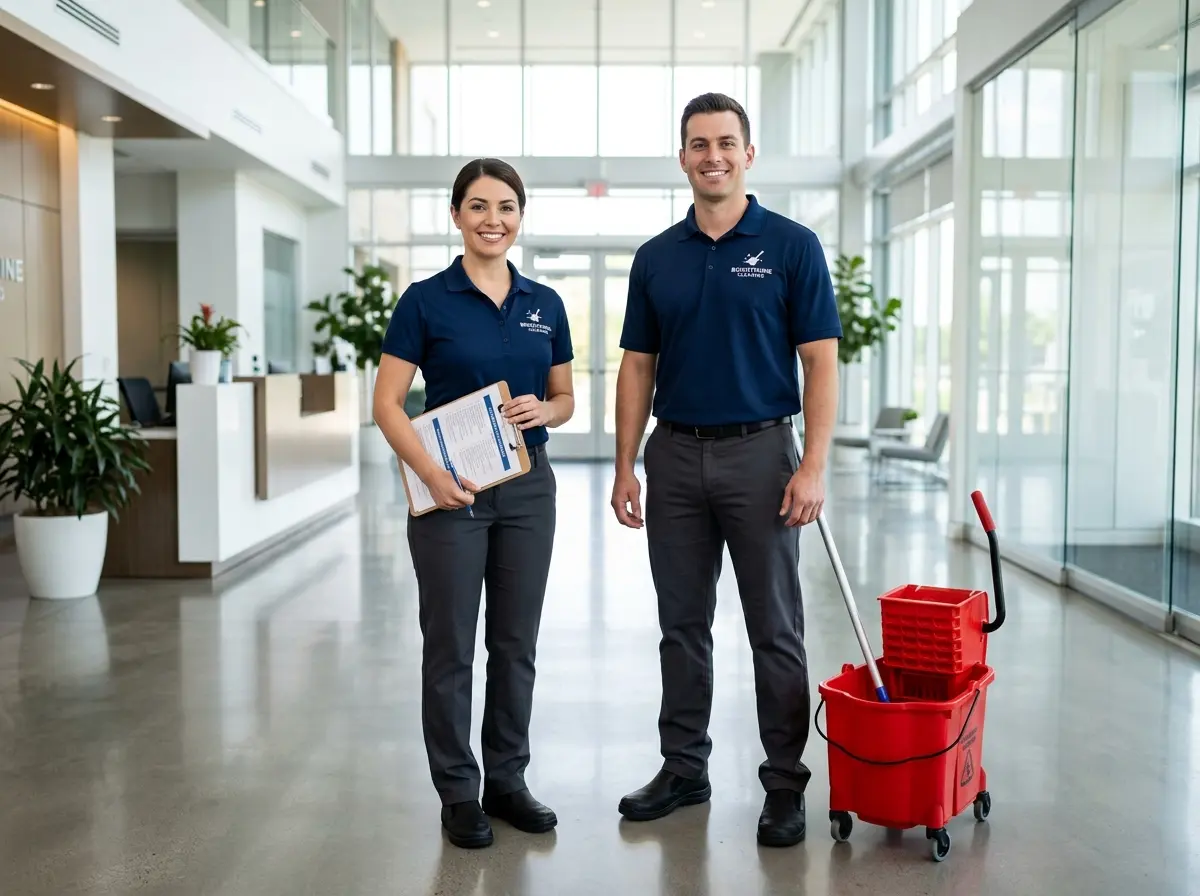
Let's Talk About the Employee Who Showed Up to Clean in Flip-Flops
You didn't think you needed to write it down. It seemed obvious. Of course your employees would show up in professional attire. Of course they wouldn't be texting on the job or arguing with customers. Of course they'd introduce themselves properly and behave like representatives of your brand.
And then one Tuesday morning, a client called to let you know your technician showed up in a torn t-shirt, headphones in both ears, and a general air of "I'd rather be anywhere else." Congratulations — you've just discovered why a formal Employee Appearance and Conduct Standard isn't optional. It's the document standing between your reputation and a one-star Google review that starts with, "I don't even know where to begin."
For cleaning companies specifically, this matters more than most people realize. Your employees enter clients' homes and businesses. They represent your brand in the most intimate, trust-dependent environment imaginable. Without clear, written standards, you're essentially crossing your fingers and hoping for the best — which, as it turns out, is not a scalable business strategy.
Why Cleaning Companies Are Especially Vulnerable to Appearance and Conduct Issues
Your Employees Are Your Brand, On-Site and Unsupervised
Unlike a retail store where a manager is nearby or a restaurant where the kitchen is out of sight, your cleaning crews operate independently inside client spaces. There's no supervisor watching. There's no camera above the register keeping everyone on their best behavior. It's just your employee, the client's property, and the impression they leave behind.
That impression becomes your reputation. A technician who's polite, uniformed, and professional reinforces everything your marketing says about your company. A technician who's disheveled, distracted, or curt with a nervous homeowner undoes all of it — regardless of how spotless the floors are when they leave.
According to a 2023 consumer survey by BrightLocal, 87% of consumers read online reviews for local businesses, and service behavior consistently ranks as one of the top complaint categories. You can mop a floor perfectly and still get a bad review because someone felt disrespected or uncomfortable. That's the reality of a trust-based service business.
Ambiguity Is Expensive
When you don't have written standards, you get inconsistency — and inconsistency costs you money. One employee wears a company polo and introduces themselves warmly. Another shows up in whatever was clean and barely makes eye contact. Both represent your brand. Both send a message to the client. Only one of those messages is the one you want sent.
Ambiguity also creates HR headaches. If an employee is disciplined or terminated for conduct that was never formally documented as a standard, you're exposed. Written policies protect your employees by being clear about expectations, and they protect you by giving you a documented framework to enforce consistently.
Client Retention Is Won or Lost in the Details
Cleaning clients don't typically cancel because your service did a mediocre job on the baseboards. They cancel — or quietly don't renew — because something felt off. Maybe the technician seemed annoyed when asked a question. Maybe they left without confirming the job was complete. Maybe they were on their phone the whole time.
These are conduct issues, not skill issues. And they're entirely preventable with a clear standard that employees are trained on, held to, and reminded of regularly. Client retention is the lifeblood of a recurring-service business, and the soft skills of your team are just as responsible for it as the quality of your cleaning products.
What a Strong Appearance and Conduct Standard Actually Looks Like
The Core Components You Can't Skip
A solid Employee Appearance and Conduct Standard for a cleaning company doesn't need to be a 40-page HR novel. It needs to be clear, specific, and enforceable. At minimum, it should cover uniform requirements (what to wear, what condition it should be in, what's never acceptable), personal hygiene expectations, phone and device usage on the job, how employees greet and interact with clients, and how to handle complaints or uncomfortable situations professionally.
Don't be vague. "Professional appearance" means nothing without specifics. Does your uniform include a hat? Are visible tattoos okay? Are employees allowed to take personal calls during a job? Write it down. The more specific the standard, the easier it is to train to — and to enforce without awkward subjective arguments later.
One practical tip: include a section on how employees should introduce themselves when arriving at a client's property. A simple script — "Hi, I'm [Name] from [Company]. I'm here for your scheduled cleaning. Is there anything I should know before I get started?" — goes a long way toward building client confidence and differentiating your service from competitors who show up and just start vacuuming without a word.
A Note on How Stella Can Help Your Cleaning Business Run Smoother
While your field team is busy making a great first impression on-site, Stella — the AI robot employee and phone receptionist — makes sure your business is equally professional on the phone. Stella answers calls 24/7, handles questions about your services, pricing, and availability, and collects client information through conversational intake forms. She can forward calls to human staff when needed or handle routine inquiries entirely on her own. For a cleaning company managing scheduling calls, quote requests, and new client inquiries around the clock, having a consistent, professional front-line presence on the phone means no call gets dropped, no lead goes cold, and no client is left listening to a voicemail that doesn't get returned until Tuesday.
Building the Standard: A Step-by-Step Approach
Start With Your Non-Negotiables
Every business has a short list of things that are simply deal-breakers — behaviors or appearances that would embarrass the company, violate client trust, or create liability. Start there. For most cleaning companies, this includes things like being under the influence on the job, using a client's personal items without permission, making negative comments about the client's home, or posting photos of a client's property on social media.
Write these down first, label them clearly as zero-tolerance items, and be explicit about the consequences. These aren't the gray areas — these are the bright lines. Getting them on paper first gives the rest of your policy a clear anchor point.
Involve Your Best Employees in the Process
Here's a move that most business owners skip: ask your top performers what they already do that they think makes a difference. The employee who consistently gets five-star reviews probably has habits worth formalizing. Maybe they always do a quick walk-through with the client before leaving. Maybe they carry a small notepad and write down any special requests for next time. These aren't just nice quirks — they're competitive advantages hiding in plain sight.
Involving your best people in drafting the standard also increases buy-in across the team. When employees see that the standards were shaped by their respected colleagues and not just handed down from a corporate template, they're more likely to take them seriously.
Train, Revisit, and Enforce Consistently
A policy that lives in a folder no one opens is not a policy — it's a legal formality. Integrate your appearance and conduct standard into onboarding, review it annually, and reference it during performance conversations. When a specific incident occurs, address it promptly and document it. Consistency in enforcement isn't just fair — it's what gives the policy teeth.
Consider a brief quarterly refresher, even if it's just a five-minute team huddle or a quick message reminder. Standards drift over time when they aren't reinforced. That's not a reflection of bad employees — it's just human nature. Your job as the business owner is to create systems that account for human nature, not wish it away.
Quick Reminder About Stella
Stella is an AI robot employee and phone receptionist designed to give businesses a professional, always-available presence — whether that's greeting customers as an in-store kiosk or answering calls around the clock as a phone receptionist. She's available for just $99/month with no upfront hardware costs, making her an accessible tool for cleaning companies of any size looking to elevate their client experience beyond the job site.
Your Next Steps Toward a Professional, Protected Business
Here's the honest truth: writing an Employee Appearance and Conduct Standard takes a few hours, and not having one can cost you clients, employees, and sleep. The math is not complicated.
Start this week. Pull up a blank document and write down the ten things you absolutely expect from every employee — in terms of how they look, how they speak, and how they behave on the job. That's your rough draft. Refine it, have your top performer review it, run it by an HR professional or employment attorney if you want extra protection, and then roll it out with proper training.
Your cleaning company may compete on price, quality, or service area — but the businesses that retain clients long-term compete on trust. A formal appearance and conduct standard is one of the clearest signals you can send — to your clients, your employees, and yourself — that you're running a professional operation that takes its reputation seriously.
And if you want the front office to match the professionalism of your field team, that's exactly the kind of thing Stella was built for.