Your Salon Is Booming — So Why Does It Feel Like Chaos?
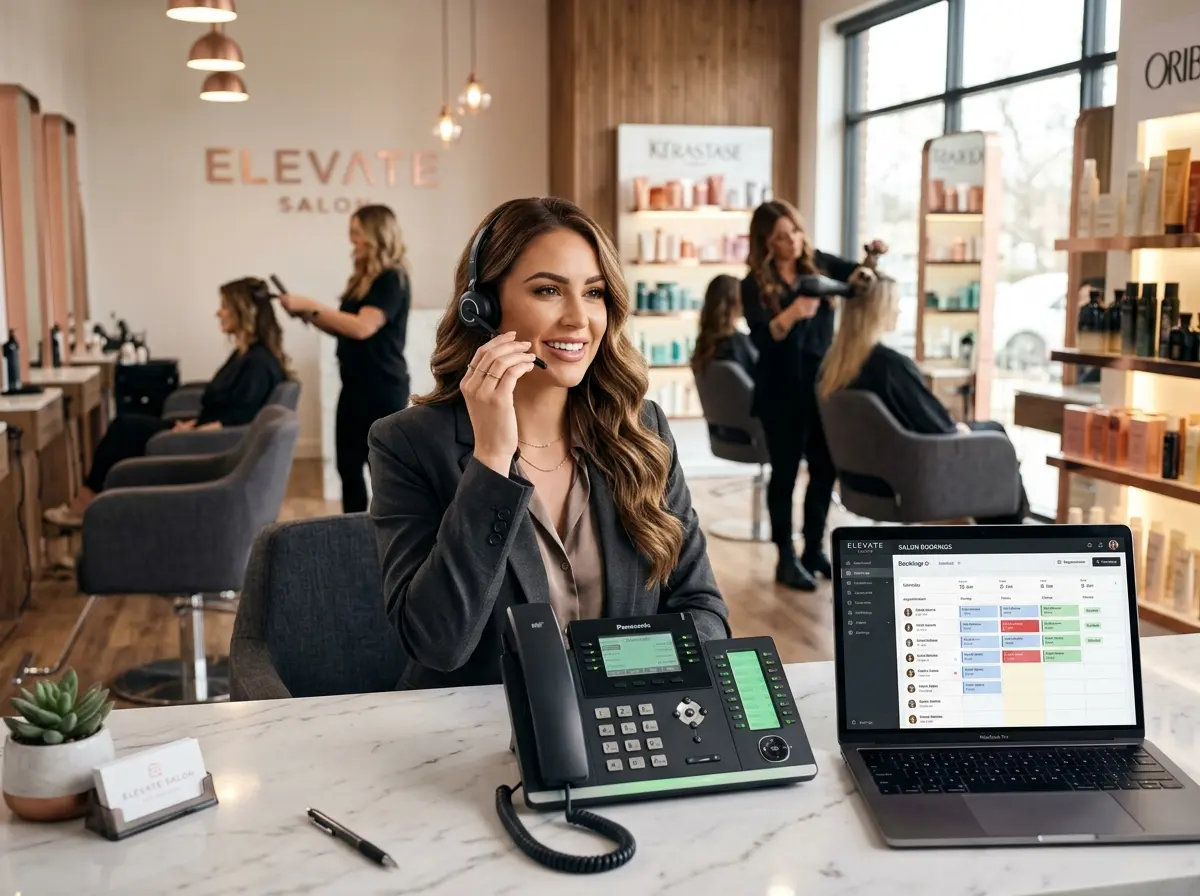
Congratulations. Your salon is busy. Clients love you, word is spreading, and the appointments are rolling in. You should be celebrating. Instead, you're watching your front desk person juggle three phone calls while trying to check someone in, answering a question about balayage pricing, and probably eating a granola bar over a trash can because there hasn't been a real break since 9 a.m.
Here's the uncomfortable truth: a ringing phone in a busy salon isn't just an inconvenience — it's a revenue leak. Every unanswered call is a potential client who just moved on to the salon down the street. Every interrupted stylist is a client experience that's slightly less magical than it should be. And every frazzled front desk employee is a resignation letter waiting to happen.
The good news? You don't have to hire three more people to fix this. You just have to get smarter about how your salon handles communication. Let's talk about that.
Why Salon Phone Traffic Is More Brutal Than You Think
Salons occupy a unique and slightly punishing position in the world of small business phone management. Unlike a retail store where someone can just browse, or a restaurant where a host can wave people to a table, nearly everything in a salon requires a conversation — pricing questions, availability checks, service clarifications, product inquiries. And most of those conversations happen on the phone, often at the exact moment your team is elbow-deep in a color application.
The Peak Hours Problem
Salon call traffic doesn't spread itself neatly across the day. It clusters. Monday mornings when clients are planning their week. Friday afternoons when everyone suddenly remembers they have a wedding on Saturday. And of course, right after you post that promo on Instagram. During these windows, a single front desk employee — no matter how talented — simply cannot keep up. Calls go to voicemail. Clients hang up. Appointments don't get booked. Revenue evaporates quietly and without drama, which is somehow worse.
Research consistently shows that over 60% of callers who reach a voicemail will not leave a message — they'll just try a competitor. In a service business built on relationships and repeat visits, that's not just a missed booking. That's a missed lifetime client.
The Hidden Cost of Interruption
There's also the cost that doesn't show up anywhere in your bookkeeping: the cost of your staff's attention being constantly fragmented. Every time a stylist has to stop and answer a basic question — "Do you do keratin treatments?" "What are your Saturday hours?" "How much is a full highlight?" — that's a small but real disruption to the service they're delivering. Multiply that across a busy Saturday and you've quietly degraded the client experience without anyone doing anything wrong. Your team isn't failing. They're just being asked to do too many things at once.
Voicemail Is Not a Strategy
Some salon owners shrug and say, "We have voicemail." That's fine. Voicemail is better than nothing, in the same way that a bandage is better than nothing when what you actually need is stitches. Clients want answers now, not a callback in three hours. They want to book while the impulse is fresh. Voicemail creates friction, and friction costs bookings.
How Technology Can Step In (Without Adding Headcount)
This is where smart salon owners stop trying to throw people at the problem and start building systems instead. The goal isn't to replace your team — it's to stop asking your team to be everywhere at once.
Let AI Handle the Routine Stuff
The vast majority of incoming salon calls fall into a very small number of categories: pricing questions, availability and booking, hours, directions, and service descriptions. These are not complex inquiries. They don't require a licensed cosmetologist or years of client relationship knowledge. They require accurate, consistent, friendly information — delivered immediately. That's exactly what AI phone tools do well.
Stella is an AI robot employee and phone receptionist that answers calls 24/7 with the same knowledge your best front desk person has — except she never puts anyone on hold, never gets flustered during a Friday afternoon rush, and doesn't call in sick the week before Valentine's Day. For salons with a physical location, she also stands inside the salon as a friendly kiosk, greeting walk-ins, answering questions, and promoting current specials without pulling your stylists away from clients.
What makes Stella particularly useful for salons is her built-in CRM and conversational intake forms. When a new client calls to ask about a service, Stella can collect their name, contact information, service preferences, and any relevant notes — all through natural conversation — and automatically build a client profile. No manual data entry. No sticky notes. Just clean, organized client information waiting for you when you need it.
She handles the routine. Your team handles the relationship. Everyone wins.
Building a Communication System That Actually Scales
Technology alone isn't the whole answer. The salons that handle growth most gracefully are the ones that build communication systems — not just buy tools and hope for the best. Here's what that looks like in practice.
Define What "Handled" Means for Your Salon
Before you can build a system, you need to know what you're trying to accomplish. Sit down and categorize your incoming calls. What percentage are pricing questions? Booking requests? Existing appointment changes? Complaints or special requests? Most salons find that 70–80% of their calls fall into just three or four buckets — and those are the ones that can be automated or systematized. The remaining 20–30% are the nuanced, relationship-driven conversations that genuinely need a human. Once you know which is which, you can route accordingly.
Set Clear Escalation Rules
A good communication system knows when to hand off. Not every call should be automated to completion — some calls need a real person, and your system should know the difference. Configure your tools so that complex complaints, VIP clients, or high-value service inquiries get routed to a human immediately. Everything else gets handled cleanly and efficiently without interrupting your floor. This kind of conditional routing — handle it yourself or forward to staff based on specific triggers — is exactly the sort of thing modern AI phone tools are built for.
Train Your Team on the New Normal
Here's something that gets overlooked constantly: when you introduce new communication tools, your team needs to know how to work with them, not around them. If your front desk person doesn't trust the AI summaries, she'll redo all the work manually and you've gained nothing. If your stylists don't know the kiosk is there to handle walk-in questions, they'll keep stopping mid-blowout to answer them anyway. Spend an hour with your team walking through the new workflow. Show them what gets handled automatically, where they step in, and how the handoff works. Buy-in makes the whole system function.
Quick Reminder About Stella
Stella is an AI robot employee and phone receptionist built for businesses exactly like yours — friendly, knowledgeable, available 24/7, and ready to work from day one at just $99/month with no upfront hardware costs. She answers calls, greets walk-ins, collects client information, promotes your specials, and keeps your CRM organized — all without a single sick day or scheduling conflict. If your salon phone is running you ragged, she's worth a very serious look.
Stop Letting Your Phone Run Your Salon
Here's the bottom line: a busy salon is a good problem to have — but only if your operations can keep up with the demand. When your phone becomes a source of chaos instead of a source of bookings, something has to change. And that something doesn't have to be hiring a second front desk employee, paying overtime, or crossing your fingers every time a call comes in during a double-booked Saturday.
The actionable next steps are straightforward. First, audit your incoming call volume and categorize what those calls are actually about. Second, identify which calls genuinely need a human and which ones just need accurate, friendly information delivered quickly. Third, invest in tools that handle the routine so your team can focus on the exceptional. And finally, build the workflow, train the team, and commit to running a tighter, smarter operation.
Your clients called because they want to be in your chair. Make it easy for them to get there — and make it sustainable for your team to keep showing up at their best. That's not just good operations. That's how you build a salon people talk about.